Cribl has released Cribl Stream 4.21.0 to fix four serious flaws, two of which allow code execution on the platform that many security teams use to route their logs. No exploitation has been reported, but this is software attackers would love to own, so it should be upgraded quickly.
What happened
On 23 November 2026, Cribl Product Security published four advisories covering Cribl Stream 4.20.4 and earlier, numbered cribl-2026-0006 to cribl-2026-0009. Cribl is the CVE Numbering Authority for Cribl Stream and Cribl Edge. All four flaws are fixed in version 4.21.0, and the vendor’s only remediation advice is to upgrade to that release or later.
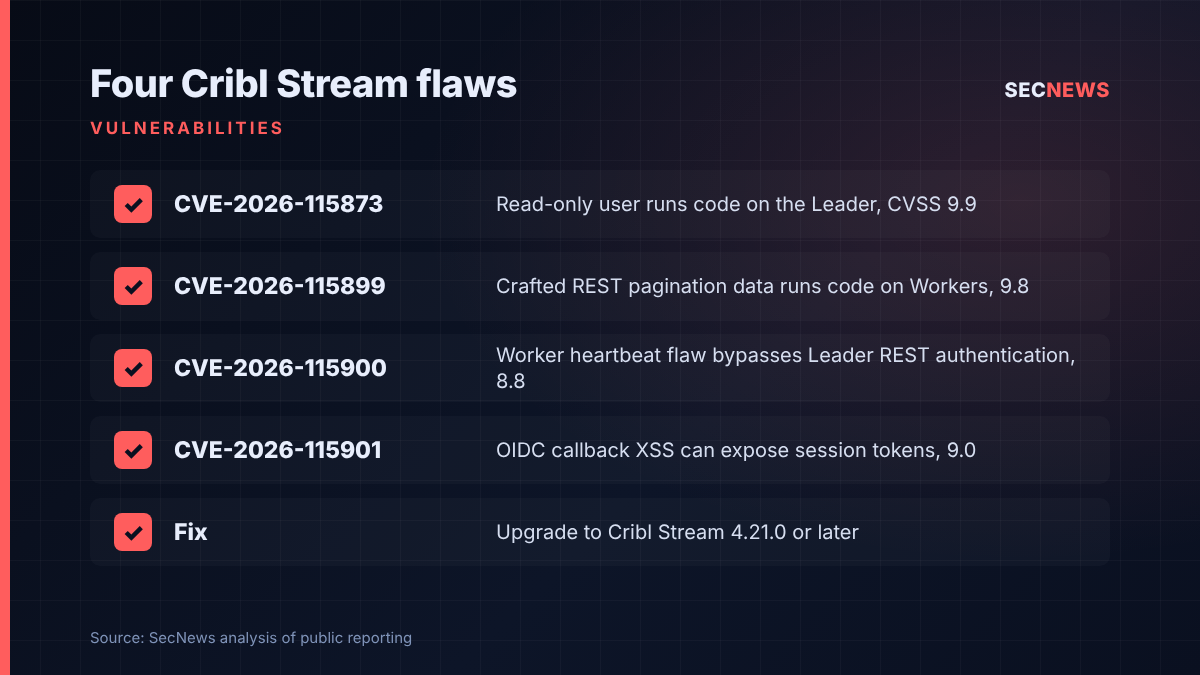
The four issues are:
- CVE-2026-115873: code injection in the nested expression compiler. It is rated 9.9 under CVSS 3.1 and 8.7 under CVSS 4.0.
- CVE-2026-115899: code injection through REST Collector pagination. It is rated 9.8 under CVSS 3.1 and 9.3 under CVSS 4.0.
- CVE-2026-115900: prototype pollution in Worker heartbeats, rated 8.8 under CVSS 3.1.
- CVE-2026-115901: cross-site scripting in the OIDC login callback, rated 9.0 under CVSS 3.1.
Cribl’s own staff found the two code injection bugs, and Bugcrowd researchers reported the other two. Neither the advisories nor the vulnerability databases tracking them report any exploitation, and none of the four is in CISA’s Known Exploited Vulnerabilities catalogue. So far, coverage is limited to the vendor advisories and CVE databases, and we have found no public proof-of-concept code.
The technical picture
A Cribl Stream deployment usually has a Leader, which holds configuration and runs the management API, and a fleet of Workers that collect, transform and forward data. Each flaw hits a different part of that design.
CVE-2026-115873 is the most worrying on paper. According to the advisory, a user with only read-only (GroupRead) access to one Worker Group can reach the Leader API and send a crafted expression. A nested compiler then lets that expression get around the restrictions meant to contain it, and code runs with the Leader service account’s permissions. Read-only accounts are the kind that get handed out freely to analysts, contractors and integrations, and this bug turns one into control of the central node.
CVE-2026-115899 needs no Cribl credentials at all, which explains its higher CVSS 4.0 score. The attacker instead has to control the pagination data that an upstream API or service returns to an existing REST Collector. That collector must use one of the affected response-based pagination methods and process the data during a job run. If it does, code runs with the Worker service account’s privileges. The practical risk depends on which third-party APIs your collectors poll and how much you trust them.
CVE-2026-115900 abuses Worker heartbeats. An attacker who holds a valid Worker distribution credential and can reach the Leader’s distribution listener can send crafted heartbeats that bypass Leader REST authentication and gain administrative API access. Where mTLS client authentication is enforced, the attacker must also hold a client certificate the Leader accepts, plus the matching private key, so properly enforced mutual TLS raises the bar.
CVE-2026-115901 is a cross-site scripting flaw in the OIDC callback, and its preconditions are narrow. The attacker needs an identity that a trusted identity provider application lets in, must control the claim Cribl treats as the OIDC user identifier, and must get through the SSO filters in place. The victim, meanwhile, has to be logged in and click a crafted authentication link. The script then runs in the Cribl origin and can expose the victim’s session token. Getting administrator access requires an administrator victim.
Why it matters for UK organisations
The vendor advisories say nothing about who uses Cribl or where. This section is my own professional framing. Telemetry pipeline tools have become a standard layer in many security operations centres and managed detection services, placed between log sources and the SIEM to filter, enrich and route events and keep licensing costs down. That position makes them highly privileged.
A compromised pipeline node can see a huge amount of sensitive data: authentication logs, cloud audit trails, endpoint telemetry and sometimes credentials that applications have logged by mistake. It usually holds API keys for its sources and destinations. Worse, an attacker who controls the pipeline controls what defenders see. Dropping or rewriting a handful of events is enough to blind a SOC to an intrusion while every dashboard stays green.
For organisations working towards the obligations expected under the Cyber Security and Resilience Bill, or already under NIS, logging and monitoring are core expectations. Infrastructure that underpins that monitoring deserves the same patching urgency as an internet-facing firewall.
Expert view
When we test SOC environments, the logging tier is often the softest high-value target on the network. It is granted wide network reach and then left alone because it “just works”. Management interfaces are frequently reachable from general user networks, and read-only accounts are handed out generously because they look harmless. CVE-2026-115873 is a reminder that “read-only” is a promise made by code, and code can be wrong.
In my experience the REST Collector bug will be underestimated because of its preconditions. Plenty of teams poll SaaS and vendor APIs that they do not control. If one of those providers is compromised, or a collector points at an endpoint that can be tampered with in transit, the conditions start to look less theoretical.
That said, the lack of reported exploitation or public exploit code is reassuring. This is a planned upgrade rather than an emergency, but I would not let it slip past the next change window. Once fixes are public, others can diff the releases and find what changed.
What to do now
- Upgrade to Cribl Stream 4.21.0 or later. Cribl says every version up to and including 4.20.4 is affected, and its advisories list no workaround beyond upgrading. Prioritise Leaders first, then Workers.
- Check where your Leader API is reachable. Restrict it to dedicated management networks or jump hosts. This maps to Cyber Essentials firewall controls.
- Review accounts with GroupRead and other read-only roles. Remove those no longer needed and treat the rest as able to reach the Leader until you have patched. This is Cyber Essentials user access control in practice.
- Audit REST Collectors. List which upstream APIs each one polls, confirm they use TLS with certificate validation, and pause any polling untrusted or unnecessary endpoints until you have upgraded.
- Enforce mTLS for Worker to Leader communication. Rotate Worker distribution credentials if there is any chance they have leaked.
- Look for signs of tampering. Review Leader configuration change history, unexpected routes or pipelines, new API tokens and gaps in event volume at your SIEM.
- Track the vendor’s trust portal. Watch for updated advisories or any change in exploitation status.
Bottom line
Cribl has fixed four serious Cribl Stream flaws, including two code execution bugs that reach the Leader and Workers at the heart of many security pipelines. Nobody has reported attacks, and the information so far comes only from Cribl and the CVE databases. Even so, owning the system that decides what your SOC sees is a prize worth chasing, so upgrade to 4.21.0, tighten access to the Leader and treat your logging tier as the critical infrastructure it is.
Sources
- Cribl: Advisory cribl-2026-0006, code injection in the nested expression compiler (CVE-2026-115873)
- Cribl: Advisory cribl-2026-0007, code injection in REST Collector pagination (CVE-2026-115899)
- Cribl: Advisory cribl-2026-0008, prototype pollution in Worker heartbeats (CVE-2026-115900)
- Cribl: Advisory cribl-2026-0009, cross-site scripting in the OIDC callback (CVE-2026-115901)
- HOL Guard: CVE-2026-115899 code injection in Cribl Stream REST Collector pagination
- HOL Guard: CVE-2026-115873 code injection in the Cribl Stream nested expression compiler
- Strix: CVE-2026-115873 Cribl Stream code injection
- Strix: CVE-2026-115900 Cribl Stream prototype pollution
- Strix: CVE-2026-115901 Cribl Stream XSS
- CVE Brief: 23 November 2026