An extortion crew calling itself Emperador says it has taken 3.9GB of data from AB InBev, the brewer behind Budweiser, Stella Artois and Corona, but nothing has been confirmed and the company has not said it was breached. AB InBev is reported to be looking into a possible cyber attack, and UK suppliers, distributors and hospitality partners should prepare for phishing that uses the claim as bait.
What happened
Early on Sunday 25 October 2026, AB InBev appeared on the leak site run by Emperador. Ransomware.live, which indexes such postings, recorded the entry at 03:22 UTC and lists the same day as its estimated attack date.
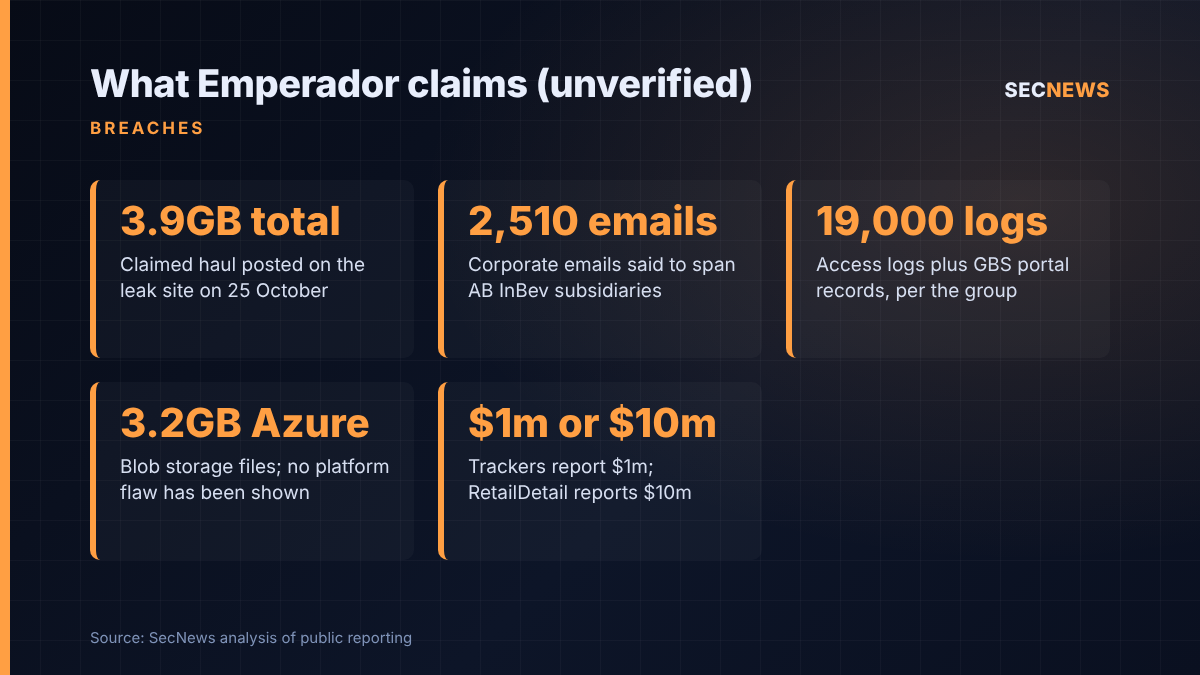
Everything known about the alleged haul comes from the criminals themselves. The group says it holds 3.9GB in total. That figure breaks down into 329,244 social-listening alerts, 2,510 corporate emails from across AB InBev subsidiaries, roughly 19,000 access logs, records from the company’s GBS portal, internal PKI certificates and 3.2GB of material it describes as Azure Blob assets. None of it has been independently verified.
The ransom figure depends on who you read. Ransomware.live, Cyber Security News and threat intelligence firm Rescana all report a demand of $1 million in Bitcoin, and Rescana notes a countdown that runs out around 23 November. Retail trade title RetailDetail, reporting on 26 October, puts the demand at $10 million, which it converts to roughly €8.9 million. Neither figure has been confirmed.
RetailDetail says AB InBev is investigating a possible cyber attack, although its report does not quote a spokesperson. At the time of writing there is no public confirmation of a breach from the company, no notification to customers or staff that I can find, and no suggestion of operational disruption. RetailDetail also cites an unnamed security expert who thinks the damage looks limited for now.
The technical picture
Read critically, the listing raises as many questions as it answers.
Take the certificates first. An X.509 certificate is designed to be public; it carries a public key and identity details, not the private key that does the sensitive work. As Cyber Security News points out, holding certificates alone does not show an attacker could impersonate internal services or decrypt traffic. The listing does not claim private keys were taken. If it had, that would be the most serious line in the post, because a stolen private key behind an internal certificate authority or a service certificate can enable interception and impersonation until it is revoked and replaced.
The Azure claim deserves the same caution. Naming Blob files proves nothing about how they were obtained. There is no evidence of a flaw in Microsoft’s platform, and in my experience incidents like this almost always come down to the customer side: a storage account key left in a script, an over-permissive shared access signature, a leaked service principal secret, or a storage container opened up to the internet for convenience and never locked down again. Any of those would explain cloud files leaving an organisation without a single server being encrypted.
Nothing published so far shows encryption, disruption to brewing or distribution, or a count of affected people. Rescana observes that 3.9GB is small for a company of this size and appears to centre on non-production material such as marketing monitoring data and portal records. That pattern fits a data-theft-and-extortion play rather than a classic ransomware detonation. Rescana describes Emperador as a group first seen in September 2026, with victims across food and drink, industry, IT, retail, healthcare and energy in several countries. Ransomware.live lists a handful of smaller businesses, two of them German, as Emperador victims posted in the days around the AB InBev entry.
Why it matters for UK organisations
AB InBev’s brands are staples of British bars and supermarket shelves, which means a long tail of UK pubs, wholesalers, logistics firms, marketing agencies and technology suppliers that deal with the group every day. If the email and portal claims are genuine, those partners are the people most likely to be targeted next. Real correspondence, names and portal context are exactly what a fraudster needs to send a convincing fake invoice or a “please update our bank details” request.
There is also a regulatory angle. Under UK data protection rules, a controller generally has 72 hours from becoming aware of a personal data breach to report it to the ICO, unless it is unlikely to pose a risk to individuals. A claim on a leak site is not, by itself, awareness of a breach, but it should start the clock on an investigation. Any UK organisation that shares personal data with a supplier or customer named by an extortion gang should be asking that partner direct questions now, not waiting for a press release.
Expert view
Leak-site postings are marketing. They exist to pressure the victim and to impress future affiliates, and they routinely inflate, recycle or mislabel data. Claimed hauls can turn out to be old backups or someone else’s data; modest listings can also hide a deeper compromise. Until a sample is authenticated or the company says something substantive, the honest position is that we do not know.
What I would focus on, if I were on AB InBev’s incident team or advising one of its partners, is the combination of access logs and certificates. Logs can reveal usernames, internal hostnames and authentication patterns that make a second intrusion easier. Certificates, even without private keys, map out internal services. Neither is catastrophic alone, but both are useful reconnaissance. When we test cloud estates, the quickest wins are rarely clever exploits; they are long-lived keys and shared access signatures nobody remembers issuing.
What to do now
- Warn finance and procurement teams. If you trade with AB InBev or its subsidiaries, brief staff to verify any change to payment details by phoning a known number, never by replying to the email.
- Ask your contacts direct questions. Request confirmation of whether any data you share with the group is in scope, and log the request for your own accountability records.
- Audit your own cloud storage. Inventory storage account keys and shared access signatures, rotate anything long-lived, prefer managed identities, and disable anonymous container access. This maps to the Cyber Essentials secure configuration and user access control themes.
- Review certificate hygiene. Know where your private keys live, protect them in hardware or a managed key vault, keep certificate lifetimes short, and rehearse revocation so it is not improvised during an incident.
- Tighten email defences. Make sure DMARC is set to enforce, flag external senders clearly and watch for lookalike domains impersonating major suppliers.
- Prepare your own leak-site playbook. Decide in advance who verifies a claim, how quickly legal and data protection leads are involved and when the ICO is told.
Bottom line
For now this is an unverified extortion claim, not a confirmed breach, and the reported ransom ranges from $1 million to $10 million depending on the source. The sensible response for UK organisations is neither panic nor indifference: assume fraudsters will exploit the headline, check what you share with the brewer, and use the moment to fix the cloud keys and certificate practices that make claims like this credible.
Sources
- Cyber Security News: Emperador Ransomware Group Claims to Have Stolen 3.9GB of Data from the Maker of Budweiser and Corona
- RetailDetail: Hackers demand nearly 9 million euros from AB InBev following a possible data breach
- Rescana: Emperador Ransomware Attack Analysis: AB InBev Azure Cloud Data Breach and PKI Certificate Exposure
- The Independent via Yahoo Finance UK: H&M investigating claims it was hit by cyber attack
- Ransomware.live: Victim: AB InBev