Hiscox, a major insurer of UK small businesses, has reported a 9.5% rise in nine-month premiums. It is also rolling out a new cyber resilience product beyond its European broker business. Rates in its London Market arm are softening, and that should shape how UK firms approach their 2027 cyber renewals.
What happened
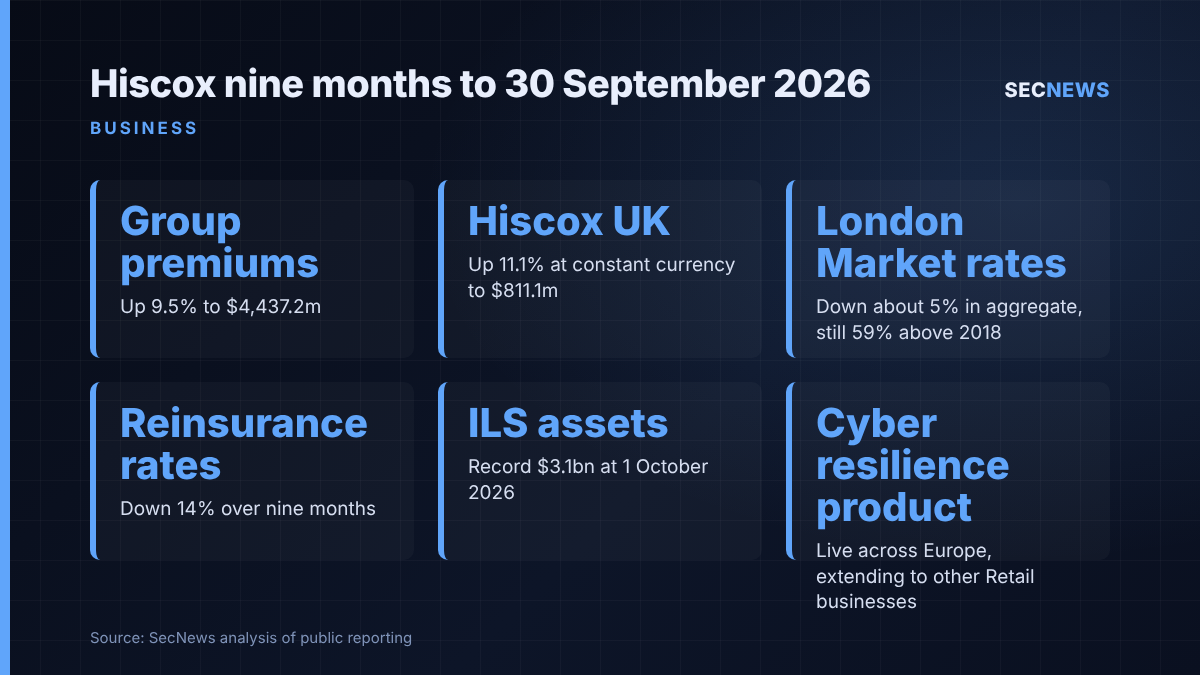
On 3 November 2026 Hiscox Ltd, the London-listed specialist insurer with its head office in Bermuda, published its trading statement for the nine months to 30 September. Group insurance contract written premiums (ICWP, the measure Hiscox now reports) rose 9.5% to $4,437.2m, up from $4,052.9m a year earlier. At constant currency the rise was 8.1%. Its Retail division, which serves small and mid-sized businesses in the UK, Europe and the US, grew 9.1% at constant currency to $2,253.3m. Hiscox kept its full-year Retail growth target of 9% at constant currency.
The UK business wrote $811.1m, up 11.1% at constant currency. Hiscox said the growth came from more policies rather than higher prices, and that its digital direct channel for the smallest firms grew by double digits. New business in that channel rose by about 40% on the previous year. London Market premiums grew 9.9% to $1,050.5m. Hiscox Re’s gross premiums rose 4.5%, but its net premiums fell 7.5% as the reinsurer cut its exposure to natural catastrophes.
The statement makes two references to cyber. In Europe, Hiscox said brokers had welcomed a new cyber resilience product, which is now live in all its European markets. It is being extended to larger SME customers in Germany and, over time, to the other Retail businesses, a group that includes the UK. In the London Market, Hiscox said it was picking up selective opportunities in cyber and general liability within its casualty book.
The detail
The figures point to a buyers’ market. Hiscox said London Market rates were down about 5% in aggregate over the nine months, though still 59% above 2018 levels. At the half-year, 76% of that portfolio was rated adequate or better. Reinsurance rates fell more sharply, by 14%. Reinsurance News noted that further cuts are expected at the 1 January renewals. In Retail, prices rose by only about 1%.
Artemis reported that ILS assets managed by Hiscox Capital Partners reached a record $3.1bn on 1 October. That is up 139% in a year, driven by retained earnings in a quiet catastrophe year. Hiscox said demand for third-party capital, especially from quota share partners, remains strong. Plenty of capital chasing risk usually means more capacity and keener pricing. Cyber is underwritten in that same specialty market.
The cyber resilience product is the item most relevant to security teams. The trading statement does not say what the product covers or how it differs from Hiscox’s existing cyber policies. Hiscox’s own research suggests the direction, though. Its 2026 Cyber Readiness Report was published in September and surveyed 6,800 security decision-makers in firms with fewer than 250 staff across the UK, Europe and the US. It found that 29% of organisations had suffered at least one successful attack in the past year. Incidents cost an average of around $52,000 a year, and organisations spent an average of $51,000 on resilience measures. Eddie Lamb, Hiscox’s global head of cyber, said cyber risk had become “a recurring cost, not an exceptional event”.
Why it matters for UK organisations
Hiscox is a major name in UK small business insurance, and it says it covers more than 100,000 cyber customers worldwide. Three points stand out for UK buyers.
First, softer specialty pricing gives firms with good controls more room to negotiate. Second, capacity is plentiful, but Hiscox describes its cyber opportunities as selective, and insurers are still choosing which risks they want. Firms with weak identity controls or flat networks should not assume a soft market will cover those gaps. Third, the move towards resilience products, which bundle prevention, response and recovery support rather than paying out only after a loss, reflects a wider change in how insurers see cyber risk. Hiscox’s October risk report found that 55% of risk managers linked cyber threats with AI-enabled fraud, the strongest risk combination it identified.
For UK organisations, how quickly the cyber resilience product reaches the UK matters as much as the premium numbers. Hiscox has not given a date, so UK SMEs and their brokers should ask about it at their next renewal.
Expert view
In my experience, insurers’ questionnaires have done more to raise the security baseline in smaller UK firms than many awareness campaigns. When a renewal depends on multi-factor authentication, tested backups and an incident response contact, the work gets done. A softer market could weaken that pressure, but trading updates like this one suggest underwriters are still being careful. The talk of discipline and walking away from underpriced business is aimed at shareholders, but it also tells buyers that a cheap quote can still come with strict conditions.
I welcome the move towards resilience products, with one caveat. A policy that includes response services is only useful if the policyholder knows how to trigger them at 2am on a Saturday. When we run incident simulations, the insurer’s breach hotline is often missing from the playbook or stored only on a system the attacker has just encrypted. Firms buying these products should test the service, not just file the schedule.
I would also be careful about reading too much into the numbers. A trading statement is a high-level summary for investors. It does not give cyber loss ratios or cyber premium growth, so we cannot tell whether Hiscox’s cyber book is growing faster or slower than the group.
What to do now
- Prepare renewal evidence early. Gather proof of MFA on email, remote access and admin accounts, patching timelines and offline or immutable backups. These line up with the Cyber Essentials controls on user access control, security update management and malware protection.
- Ask your broker about resilience cover. Ask whether Hiscox’s cyber resilience product, or a competitor’s, will be offered in the UK, what pre-incident services it includes, and how they compare with your current policy.
- Use the soft market to buy quality, not just a lower price. If the premium falls, look at spending the saving on a higher limit, a lower excess or better business interruption cover, rather than simply banking it.
- Put the insurer’s response line into your incident plan. Store the hotline number and policy details offline, and include them in your next tabletop exercise.
- Check AI and fraud wording. Insurers increasingly see cyber, social engineering and AI-enabled fraud as linked risks. Confirm how your policy treats payment diversion and deepfake-enabled fraud.
Bottom line
Hiscox’s results describe a growing small business insurer in a softening specialty market that is still choosy about cyber risk. For UK firms, the likely result at renewal is better pricing for those that can prove their controls, plus the gradual arrival of resilience products that build security services into the policy. Prepare the evidence now and push brokers on when those products will reach the UK.
Sources
- Hiscox Ltd (RNS via TradingView): Q3 2026 Trading Statement
- Artemis: Hiscox ILS assets rise $200m to $3.1bn on retained earnings in Q3, up 139% year-on-year
- Reinsurance News: Hiscox Re net ICWP reduces in 9M’26 amid deliberate cycle management
- Hiscox: One in three firms hit by cyber attacks but businesses fight back with resilience spend
- Hiscox: Businesses boost risk management spend but resilience gap remains