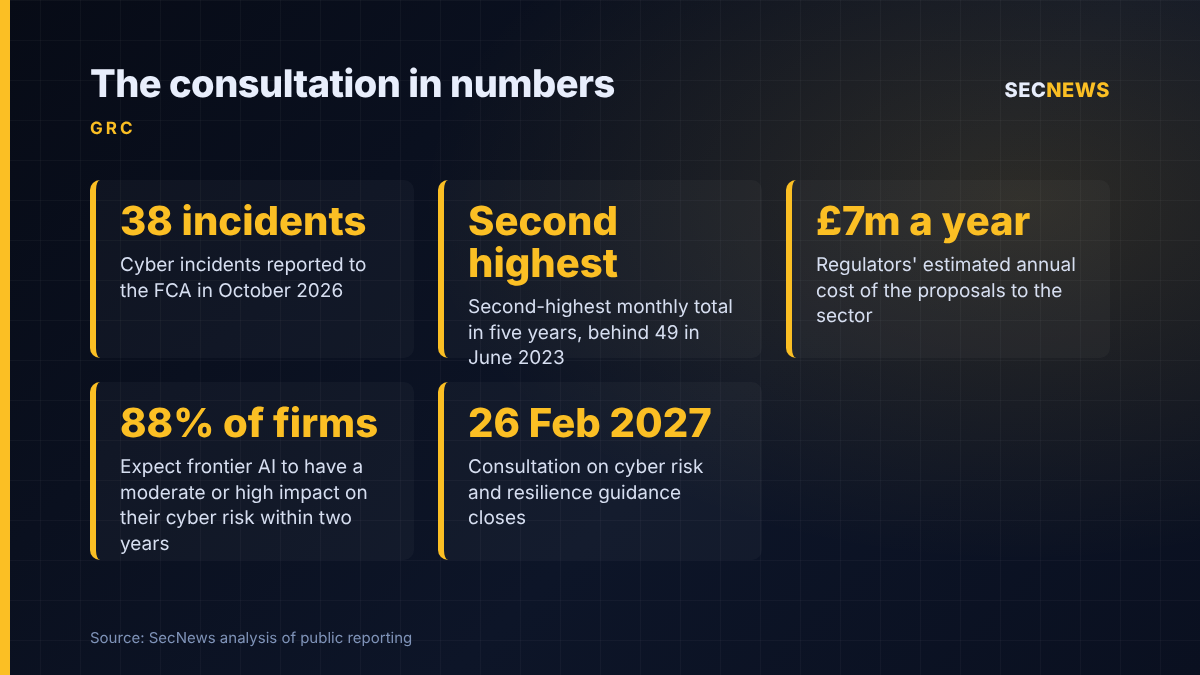
Britain’s financial regulators want banks, insurers and other firms to plan on the basis that attackers will get in, and to prove they can rebuild core systems afterwards. The draft guidance is open for comment until 26 February 2027.
What happened
On 19 November 2026 the Bank of England, the Prudential Regulation Authority (PRA) and the Financial Conduct Authority (FCA) published a joint consultation on how regulated financial firms should manage cyber risk and resilience. PRA chief executive Katharine Braddick trailed it the evening before at the UK Finance annual dinner, where she called operational risk the fastest-escalating risk area for the firms the PRA oversees. She said cyber resilience would carry “materially greater weight in our supervision”.
The FCA says it received 38 cyber incident reports in October, its second-highest monthly figure in five years. Only June 2023 was higher, with 49 reports during the MOVEit campaign.
The regulators present the package as a consolidation of what they already expect, not a new rulebook. FCA chief executive Nikhil Rathi said firms had asked for clarity, adding: “Our response shouldn’t always be more rules.” Even so, City AM reports that supervisors will assess firms against the guidance, with enforcement powers behind it.
The detail
The draft is organised around three areas. The first is governance: cyber risk belongs inside the wider risk framework, with named owners and real oversight from the board and senior management. The second is protection, covering critical infrastructure, identity and access, data, and controls over suppliers. The third is detection and response, including a working process for learning from incidents.
The guidance builds on the Cyber Assessment Framework from the National Cyber Security Centre, so anyone who has worked with NIS-regulated operators will recognise the outcome-based structure. The NCSC’s chief executive, Dr Richard Horne, welcomed the proposals. Braddick said the aim is to set out how firms should demonstrate resilience, not to prescribe every control.
The most concrete change concerns recovery. City AM reports that the paper expects playbooks for rebuilding core banking systems from nothing, without trusting backups that may themselves be compromised. Where proportionate, testing should go “beyond traditional tabletop exercises” and measure how fast a bare metal rebuild could be completed.
According to City AM, firms are also expected to map weaknesses across their dependencies, including open source components and physical infrastructure, and they remain accountable when an outsourced service fails. The paper asks firms to swap periodic vulnerability management for continuous exposure management. It warns that AI capabilities are doubling every eight months, letting attackers exploit vulnerabilities in hours rather than weeks or months.
Separate “effective practices” on frontier AI and quantum computing risk were published alongside the consultation, outside the formal process. The regulators put the annual cost to the sector at about £7m. In a joint survey, 88 per cent of firms said frontier AI would have at least a moderate effect on their cyber risk within two years.
Braddick also announced a Systemic Resilience Council, led by the Bank, which meets for the first time next month. It brings authorities together with the chief executives of systemically important firms and infrastructure providers. Early priorities are frontier AI and assurance that firms can recover from scenarios needing a material rebuild of their technology. It will work alongside the Cross-Market Operational Resilience Group and the CBEST and STAR-FS schemes.
Why it matters for UK organisations
For regulated firms, this is the clearest statement yet of what supervisors will ask to see. The operational resilience rules that took full effect in March 2025 told firms what to achieve. This consultation explains how to do it for cyber, and what evidence will be expected. Firms that have treated their self-assessment as paperwork should expect harder questions.
The impact goes beyond banks. The supply chain and rebuild expectations will reach managed service providers, software vendors and cloud partners through contract clauses, due diligence questionnaires and requests for joint testing. If you supply a bank or insurer, expect to be asked how your own recovery would work and how long it would take.
Aligning with the government’s assessment framework also helps firms that will fall under both the financial regulators and the future Cyber Security and Resilience regime, since much of the same evidence should serve both.
Expert view
The assume-breach framing is right, and in my experience it is still not how most boards think. When we run red team engagements against mature organisations, initial access is rarely the hard part. What decides the outcome is how far an attacker can move and whether the business can get back on its feet. A timed bare metal rebuild cuts through comfortable assumptions. Many recovery plans quietly depend on Active Directory, the backup console or the hypervisor management plane still being trustworthy, and those are often the first targets for a capable ransomware crew.
The warning about tainted backups is pointed. Immutable storage helps, but it does not prove that what you restore is clean, or that you can restore it at the scale and speed the business needs. That takes rehearsal, which is expensive and disruptive, so smaller firms will need to agree with supervisors what “proportionate” really means.
The shift to exposure management is overdue. Patch counts and CVSS dashboards say little about which weaknesses an attacker can actually reach and chain together. Attack path analysis and regular adversarial testing tell you far more. Braddick’s emphasis on core hygiene is also welcome, because basic controls applied inconsistently remain a common root cause, and AI-assisted attackers will only exploit them faster.
One caution: the £7m figure looks optimistic if firms take rebuild testing seriously. Rebuilding a core platform in a realistic isolated environment is costly, and few firms have the spare capacity.
What to do now
- Respond before 26 February 2027. Proportionality, the scope of rebuild testing and how evidence will be judged are all still open.
- Run a gap analysis. If you already report against the NCSC framework for another regulator, reuse that work and note where financial sector expectations go further.
- Test a clean-room rebuild. Pick one important business service and time a rebuild of its identity, platform and data layers from known-good sources, assuming production backups and admin tools are untrusted.
- Isolate recovery infrastructure. Separate backup credentials from the main directory, enforce MFA and keep offline or immutable copies. This maps to the Cyber Essentials user access control and secure configuration controls.
- Map supplier and open source exposure. Keep a software bill of materials for critical services and record which third parties could stop them.
- Prioritise by reachability. Rank weaknesses by attack path rather than raw severity, and patch internet-facing systems within the 14 days Cyber Essentials allows for high and critical updates.
- Brief the board. Supervisors will want evidence that directors understand cyber risk and the basis of the self-assessment.
Bottom line
UK financial regulators have stopped asking whether firms have cyber controls and started asking whether they can recover when those controls fail. Firms that can rebuild from clean sources, quickly and with evidence, will find the next supervisory cycle far easier than those relying on backups they have never tried to restore.
Sources
- Bank of England: Transparency and predictability, a foundation for future resilience (speech by Katharine Braddick)
- Reuters (via The Star): UK finance sector cyber incidents hit second-highest level in five years
- City AM: UK banks told be ready to rebuild from scratch after cyberattacks
- PA Media (via AOL): Cyber attacks: FCA and Bank of England make new resilience plans as threats grow