CrowdStrike has agreed to buy two young AI security companies, Fiddler AI and Dreadnode, to cover testing and monitoring of AI agents inside its Falcon platform. The Wall Street Journal puts the combined price at about $495m, and the deals show the big platform vendors moving quickly to absorb AI agent security.
What happened
On 3 November 2026, at its Fal.Con Europe conference in Barcelona, CrowdStrike said it had signed definitive agreements to acquire two companies. Fiddler AI, founded in 2018 and based in Palo Alto, makes observability and explainability software for AI models and agents. Dreadnode, founded in 2023, automates adversarial testing of AI systems before they go into production.
CrowdStrike confirmed both agreements but did not publish a price. It said only that it will pay mostly in cash, plus some stock that vests over time. The Wall Street Journal reported that Fiddler is costing roughly $400m and Dreadnode about $95m. CrowdStrike has not confirmed those figures, so treat them as reported rather than settled. Both deals are expected to close in CrowdStrike’s fourth quarter of fiscal 2027, subject to the usual conditions.
For context, FourWeekMBA’s analysis of the deal notes that Fiddler had raised around $100m in total, including a $30m Series C in January 2026. Dreadnode’s last disclosed round was a $14m Series A in February 2025. The same analysis puts the reported total at under a tenth of the roughly $5bn in cash CrowdStrike held at the end of July.
The technical picture
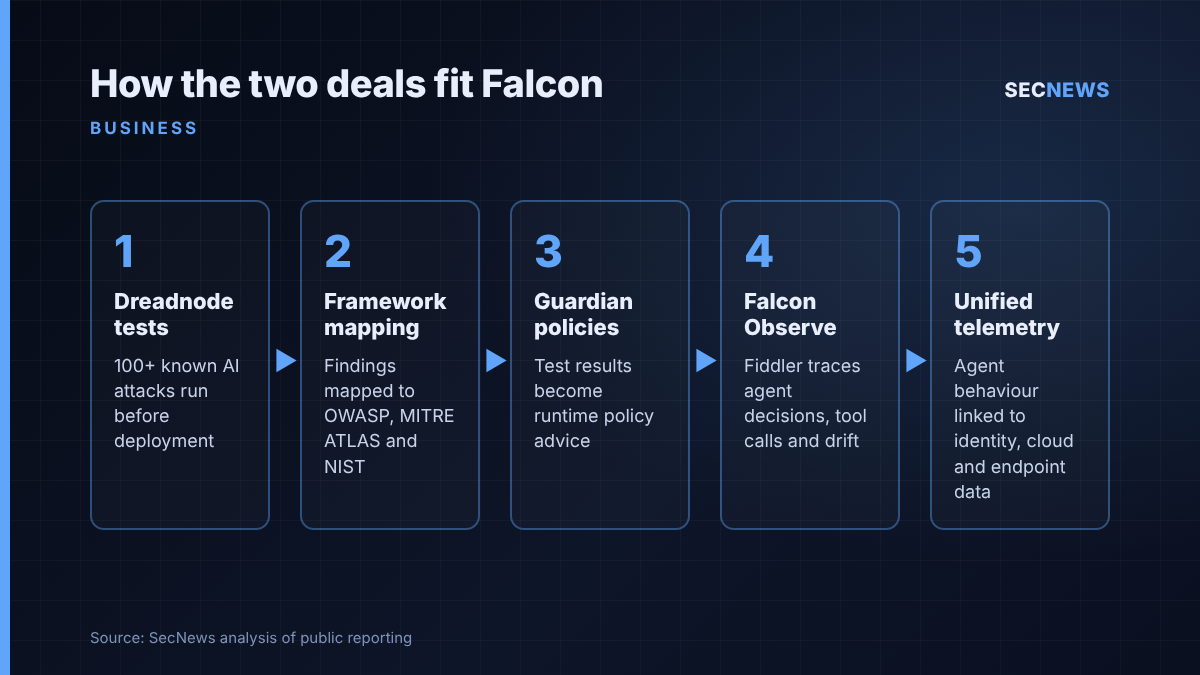
The two companies cover opposite ends of an AI system’s life. Dreadnode works before release. CrowdStrike says its platform throws more than 100 known attack techniques, including jailbreaks and prompt injection, at models, agent reasoning loops, applications and MCP servers. Findings are graded by severity and mapped to frameworks security teams already use: the OWASP Top 10 for LLMs, OWASP’s agentic security guidance, MITRE ATLAS and the NIST AI Risk Management Framework. The output is meant to support a go or no-go decision on deployment, and human reviewers can reclassify individual findings.
Fiddler mainly works after release, although it also evaluates agents before production. It will be sold as Falcon Observe and records what agents actually do: the decisions they take, the reasoning paths they follow and the tools they call. It flags drift, hallucinations and actions nobody intended, and it tracks token usage and spend. It collects data through OpenTelemetry and supports common agent frameworks. CrowdStrike’s chief executive, George Kurtz, called it “the flight recorder for every agent”.
CrowdStrike plans to plug both products into Falcon Guardian, its runtime protection for AI agents. Dreadnode’s test results will become policy recommendations in Guardian, its testing data will feed CrowdStrike’s SafeMind models, and its staff will join the company’s Cyber Superintelligence Lab. Fiddler’s telemetry will be linked to the identity, cloud and endpoint data Falcon already collects.
Why it matters for UK organisations
Many UK organisations are moving AI agents from pilots into real workflows: drafting customer replies, querying internal systems, raising tickets, and in some cases changing records. Security teams are frequently asked to approve these deployments without any agreed way to test them first or watch them afterwards. AI security has meanwhile been a crowded field of small specialists. The deal suggests the field is now folding into the large platforms, as cloud security posture management and identity threat detection did before it.
For UK buyers this cuts both ways. If you already run Falcon, AI testing and monitoring may arrive as an add-on from a supplier you have vetted, which simplifies procurement. If you have signed with a standalone AI security start-up, you have one more reason to ask how long it will stay independent and what happens to your contract and data if it is bought. Kurtz’s line that blaming the model will not satisfy regulators or boards reflects a wider shift. UK supervisors increasingly expect firms to explain automated decisions and to evidence their controls. Agent activity that is never logged cannot be explained after an incident.
The conference also produced a smaller European channel announcement: BT, Computacenter and Grant Thornton UK are among the partners joining CrowdStrike’s QuiltWorks programme. In practice, many UK mid-market organisations will probably meet these AI capabilities through a managed service provider rather than buying them directly.
Expert view
The interesting part of this deal is the pairing more than the price. Testing an AI agent once before launch is not enough, and monitoring it without having tested it means you do not know what normal looks like. A traditional test report is a snapshot that ages from the day it is issued; for AI agents it ages faster, because the model, the prompts, the connected tools and the data can all change without a single line of code changing. Pre-deployment testing combined with continuous behavioural monitoring is the right model.
Some caution is warranted. Running a catalogue of more than 100 known attacks automatically is a useful baseline, but it is not the same as a skilled tester working out how your particular agent, with your permissions and your data, can be made to misbehave. Many of the worst outcomes I would expect from agents are not clever jailbreaks. They are mundane design failures: an agent holding far more access than it needs, or trusting content from an email or web page it should treat as hostile. A tool can surface those problems. It cannot decide your architecture.
Lock-in is the other consideration: an agent audit trail tied to one platform’s telemetry is hard to move later, so ask now how you would export it.
What to do now
- Build an inventory of your agents. List every AI agent and assistant in use, who owns it, which identity it runs under and which systems and data it can reach. You cannot test or monitor what you have not found.
- Apply least privilege to agents. Treat agent service accounts like any other privileged identity, in line with the Cyber Essentials user access control requirements: give them only the access they need, review it regularly and remove standing administrative rights.
- Test before you deploy, every time something changes. Make adversarial testing against frameworks such as the OWASP Top 10 for LLMs a release gate, and repeat it when models, prompts or connected tools change, not only at launch.
- Log agent actions centrally. Capture tool calls and decisions in your SIEM alongside identity and endpoint data, so an investigation can reconstruct what an agent did and on whose behalf.
- Review your AI security suppliers. If you rely on a standalone vendor, check change-of-control clauses, data handling and exit terms. Falcon customers should ask how Falcon Observe will be licensed, and commission manual testing for high-risk agents regardless.
Bottom line
CrowdStrike’s reported $495m purchase of Fiddler AI and Dreadnode signals that AI agent security is becoming a standard platform feature rather than a niche product. UK organisations should welcome better tooling, but should first get the basics right: know your agents, limit their access, test them properly and keep a record of what they do.
Sources
- CrowdStrike: CrowdStrike to Acquire Fiddler to Deliver Agent Observability for AI Trust
- CrowdStrike: CrowdStrike to Acquire Dreadnode to Advance AI Trust and Deliver Automated AI Security Testing
- FourWeekMBA: CrowdStrike’s $495M AI Deal Values Fiddler at 4x Its Funding
- Securities.io: Dreadnode Deal Would Bring Pre-Deployment AI Testing to Falcon
- Investing.com: CrowdStrike to acquire AI security testing firm Dreadnode
- CrowdStrike: CrowdStrike Scales Project QuiltWorks Across Europe