WorkOS, which sells single sign-on and directory sync to software companies, says an intruder got into an internal sales application and reached CRM records, support notes and excerpts of customer Slack conversations. The company says an AI-assisted attack framework drove the intrusion, and it warns customers to expect phishing that quotes their own conversations back at them.
What happened
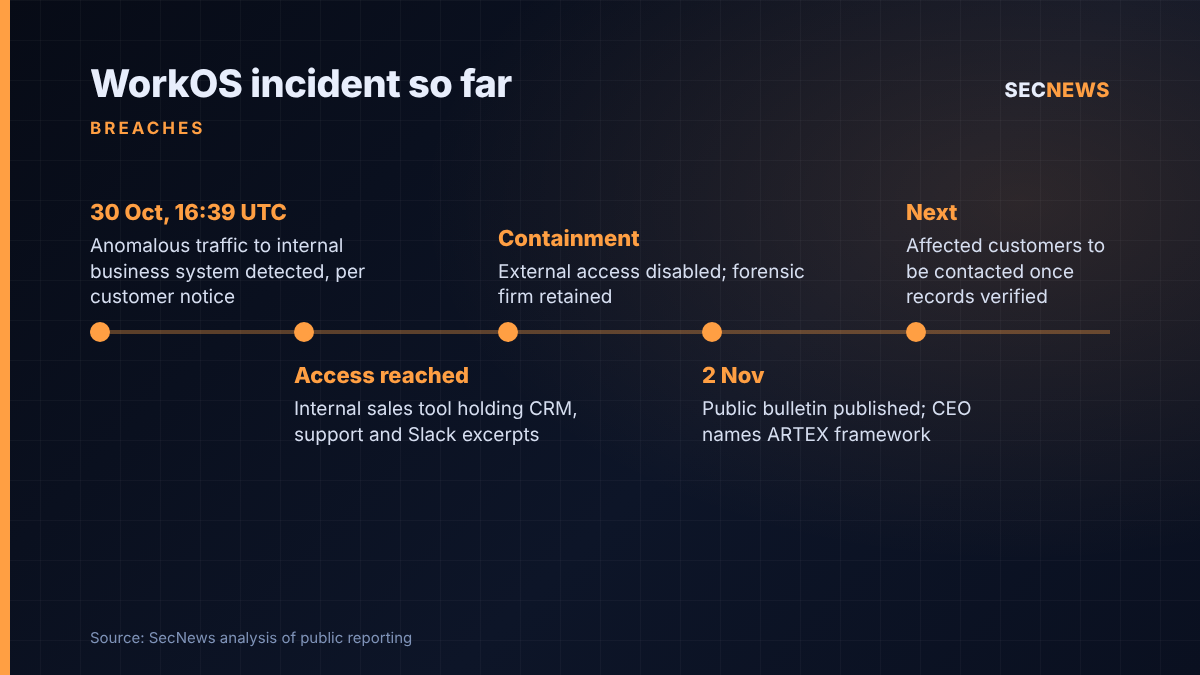
WorkOS published a security bulletin on 2 November 2026. It says the company found unauthorised access on 30 October to an internal tool that its sales and customer-facing staff use. According to the bulletin, the intruder reached business information the company keeps for selling to and supporting customers, not the identity data WorkOS processes for them. The company says it has seen no evidence that production services or the data inside its platform were touched.
The bulletin itself is careful about the tooling. It refers to an “AI-assisted offensive security framework” that automated scanning and exploitation attempts, without naming it. Chief executive Michael Grinich went further in posts on X and Hacker News, saying the attack involved ARTEX, an autonomous agent framework built for offensive work. Google Threat Intelligence Group, Mandiant and Wiz have each written about ARTEX in separate investigations, according to Cyber Security News. Nothing published so far ties this incident to those campaigns or to a named threat actor.
A customer posted the breach notification they received on Hacker News, and it adds detail the public bulletin leaves out. According to that notice, WorkOS detected anomalous traffic at 16:39 UTC on 30 October, and the attack was likely driven by ARTEX from IP addresses in Hong Kong and China. The intruder reached an internal API behind the sales and marketing tools and, through it, pulled data from the company’s Salesforce and Snowflake instances. WorkOS has not repeated those specifics publicly, so they should be read as its initial account rather than settled findings. Source IP geography also says little about who was really at the keyboard.
WorkOS says it has blocked external access to the affected application, started a wider review of access controls on its internal tools and hired outside forensic investigators. It will contact affected organisations once it has confirmed which records relate to each of them.
The technical picture
The bulletin lists four groups of data the compromised tool could reach:
- Contact data: staff names, emails, phone numbers, roles and employers stored in the CRM.
- Commercial records: account histories and notes on the sales relationship.
- Conversations: summaries and extracts of sales calls and support threads, plus excerpts from customer Slack conversations.
- Usage metadata: how customers use WorkOS products, including whether their connections and directories are healthy.
These categories describe what the tool could reach, not a confirmed list of what was taken. Several key facts are still missing: how the intruder got in, whether stolen credentials or a software flaw was used, how long they had access before detection and how many customers are affected.
The usage metadata is the category I would watch most closely. The customer notice describes the product usage metrics as aggregated and de-identified, which may limit the damage, but if connection or directory health can be tied to named customers, knowing which identity connections are failing is useful reconnaissance against those customers’ own estates. Pair that with support tickets about SSO problems and an attacker has a list of organisations whose identity plumbing is under strain, along with the names of the engineers fixing it.
The architecture is familiar too. When we test SaaS companies, production gets the hardening, change control and pentest budget. Internal go-to-market tooling often sits outside that boundary: an API wired up to feed a CRM, a data warehouse and a chat integration, with broad read access and little monitoring.
Why it matters for UK organisations
WorkOS sits in the login path for many business applications, including software UK organisations buy without knowing who supplies the SSO layer. The direct exposure here is staff details and conversations, not tokens or user directories. The practical risk is social engineering, and it is a serious one.
An attacker holding real support threads can write an email that cites a genuine ticket, names the right account manager and refers to a problem the recipient actually raised. That material is what makes help desk impersonation and invoice fraud work, and both remain among the most effective routes into UK firms. WorkOS’s own advice reflects this: check unexpected requests even when they mention real colleagues or past conversations.
There is a data protection angle as well. Work contact details for named people are personal data under UK GDPR, so a UK organisation’s employees may now appear in someone else’s breach. Reporting the CRM breach is WorkOS’s responsibility. A UK customer should still work out what it shared with the vendor, including anything pasted into a shared Slack channel, and record any resulting risk. If configuration details, logs or secrets ever went into a support thread, treat them as exposed.
Expert view
WorkOS deserves credit for disclosing within days and for being plain that an automated framework was involved. I would still not make “AI-driven” the headline. An agent framework does not create weaknesses; it finds existing ones faster and more patiently than a human operator. In my experience, the internal tools that leak in these cases share the same traits: an exposed endpoint, an over-privileged service account and logs nobody reads. AI changes the speed and scale of an attack, not what makes it possible.
The gap between the customer notice and the public bulletin is worth noting. One named specific platforms and source locations; the other speaks more generally. WorkOS has offered calls with its security team, and I would take one. Remember too that “no evidence” means nothing has been found yet, not that nothing happened.
What to do now
- Establish your exposure. Check your SaaS inventory for WorkOS, and ask key suppliers whether their SSO or directory sync runs on it.
- Warn the people named in the relationship. Brief identity, IT and procurement contacts to expect convincing pretexts. Insist on out-of-band checks for any request to change configuration, reset access or alter payment details.
- Clean up shared channels. Search shared Slack channels and tickets for keys, certificates or connection strings and rotate anything you find. This applies the Cyber Essentials user access control and secure configuration controls to your supplier relationships.
- Harden your help desk. Require strong identity checks before any password or MFA reset, and give administrators phishing-resistant MFA.
- Press for answers. Ask WorkOS about the access route, how long the intruder was inside and which records concern you. Log the answers in your supplier risk register.
- Audit your own internal tooling. List the APIs feeding your CRM, warehouse and chat integrations, and confirm each one is authenticated, least-privilege and monitored.
Bottom line
This looks like a contained breach of business data, not of WorkOS’s identity platform. But what was taken is exactly what social engineers want, and the route in shows how loosely internal sales systems are often guarded. UK customers should expect well-researched pretexts, tighten verification now and push the vendor for the details it has not yet published.
Sources
- WorkOS: October 30th, 2026 Data Security Incident
- Hacker News: WorkOS reports security breach (customer notification and CEO comment)
- Cyber Security News: Hackers Use ARTEX AI to Breach WorkOS and Access Customer Slack Conversations
- GBHackers: Hackers Use AI-Powered Attack Framework to Breach WorkOS and Access Customer Data
- RuntimeWire: WorkOS says ARTEX attack accessed internal sales tool