Germany’s parliament has voted to let its intelligence services hack, disrupt and take down hostile infrastructure abroad, ending decades in which they could only collect and report. For UK organisations with German operations, suppliers or customers, the new law changes both the threat picture and the compliance obligations.
What happened
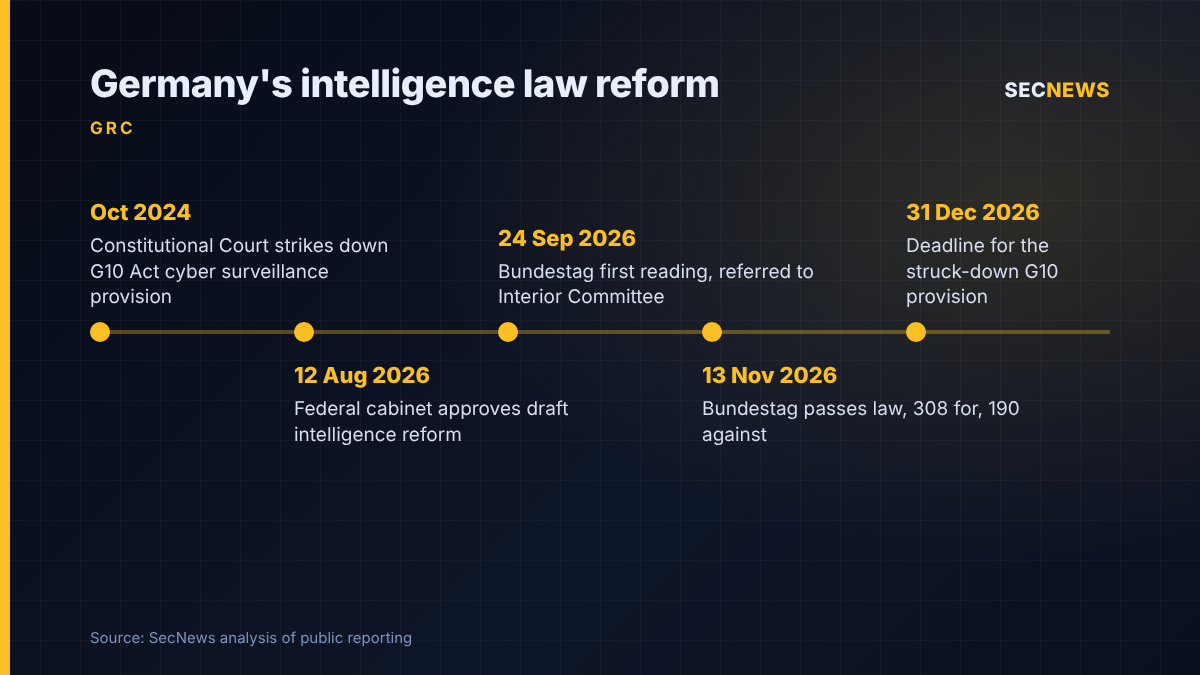
On Friday 13 November 2026 the Bundestag passed the most significant rewrite of German intelligence law since the post-war settlement. According to The Record, the vote was 308 in favour and 190 against, with 71 abstentions. Interior Minister Alexander Dobrindt described the package as the “reform of the century”, and the federal government has pointed to Russian cyber attacks and disinformation as the reason it is needed.
The federal cabinet approved a draft on 12 August, and the Bundestag held a first reading on 24 September before sending it to the Interior Committee. Reporting on the cabinet draft said the new regime was meant to take effect on 1 January 2027. There is also a hard deadline in the background: in October 2024 the Federal Constitutional Court ruled that a provision of the G10 Act allowing the BND to monitor cyber threats was unconstitutional, and that provision survives, under conditions, only until 31 December 2026.
The vote was not uncontroversial. Critics of the draft included opposition parties, the federal data protection commissioner, civil liberties groups and Germany’s internet industry association, who warned of weaker safeguards and possible constitutional challenge. On the day of the vote, the AfD’s Christian Wirth attacked a late amendment on information sharing with regional intelligence offices, calling it a “Lex AfD”.
The detail
The core change is a shift from intelligence gathering to active defence. Until now, the Bundesnachrichtendienst (BND), Germany’s foreign intelligence service, mostly collected information and passed it to police, prosecutors or the armed forces. Under the new law it can act against threats from foreign powers itself. According to The Record, the powers stretch to breaking into systems abroad, disrupting an adversary’s supply chains and dismantling servers that state-sponsored hacking teams rely on. Earlier coverage of the draft, from Merkur’s regional titles and heise online, gave examples such as disrupting IT at chemical weapons laboratories or drone factories, and redirecting data streams or attacking the infrastructure behind an attack on German targets.
The domestic service, the Bundesamt für Verfassungsschutz (BfV), gets a narrower but still significant set of covert powers. These include blocking or rerouting data traffic. The draft also described altering transmitted content and deleting or changing stored data where a particular threat requires immediate action. The BfV still cannot use force against individuals, and the law bars measures intended to endanger anyone’s life or physical safety. That puts Germany some distance from agencies with paramilitary arms.
Several provisions matter for the private sector. Both agencies gain a legal basis to run biometric image matching and to analyse large datasets with AI. Last-minute amendments, The Record reports, let the authorities require telecoms operators to “freeze” traffic data and extend BND retention of bulk metadata from 12 to 13 months. Reporting on the cabinet draft also said technology companies would face tougher cooperation duties, backed by fines of up to €1 million, and that video operators and telecoms providers could be required to provide footage or technical support for surveillance.
Oversight sits with the Independent Control Council (Unabhängiger Kontrollrat). Hacking and active measures inside Germany need its approval in advance, and its panel doubles from six to twelve members. Drafts also required the national security council to declare a special intelligence situation before the most far-reaching powers could be used.
Why it matters for UK organisations
First, there is the compliance angle. Any UK business running telecoms, hosting, cloud, video or data services in Germany should expect more formal requests from German agencies, and possibly orders to preserve traffic data. Those requests will arrive under a law that is new, untested in the courts and likely to be challenged. Legal and privacy teams need to know who receives such requests, how they are verified and how they fit alongside UK GDPR and UK law enforcement obligations, before the first one turns up.
Second, the threat picture. A close NATO ally now has explicit authority to go after the servers and tooling used by state-backed groups. Disrupted adversaries usually rebuild, often on rented infrastructure in third countries, the UK included. Hosting firms and managed service providers should expect more takedown requests and more visibility of shared infrastructure being used against them.
Third, the policy debate. The UK already gives its agencies equipment interference powers under the Investigatory Powers Act and runs offensive cyber operations through the National Cyber Force. Germany has now set its own framework, with prior approval from an independent panel for domestic operations and explicit limits on harm to people. Expect those design choices to feature in UK discussions about oversight, and in any review of the UK’s own regime.
Expert view
I understand why governments want to break the infrastructure that keeps hitting them. Disrupting command-and-control servers can buy defenders real time. But I would caution anyone who sees this as a reason to relax. Takedowns are temporary, and in my experience a well-resourced state group will be back on new infrastructure within days.
The bigger issue for security teams is the duty to cooperate. Requests to freeze traffic data or provide technical help are only as safe as the process that checks them. Social engineers already impersonate police and regulators to extract customer data. A new, unfamiliar legal power with fines attached is exactly the sort of lever they will try to pull. Verification of authority is a control, not an administrative step.
The Green MP Konstantin von Notz called during the bill’s first reading in September for proper management of vulnerabilities held for state hacking. That is the point I would underline. Any state that stockpiles flaws for offensive use leaves those flaws open in the products the rest of us run.
What to do now
- Map your German footprint. List entities, data centres, telecoms and cloud services and suppliers in Germany that could receive agency requests or data preservation orders.
- Set a lawful request procedure. Name owners, require independent verification through known channels and log every request. Treat urgent, unverified demands as possible fraud.
- Review data retention and segregation. Know which logs and metadata sit in German jurisdiction and whether a preservation order there could reach UK customer data.
- Harden against retaliation and infrastructure churn. Keep secure configuration, patch management and malware protection, the Cyber Essentials controls, tight on internet-facing systems, and watch for misuse of your own hosting.
- Brief the board. Add foreign government access powers to the risk register next to existing UK and US lawful access risks.
Bottom line
Germany has moved its spies from watching to acting, with an independent panel holding the brakes. For UK organisations, the practical consequences are new cooperation and data preservation duties in a key European market, and a cyber conflict in which states take adversary infrastructure down more often. Get your lawful request process and your German data map ready now, not when the first order arrives.
Sources
- The Record: German parliament passes law giving spy agencies hacking, sabotage powers
- Sigmalive: German intelligence reform to allow sabotage, cyber disruption and forgery
- leinetal24 (Merkur): Dobrindt: Aus Nachrichtendiensten werden echte Geheimdienste
- gblock: Germany spy agency hacking and sabotage powers
- heise online: Federal Trojan: BND to be allowed to enter apartments to install spyware