La Poste has publicly confirmed that attackers who broke into Maileva, its business mailing platform, in September stole names and postal addresses belonging to 22 million people. The scale first surfaced in leaked documents in October, and the group has now confirmed it to a national news agency.
What happened
On 15 November 2026 La Poste confirmed to AFP that Maileva, a document dispatch service run by its Docaposte subsidiary, had suffered a data breach affecting 22 million people. That is roughly a third of the French population.
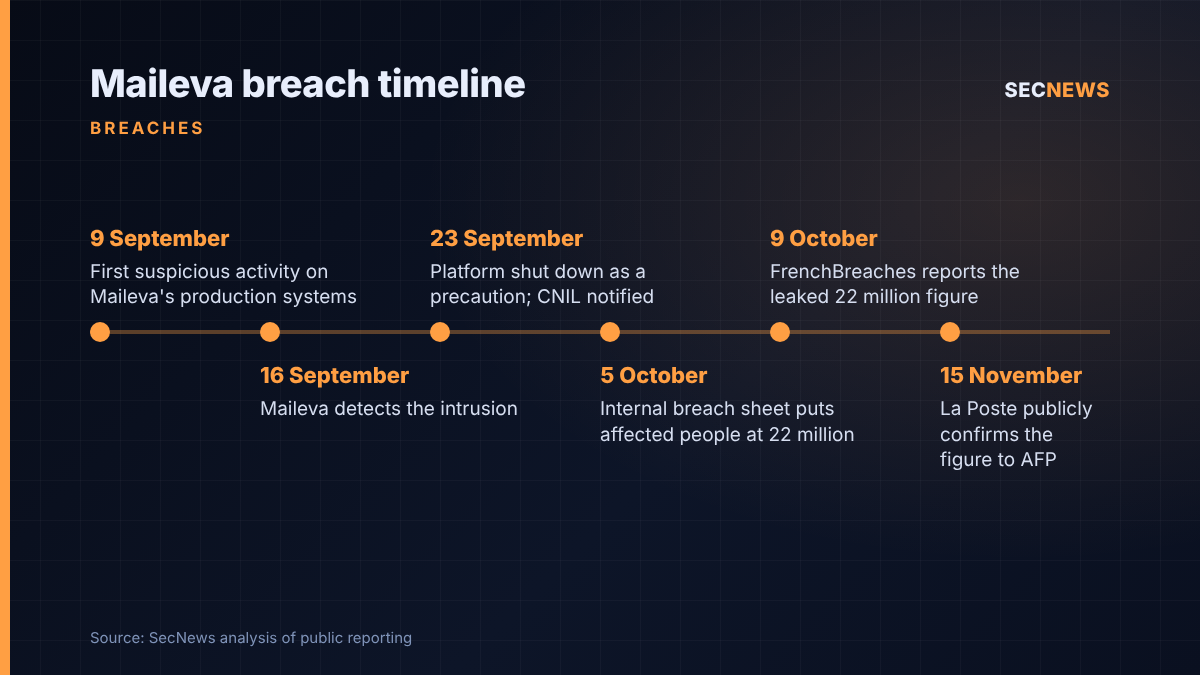
The attack itself is not new. According to a timeline Docaposte later shared with customers and reported by FrenchBreaches, suspicious activity on Maileva’s systems began on 9 September. The company detected the intrusion on 16 September, with further detection in some customer environments the following day. At 07:00 on 23 September it shut the platform down as a precaution and notified the CNIL, the French data protection regulator, that evening. Services began returning on 28 September.
Maileva’s first message to customers described attempts to take over some accounts and send fraudulent post in other organisations’ names. There was no mention of mass data theft. That changed on 5 October, when a breach information sheet drawn up by Docaposte’s data protection officer put the number of affected people at 22 million. FrenchBreaches reported that document on 9 October, and Cyberattaque.org, which first broke news of the outage on 24 September, has since pieced together a list of downstream victims. Maileva confirmed it in writing to Cyberattaque.org, published on 13 November, before the group’s statement to AFP.
Maileva has also filed a criminal complaint and says a judicial investigation is under way. It says it has informed every client company affected. No attacker has been publicly identified.
The technical picture
Maileva lets businesses and public bodies upload documents such as payslips, invoices, registered letters and payment reminders, which it then prints and posts for them. Citing Le Monde, Security Affairs puts its user base above 70,000.
The Docaposte breach sheet says an external attacker exploited an application flaw to reach Maileva’s production environment. The flaw has not been named. The attacker then reached the mail tracking database, which holds about 39 million letter references. Once repeat mailings to the same people were removed, that came down to an estimated 22 million individuals across all clients. Depending on each client’s contract, the records can go back as far as ten years.
Three groups of data were exposed:
- Recipients: title or gender, first and last name, and postal address.
- Senders: the name on the user account, the login identifier, the email address, and the file name attached to each letter.
- Billing: through OpenCell, the application Maileva uses for invoicing, the contact details of client billing staff, invoice amounts and company IBANs.
La Poste says individuals’ bank details were not compromised. The breach sheet does not say whether letter contents were taken. At least one downstream case suggests some letter contents may also have been exposed. Hôpital Foch in Suresnes told patients that an intruder may have read payment reminders sent between 9 and 23 September. Those reminders showed invoice numbers, dates of treatment and sums due, but not what the care was. The hospital sends these letters through Kiwee.care, a medical billing and debt recovery firm that in turn uses Maileva for printing and postage.
Why it matters for UK organisations
Most of the 22 million have never heard of Maileva. In La Poste’s words they are “recipients of Maileva’s client companies”: tenants of the social landlords Flandre Opale Habitat and Altéal, patients of Inovie laboratories, users of a regional transport network and an occupational health service. Their data travelled along a chain of suppliers they could not see.
The UK relies on the same model. Councils, housing associations, NHS trusts, lenders, utilities and payroll bureaux routinely hand print-and-post work to hybrid mail suppliers, often through a software platform or a billing intermediary. Under UK GDPR each controller remains responsible for the personal data, and processors must give sufficient guarantees about their security. The Kiwee.care case shows how quickly accountability blurs when there is a processor behind the processor. Kiwee.care told Cyberattaque.org that it acts as a processor and would leave each healthcare client to inform its own patients.
The fraud risk is concrete. Someone holding a tenant’s name, address, customer number and the fact that they owe their landlord money can write a very convincing payment demand. The leaked IBANs and billing contacts suit invoice redirection scams, and Docaposte has itself warned clients to watch for fraud aimed at executives and finance staff.
Expert view
When we scope supplier assurance work, outbound mail is almost always missing from the list. It gets treated as a commodity utility rather than a system holding a decade of who wrote to whom and why. This incident shows why that is a mistake. An address list is mildly sensitive on its own. Put it next to a sender name and a file name like “final_reminder_oncology_invoice.pdf” and you have special category data by inference.
The timeline matters too. Roughly a week passed between the first suspicious activity and detection, and another week before the platform was taken offline. Customers were first told this was account misuse, and only later learned of a database compromise affecting tens of millions. In my experience that pattern, a reassuring first statement followed by a much worse forensic picture, is common. Controllers who rely on the first supplier notice to decide whether they need to report to the regulator often get it wrong.
Keeping ten years of tracking data on a live production platform is a business choice. Data that no longer exists cannot be stolen.
What to do now
- Map your mail chain. List every supplier that prints or posts documents for you, including those used by your billing, collections and HR providers, and what data each holds.
- Cut retention. Ask hybrid mail and document platforms to delete tracking and content data once you no longer need it for proof of posting. Write that limit into the contract.
- Check processor terms. Make sure contracts require prompt breach notice with clear data categories, and that sub-processors such as print platforms are named and approved.
- Prepare for the 72-hour clock. Plan how you will assess a supplier incident and decide whether to report to the ICO within 72 hours, even when the first notice understates what happened.
- Harden finance processes. Verify any change of bank details by calling a number you already hold, and brief finance staff on invoice fraud that uses genuine-looking customer references.
- Apply Cyber Essentials to suppliers’ platforms. Require MFA on customer portals (user access control) and evidence of timely patching of internet-facing applications (security update management).
Bottom line
The attack was in September and the figure leaked in October. La Poste’s confirmation makes it official: one application flaw at one mailing supplier exposed 22 million people who never chose to use it. UK organisations should treat their print-and-post chain as part of their attack surface, cut what it keeps, and test how quickly they would hear the full story.
Sources
- Security Affairs: Data breach at La Poste subsidiary Maileva affects 22 million people in France
- FrenchBreaches: Maileva (groupe La Poste) : 22 millions de personnes touchées par une cyberattaque
- Cyberattaque.org: Docaposte confirme le vol des adresses de 22 millions de Français après une cyberattaque chez cette filiale de La Poste