Google says it has found, for the first time, attackers running an AI pipeline that reads a vendor’s security patch, works out the bug, writes an exploit and fires it at live websites with nobody at the keyboard. The same report shows a suspected North Korean cluster planting a backdoor in Claude Code configuration files, which should put every UK development team on notice.
What happened
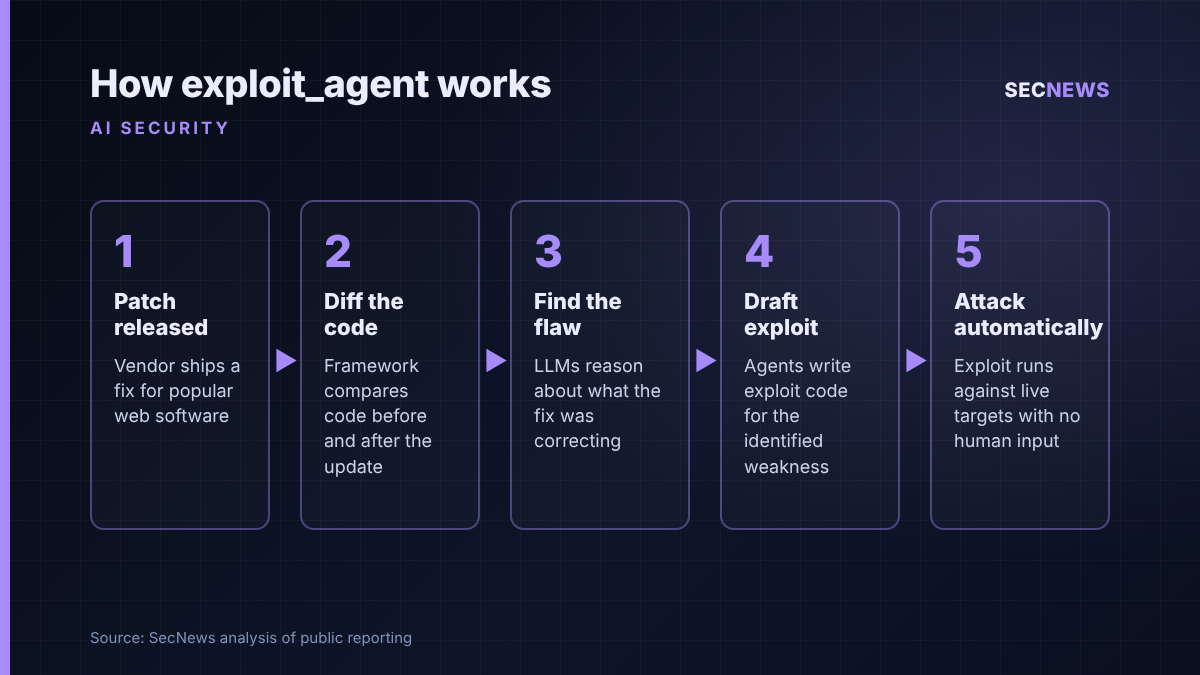
On 16 November 2026, Google Threat Intelligence Group (GTIG) and Mandiant published the latest edition of their quarterly AI Threat Tracker, titled “Agentic Threat Activity Crosses a Significant Threshold”. The headline finding is an exposed staging server running a multi-agent framework its operator called exploit_agent. Hooked up to several frontier and locally hosted large language models (LLMs), it continuously compares versions of popular web application software from before and after a patch, reasons about what the fix was for, drafts an exploit and then runs it against targets automatically.
GTIG describes this as the first time it has seen threat actors fully automate both finding and exploiting vulnerabilities with no human involvement; its previous tracker had reported only partially automated chains. An environment file on the server carried Russian-language comments about loading LLM API keys for the “exploit_agent pilot”, and The Register reports the operator as suspected Russian-speaking, although Google has not named a group or a country. Victim telemetry pointed to French media, entertainment and education websites, and the server also held stolen data plus scripts for internal reconnaissance, brute-forcing, planting webshells and removing rival attackers’ webshells.
The report goes well beyond that one server. It records a suspected DPRK cluster, MIDNIGHT NEPTUNE, abusing AI coding assistants as an internal supply chain route; a growing trade in stolen LLM access through so-called “LLM mixers”; and wider use of open source offensive agent frameworks. ARTEX and CAIRN, both covered here before, appear again alongside PentAGI, CyberStrikeAI and HexStrike AI.
The technical picture
The exploit_agent technique is patch diffing, an old discipline that used to need a skilled reverse engineer and a few days. Google’s illustration shows the framework inspecting an access control check in Spectra, a WordPress blocks plugin, exactly the kind of high-volume, internet-facing code where a vendor’s fix tells an attacker precisely where to look. GTIG argues that n-days suit LLMs better than zero-days because the source material is finite: two code versions, release notes and any published research. It cites the PaperCut flaws exploited as zero-days in late August, where GreyNoise reported a likely LLM-assisted campaign hitting hundreds of organisations four days after disclosure.
MIDNIGHT NEPTUNE is the more novel tradecraft. Targeting cryptocurrency firms in North America and Europe, the group used fake recruiter profiles whose photos carried Google’s SynthID watermark, then fake meeting platforms with ClickFix lures urging victims to run “diagnostic fix scripts”. Once inside, it edited .claude/settings.json in internal repositories so that launching Claude Code fetched the SOMBERMEME backdoor. No flaw in the assistant was needed; the attacker simply abused a legitimate configuration hook that runs commands on the developer’s machine.
On LLMjacking, Mandiant says some incidents ran up more than $100,000 in a single day and up to $1 million before containment. Attackers harvested keys from public GitHub repositories, created rogue service accounts, and in one case abused CVE-2026-40217, a LiteLLM flaw that turns limited “virtual keys” into administrator credentials. The stolen capacity is resold through mixers, with advertised prices ranging from $0.10 to $25 per million tokens; APIMart charges per token, while JetNight sells monthly subscriptions.
Why it matters for UK organisations
No UK victim is named, but that offers little comfort. The tooling would work just as well against a WordPress estate in Leeds. The National Cyber Security Centre (NCSC) said on 3 November that AI is “highly likely” to scale up vulnerability exploitation within two years, and argued that AI exposes long-tolerated weaknesses rather than inventing new ones. Google’s evidence suggests that timeline is already being tested.
The practical effect is on patch windows. Many UK organisations, particularly in education, charities, local government and SMEs, run content management systems and plugins on monthly or ad hoc update cycles. If an automated pipeline can turn a published fix into a working attack within hours, the gap between “patch available” and “patch applied” becomes the main exposure. Cyber Essentials already requires critical and high-risk updates to in-scope software within 14 days; for public web applications that should now be treated as an upper limit, not a target.
The Claude Code finding matters because UK firms are adopting AI coding assistants quickly, often through individual developer choice rather than central policy. Repository configuration files for these tools are rarely covered by code review rules or endpoint detection. The site recently reported Darktrace research on stolen Claude keys turning the tool into an implant; MIDNIGHT NEPTUNE shows a state-backed group doing something similar in real intrusions.
Expert view
In my experience, the slowest part of exploiting a fresh n-day was always understanding the patch. That step is now cheap, which means the speed advantage defenders relied on, often measured in days, has largely gone for commodity web software. When we test public-facing estates, unpatched plugins and forgotten staging sites remain among the most common findings, and those are exactly what a tool like exploit_agent will find first.
There is a silver lining in Google’s analysis. GTIG notes that these frameworks “trade stealth for velocity”: they are noisy, leave recognisable code traces and generate odd traffic. Organisations with decent web logging, a web application firewall and someone who actually reviews alerts should be able to spot automated exploitation attempts.
The coding assistant hooks are the part I would worry about most. Any file in a repository that tells a tool to run a command on start-up is effectively executable code, and should be treated as such.
What to do now
- Shorten patch times for public web apps. Inventory internet-facing CMS platforms, plugins and print or management portals, and aim to apply critical fixes within days. This maps to the Cyber Essentials security update management control.
- Remove what you do not need. Take down old staging sites and unused plugins, and restrict admin interfaces by IP or VPN (Cyber Essentials secure configuration and firewalls).
- Audit AI assistant configuration. Search repositories for .claude/settings.json and similar agent hook files, require code owner review for changes, and alert on hooks that download or execute anything.
- Protect LLM keys and spend. Scan code for exposed AI API keys, patch any LiteLLM gateway against CVE-2026-40217, set billing alerts and quotas, and monitor for new service accounts.
- Brief staff on recruiter lures. Developers and finance staff should be wary of unsolicited job approaches leading to “meeting fix” scripts.
- Watch for automated exploitation. Review WAF and web server logs for bursts of targeted requests soon after patch releases.
Bottom line
Google has now documented what many in the industry expected: attackers using AI to go from patch to exploit without human effort. For UK organisations the answer is not exotic AI defence but faster patching of exposed systems, less unnecessary internet exposure, and treating AI tool configuration files as code. The defenders who already do the basics well will feel this least.
Sources
- Google Cloud: GTIG AI Threat Tracker: Agentic Threat Activity Crosses a Significant Threshold
- The Register: Google: AI agent turned a security patch into a working exploit with no human help
- The Hacker News: Google Finds Hackers Using AI Agents to Build and Run Exploits From Software Patches
- NCSC: Cyber chief: UK facing AI-powered attacks on critical infrastructure within two years