Infoblox, whose DNS, DHCP and IP address management kit runs underneath many large networks, has confirmed that intruders got at company information through a hacked SharePoint migration contractor. According to The Register, the haul included backup configuration data from some customers’ NIOS deployments as well as sensitive staff records.
What happened
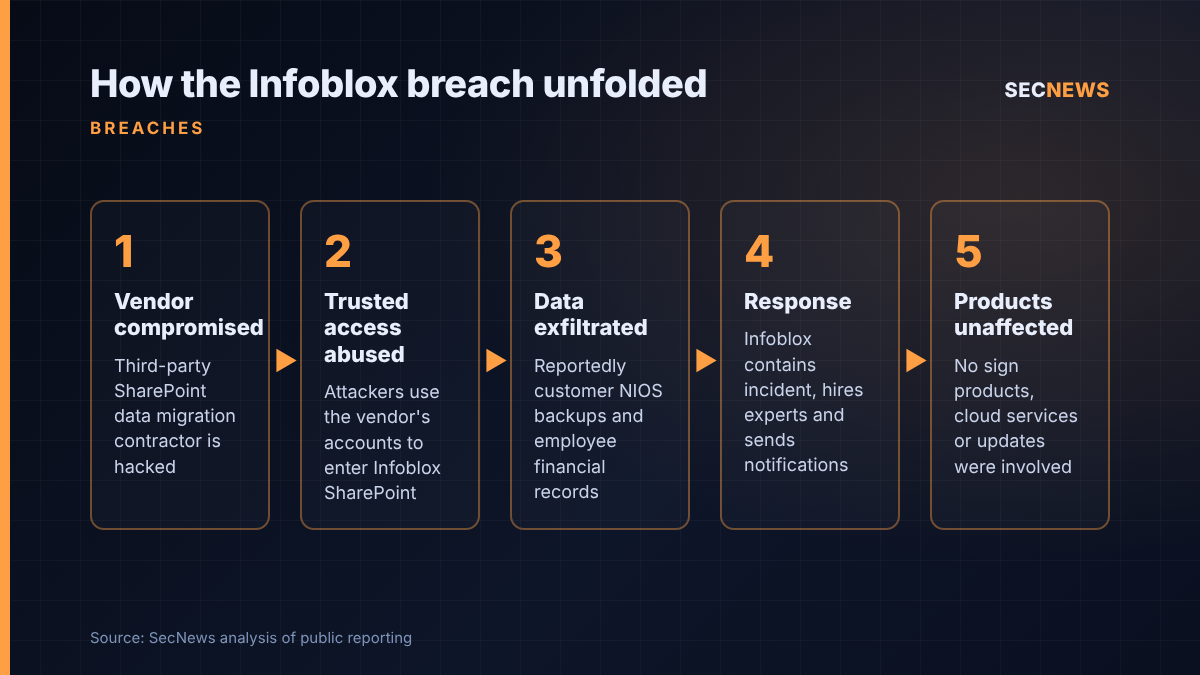
On 16 November 2026 Infoblox confirmed to both TechCrunch and The Register that it is looking into what it calls a “security event”. Unauthorised parties reached certain company information by way of a third-party data migration vendor that had itself been compromised. The company says it triggered its incident response plan straight away, took containment steps and brought in external specialists to establish the scope of the intrusion.
TechCrunch, citing two people familiar with the matter, reported that the vendor’s job was moving data into or around SharePoint. One of those people said sensitive customer data was taken. Infoblox has not named the firm.
The Register went further. Its sources said the contractor had been granted trusted rights within Infoblox’s SharePoint, and that the attackers used the contractor’s own accounts to pull data directly out of Microsoft SharePoint. According to The Register, that data included configuration information relating to some customers’ NIOS (Network Identity Operating System) deployments. The publication also says it has seen an email from chief executive Scott Harrell to staff listing compromised employee details: direct deposit banking information, contact details, dates of birth and US Social Security numbers, covering both employees and their dependants.
Infoblox says it has sent out notifications and that its investigation so far has found nothing to suggest its products, cloud platform, update delivery or build pipeline were involved. It has declined to say how many customers or employees are affected, what categories of data were exposed, or whether the attackers have made contact or demands. Staff have reportedly been offered two years of credit monitoring and a $100 payment towards a password manager.
The technical picture
Two details stand out. The first is the route in. Nothing reported so far points to a flaw in Infoblox’s own products; the attackers appear to have simply logged in as a trusted supplier. A migration contractor typically needs broad read and write rights across document libraries to do its work, often through a service account or an app registration with tenant-wide permissions. If that identity is taken over, or the contractor’s own environment is breached, the attacker inherits exactly the access the customer granted.
The second is what was sitting in SharePoint. The Register describes the NIOS material as saved snapshots used to restore an appliance or Grid after a failure or a botched upgrade, including DNS and DHCP configuration, Grid databases and reporting logs. For anyone who has run NIOS, that is effectively a blueprint of the network: internal zone data and host names, subnet and scope layouts, which servers are authoritative for what, and how the Grid members talk to each other. Nobody has publicly confirmed whether any credentials, keys or TSIG secrets were inside those snapshots, and I would not assume either way until Infoblox says so.
Why it matters for UK organisations
No UK customer has been named as affected, and Infoblox has not said where the affected customers are based. My assessment, from years of testing networks in this country, is that Infoblox Grids are common in UK enterprise, finance, higher education and public sector estates, because core DNS, DHCP and IPAM is exactly the kind of plumbing large organisations buy rather than build. Any UK organisation that has ever uploaded a NIOS backup or support bundle to Infoblox should treat itself as potentially in scope until told otherwise.
A stolen configuration does not hand over the network by itself, but it removes much of the reconnaissance an attacker would otherwise have to do noisily. Knowing internal naming conventions, where the domain controllers sit and which ranges hold management interfaces makes targeted phishing, lateral movement planning and DNS-based attacks cheaper and quieter.
There is also a broader lesson that UK boards will recognise from recent supply chain incidents. The Cyber Security and Resilience Bill puts heavier weight on managing supplier risk for essential and digital services, and the ICO expects controllers to vet processors properly under UK GDPR. A migration project is a short engagement that often gets generous, poorly scoped access and is rarely revisited once the work is done.
Expert view
In my experience, migration and integration contractors are among the most over-privileged identities in any Microsoft 365 tenant. They get Global Administrator or Sites.FullControl.All “just for the cutover”, the project overruns, and six months later the account is still live with no conditional access and no owner. When we test tenants, dormant third-party app registrations with broad Graph permissions are a regular finding.
If The Register’s sources are right, what I find more uncomfortable is that a security vendor was holding customer recovery data in a general collaboration platform where a migration supplier could reach it. Support artefacts deserve the same handling as the production systems they describe: segregated storage, short retention and tight access. Infoblox’s assurance about its build pipeline protects product integrity, but it does little for a customer whose network map may have been taken.
I would also urge some caution. At this stage the customer data specifics come from The Register’s sources and the CEO email it has seen, not from a published Infoblox advisory. Organisations should press their account teams for a straight answer rather than either panicking or shrugging it off.
What to do now
- Ask Infoblox directly whether your organisation’s NIOS backups, support bundles or Grid exports were in the affected data, and get the answer in writing.
- Assume exposure if you have shared backups: review what those files contained and rotate any secrets they may have held, such as TSIG keys, admin passwords, RADIUS or LDAP bind credentials and API tokens (Cyber Essentials: secure configuration, user access control).
- Harden the Grid itself: restrict management interfaces to dedicated admin networks, enforce MFA for administrators and confirm NIOS is on a supported, patched release (Cyber Essentials: firewalls, security update management).
- Raise monitoring on DNS and DHCP infrastructure for unusual zone transfers, admin logins from new sources and configuration changes.
- Audit third-party access in your own Microsoft 365 tenant: list guest accounts, enterprise apps and service principals with SharePoint or Graph permissions, and remove anything tied to finished projects.
- Time-box supplier access for migrations and similar projects, using just-in-time privilege, named accounts and conditional access, with a contractual duty to report compromise quickly.
- Brief staff on targeted phishing that may use real internal host names or project detail to appear credible.
Bottom line
This looks less like a product failure than a familiar supplier access failure with an unusually sensitive payload. If The Register’s account is right, some Infoblox customers have had detailed maps of their core network services taken. UK users of NIOS should get clarity from Infoblox now, rotate anything that could have been in their backups, and take a hard look at which contractors still hold keys to their own SharePoint.
Sources
- The Register: Infoblox customer and staff data exposed in Sharepoint breach
- TechCrunch: Cyber giant Infoblox confirms security incident after hackers access ‘company information’
- Mallory: Infoblox Breach Through Migration Vendor Exposes Customer and Employee Data
- LavX News: Infoblox investigates SharePoint breach that exposed customer and employee data