Researchers at VulnCheck have published 14 root-level vulnerabilities in Copeland’s XWEB EVO refrigeration supervisor, and opportunistic attackers were firing at one of them within two hours of the CVE going live. Five of the flaws reach the final firmware release, and because the product is out of support, they will never be patched.
What happened
On 13 November 2026 VulnCheck disclosed 14 vulnerabilities in XWEB EVO, the Dixell supervisory controller now sold under the Copeland (Emerson) brand. These boxes sit in the back offices of supermarkets and cold stores and manage entire banks of fridges and freezers. Researcher Valentin Lobstein proved every one of them to root on lab rebuilds of the vendor firmware.
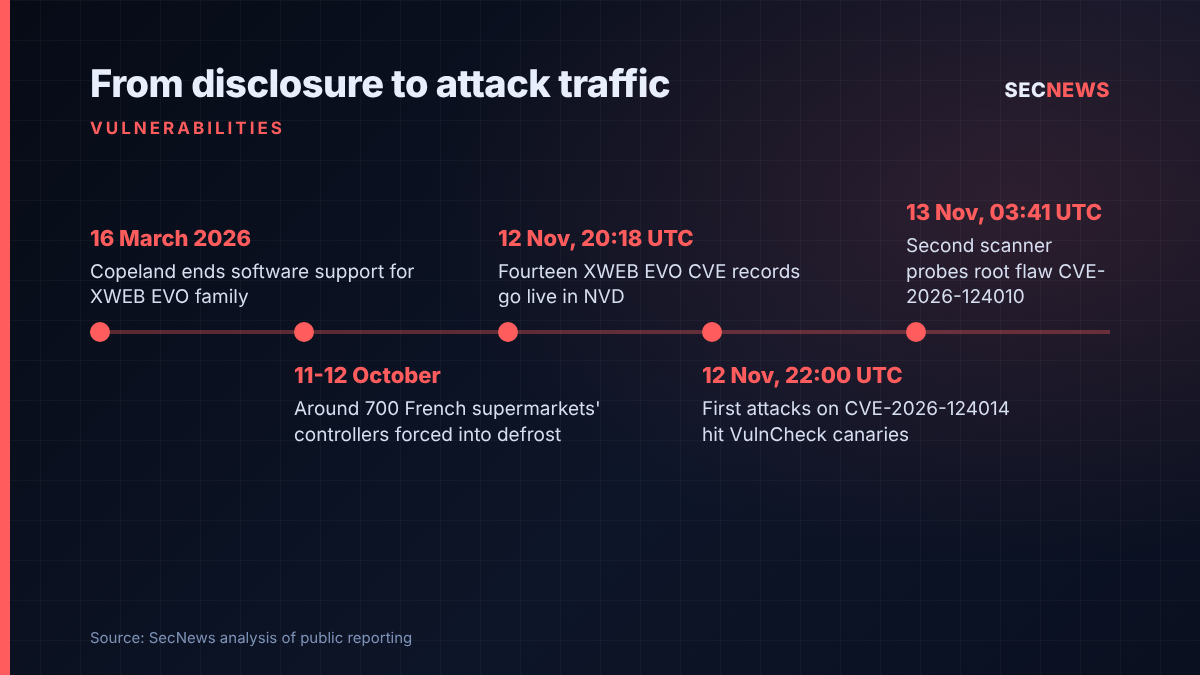
The CVE records, CVE-2026-124002 through CVE-2026-124015, appeared in the National Vulnerability Database at 20:18 UTC on 12 November. No proof-of-concept code had been published, yet by 22:00 UTC VulnCheck’s canary sensors were logging in-the-wild attempts against CVE-2026-124014, an unauthenticated write to the system configuration file. A single host on a commodity hosting network sent 87 requests in the first hour and 125 by the following morning. At 03:41 UTC on 13 November a second source, an established opportunistic scanner, began probing CVE-2026-124010, which gives unauthenticated command execution as root. Both flaws went straight into VulnCheck’s own KEV catalogue. SecurityOnline reported that, at the time of its report, neither appeared in CISA’s KEV list.
Copeland’s March 2026 bulletin moved the XWEB EVO family to end of software support, so no fixes have been issued since 16 March 2026. The vendor advises customers to migrate to XWEB Pro.
The technical picture
The 14 CVEs fall into two groups, and which group applies depends on the firmware.
Nine flaws affect only builds from before a 2021 rewrite of the web application. They include command injection in the login page that fires before the password is checked (CVE-2026-124002), a baked-in master password that unlocks the Administrator login (CVE-2026-124004), a session-free password reset (CVE-2026-124015) and the configuration write already being targeted (CVE-2026-124014). The worst is CVE-2026-124010. It sits in a compiled, setuid-root CGI program that accepts a parameter and passes it to the shell without asking for a session. A further flaw, CVE-2026-124003, makes the Lua interpreter that runs the web pages setuid root, so any injection that lands in that code runs with full privileges.
The second group is the more worrying one, because it survives on 5.8.8, the final release. The daily “code of the day” Administrator password is generated from the device’s MAC address plus the calendar date, without any secret key (CVE-2026-124005). An unauthenticated status page gives that MAC address and the device clock to anyone who asks (CVE-2026-124011). The Administrator account accepts the daily password on its own (CVE-2026-124012), and the operating system root password is rebuilt each day from a fixed prefix plus the same code (CVE-2026-124006). Taken together, an attacker who can reach the web interface can calculate valid credentials offline, switch on SSH and sign in with root rights. A post-authentication command injection in the configuration import function (CVE-2026-124013) makes up the fifth current-firmware flaw.
VulnCheck says both flaws seen in the wild affect only the older firmware, although the published CVE record for CVE-2026-124014 lists versions up to 5.8.8 as affected. VulnCheck says the two scanning sources look opportunistic. In its words, “neither scanning source is evidence of the October refrigeration campaign”.
Why it matters for UK organisations
For context, on the night of 11 to 12 October attackers pushed refrigeration controllers at roughly 700 French supermarkets into defrost, and fires broke out in at least 15 stores. CERT-FR listed Copeland and Dixell XWEB kit among the compromised controller types, and on 9 November France attributed the campaign to an Iranian state unit. This week’s disclosure hands every opportunistic scanner a fresh, documented route in.
None of this is specific to France. Any UK retailer, convenience chain, food distributor, pharmaceutical cold store or facilities contractor running XWEB EVO is in scope. VulnCheck counts about 1,663 internet-exposed EVO hosts on Shodan, and Onyphe data puts the figure near 1,960, against just 108 for the supported XWEB Pro line.
Ownership is the other problem. These controllers are often installed and remotely maintained by refrigeration engineers, not by IT, and in many estates they never appear on a vulnerability scan or an asset register. VulnCheck notes that even its own product-fingerprinting dataset cannot see the unsupported EVO firmware at all. For organisations working towards Cyber Essentials, unsupported software that can reach the internet is a straightforward non-compliance, and it falls inside the boundary of scope whenever it shares a network with in-scope systems.
Expert view
When we test retail and logistics networks, the building management and refrigeration kit is regularly the softest thing on the wire. It tends to sit on a flat network next to the tills, with a vendor-supplied modem or port forward that nobody in the security team knew about.
What stands out here is speed. A one-paragraph CVE record, with no exploit code, was enough for someone to start hitting sensors within two hours. Attackers now read NVD the same way defenders read their inbox, and they read it faster. For a product that will not get a patch at all, the only control left is architecture.
The predictable password design deserves a word too. Deriving an administrator credential from a hardware identifier and the date is a convenience for field engineers, and in practice it works as a master key that anyone can calculate. The 2021 rewrite kept that design, and October showed what a fridge forced into defrost can cost.
What to do now
- Find every XWEB EVO unit. Ask facilities teams and refrigeration contractors directly, and check for 4G routers or port forwards that integrators may have installed outside your IT estate.
- Take the web interface off the internet today. Put remote access behind a VPN or a tightly scoped firewall allowlist (Cyber Essentials: firewalls).
- Segregate the controllers. Place them on a dedicated network segment with no route to corporate systems or payment networks (Cyber Essentials: secure configuration).
- Assume exposed units may be compromised. Review logs for unauthenticated requests to the configuration script and the console CGI. Block the two scanner addresses VulnCheck published, and check setpoints, defrost schedules, alarms and user accounts for unexpected changes.
- Update legacy units to 5.8.8 as a stopgap. This removes most of the older injection and backdoor flaws, but not the credential weaknesses, and may not close CVE-2026-124014.
- Plan and fund migration to a supported platform. Under Cyber Essentials security update management, unsupported software should be removed or isolated, and that applies to OT as well.
- Write it into contracts. Require refrigeration and building services suppliers to tell you about remote access paths and end-of-support dates.
Bottom line
Copeland’s XWEB EVO now has 14 public root-level flaws, two attracting live attack traffic and five that will never be fixed. If one of these units is reachable from the internet anywhere in your estate, treat it as a priority incident risk. Get it off the internet, check it for tampering and start the replacement conversation this week.
Sources
- VulnCheck: Code of the Day: Unauthenticated Root in Copeland XWEB EVO
- VulnCheck: Dixell/Copeland XWEB EVO Predictable Root Password Generation (CVE-2026-124006)
- SecurityWeek: Hackers Probe Newly Disclosed Flaws in Copeland Refrigeration Controllers
- SecurityOnline: CVE-2026-124010: Copeland XWEB EVO Root RCE Actively Exploited