A race condition that has sat in the Linux kernel’s TCP code since 2015 lets a remote attacker with no credentials crash Linux servers running ordinary network services, with cloud machines most exposed. Fixed kernels are already out from Debian, so UK teams should treat this as a scheduled patch-and-reboot job for internet-facing hosts this week.
What happened
On 15 November 2026 (UK time), the researcher Hyunwoo Kim, who goes by v4bel, posted a full advisory for a bug he calls NoisyTCP to the oss-security mailing list, along with a matching write-up on GitHub. It is tracked as CVE-2026-99288. He reported it privately via the linux-distros list and wrote the upstream fix himself.
The upstream fix is commit 4e2b3ef19e0e, dated 3 November. Kim traces the bug back to commit 079096f103fa from 3 October 2015, so it has been in the kernel for about 11 years. In his words it “affects almost all Linux distributions”.
Readers may remember our 4 November piece on the earlier IPv4 TCP handshake use-after-free that Red Hat rated 9.8 while Ubuntu LTS users waited for a fix. NoisyTCP is a separate flaw, has a separate CVE and needs a separate patch. If you patched for that earlier bug this month, that kernel may well not include this fix.
The technical picture
NoisyTCP lives in the code that matches incoming packets to existing connections. Those lookups take no locks for speed, so socket memory can be recycled while another CPU still holds a stale reference, and the kernel did not confirm the object it found was still registered in the connection table. Debian’s tracker carries the upstream commit message, which describes the change as making the kernel “reject unhashed sockets during established lookups”.
Kim describes two ways to trigger the bug. The practical one makes the kernel follow a null pointer and panic, which takes the whole host down. He stresses that in a containerised setup the crash kills the host and every container on it, not just the targeted service. The second route leads to a use-after-free, the class of memory corruption that can sometimes be turned into code execution. Kim says this second route depends on several races succeeding in sequence and is generally hard to hit. Red Hat’s assessment says the flaw causes a crash but does not allow data alteration or code execution. It rates the bug Important, with a preliminary CVSS score of 7.5.
A few preconditions decide who is realistically exposed. Several CPUs have to process the attacker’s packets in parallel, so the server needs two or more receive queues on its network card, or Receive Packet Steering spreading the load. Both are common on modern servers, including many cloud instances. The attacker only needs to reach a listening TCP port, and Kim names Nginx, Apache and SSH in their default configurations as reachable targets. No login is required at any point.
Timing matters too. Kim reports that against default web and SSH servers on QEMU/KVM virtual machines, where virtual CPUs get pre-empted, the crash took between roughly five seconds and two minutes. On a quiet physical server with eight receive queues, it took about 14 hours even with a tuned proof of concept. Kim has published the analysis but not a weaponised tool, and says his own exploit so far is limited and lab-specific, aimed at VM servers.
Why it matters for UK organisations
Linux runs much of the UK’s public-facing infrastructure. That covers web front ends, reverse proxies, VPN concentrators built on Linux appliances, Kubernetes worker nodes and SSH bastions across both government and private sector estates. A remote, unauthenticated way to crash those boxes is an availability problem even without code execution. It suits extortion or nuisance attacks against public services.
The cloud angle is the uncomfortable part. Kim’s timings suggest exploitation is fastest on exactly the multi-queue virtual machines that UK organisations rent from AWS, Azure and Google Cloud. Managed services are patched by the provider, but anything running on your own VM images is your job under the shared responsibility model. Organisations covered by the NIS Regulations, or in scope of the planned Cyber Security and Resilience legislation, will need a clear record of when an issue like this was assessed and fixed.
Patch levels currently differ between distributions. Debian has fixed kernels for bookworm (DLA-4906-1) and trixie (DSA-6628-1). Ubuntu’s tracker gives the CVE Medium priority, and when we checked, its supported releases were still listed as needing evaluation. Red Hat has published its rating and statement. Check your vendor’s errata.
Expert view
In my experience, this kind of crash bug gets deprioritised because it is “only” denial of service and the CVSS score is not in the nines. I think that is a mistake here. The attack surface is any open TCP port, the precondition is the default for cloud hardware, and the impact is a full host panic that takes every co-located container with it.
It is also the second remotely reachable TCP stack bug in a month. Teams that can only push kernel updates on a quarterly maintenance cycle should use this as a reason to fix that. Live patching and rolling node replacement exist so a reboot-dependent fix need not wait for a change freeze.
A word on the workarounds. Turning off SYN cookies closes the path Kim used, but it removes a standard defence against SYN floods, so it swaps one availability risk for another. It is also set per network namespace, easy to miss on container hosts. Dropping to a single receive queue will hurt throughput on busy systems. Both are stopgaps, not a strategy.
What to do now
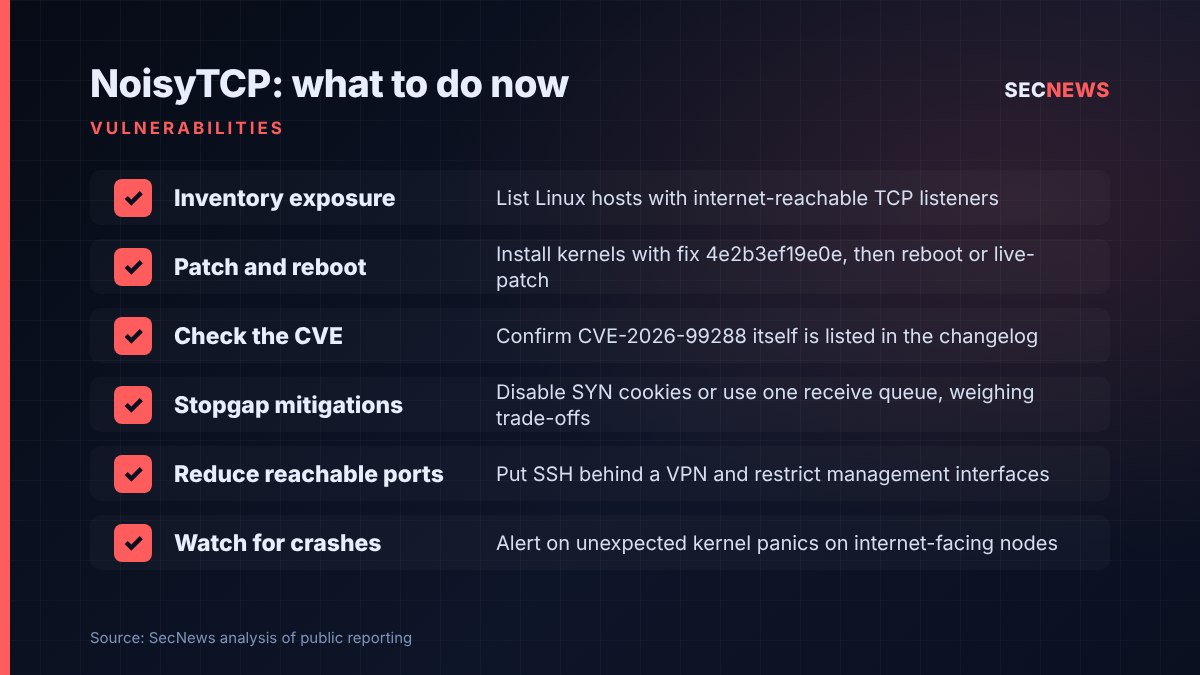
- Inventory exposure. List Linux hosts with internet-reachable TCP listeners, starting with web servers, reverse proxies, SSH bastions and Kubernetes nodes that face the internet. This is your Cyber Essentials firewall and secure configuration scope.
- Patch and reboot. Install your distribution’s kernel update that includes the 4e2b3ef19e0e fix as soon as it ships, then reboot or live-patch. The Cyber Essentials security update management control expects high-risk fixes within 14 days. Do not let a missing reboot leave you running the old kernel.
- Do not confuse the CVEs. Confirm that CVE-2026-99288 appears in your vendor’s changelog, rather than relying on earlier TCP patching this month.
- Use mitigations only where you must. If a host cannot be updated quickly, weigh disabling SYN cookies (per namespace) or reducing to one receive queue against your SYN flood and performance risk, and record the decision.
- Reduce reachable ports. Put SSH behind a VPN or bastion and restrict management interfaces by source address.
- Watch for crashes. Alert on unexpected kernel panics and reboots on internet-facing nodes. A cluster of them may be an attack, not a hardware fault.
Bottom line
NoisyTCP will not hand anyone a shell today, but it lets an unauthenticated attacker crash Linux servers through ordinary open ports, and cloud VMs are the easiest targets. It is a different bug from the TCP flaw patched earlier this month, so check that your vendor’s kernel includes this specific fix, deploy it, and make sure the reboot actually happens.
Sources
- oss-security: NoisyTCP: Linux Kernel TCP Pre-auth Remote Corruption (CVE-2026-99288)
- GitHub (Hyunwoo Kim): NoisyTCP advisory
- Cyber Security News: NoisyTCP: 11-Year-Old Linux Kernel Flaw Lets Unauthenticated Attackers Crash Servers Remotely
- Red Hat: CVE-2026-99288
- Debian Security Tracker: CVE-2026-99288
- Ubuntu: CVE-2026-99288