A USB worm that French police dismantled in 2019 is spreading again, because someone re-registered the domains it was built to call home to. Kaspersky says the revived Retadup botnet now delivers a new build of the evasive CoffeeLoader, unpacked on the victim’s graphics card.
What happened
On 16 November 2026 Kaspersky researcher Oleg Kupreev published an analysis on Securelist of a CoffeeLoader variant the company first spotted in August. The interesting part is not only the loader but how it arrives. The new samples are being installed by Retadup, a worm written in AutoIt and AutoHotkey that has been around since 2017 and spreads through removable drives.
Retadup should be dead. In July 2019 French law enforcement got into its command servers, took over the botnet and told every infected machine that checked in to remove the worm. More than 850,000 computers were cleaned within a few weeks. According to Kaspersky, however, someone began re-registering the worm’s old command and control domains in 2024. Those servers started handing out SmokeLoader, packed with the Armoury packer, and by early 2025 they had switched to CoffeeLoader.
Kaspersky cannot say whether the original author came back or a newcomer saw an opportunity. The worm’s protocol is simple, just plaintext commands encoded in Base64 and then hex, so anyone holding the domains can give orders. Kaspersky’s products blocked Retadup infection attempts on about 15,000 systems between January and September, with Peru, Angola, Russia and Bolivia the hardest hit. Cyber Press stresses that these were blocked attempts, not confirmed infections.
The technical picture
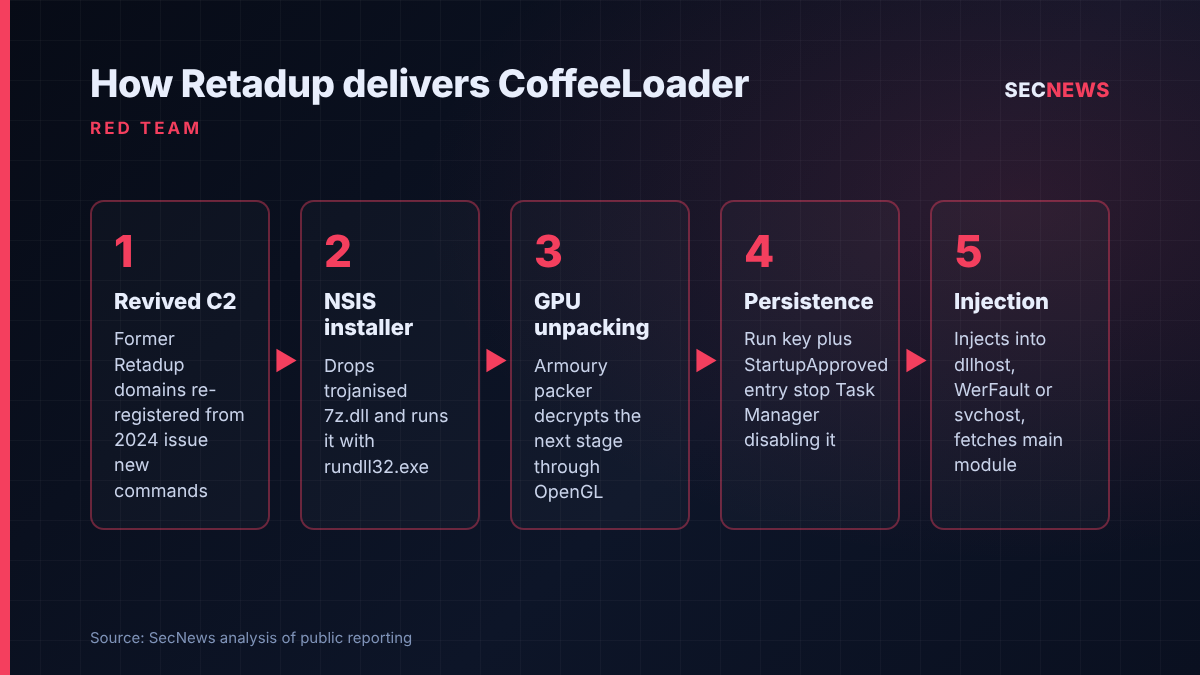
The chain starts with an NSIS installer. It drops a file called 7z.dll into a temporary folder and launches it with rundll32.exe. The DLL is a doctored copy of the genuine 7-Zip library: part of its code has been swapped for self-decrypting shellcode, which turns out to be an updated Armoury packer.
Armoury is known for using the GPU. Zscaler ThreatLabz, which first documented CoffeeLoader in 2025, described how earlier versions ran a small XOR decryption routine through the OpenCL compute library, so the real payload only appeared after code had executed on the graphics hardware. ThreatLabz noted that this approach can make life harder for analysis in virtual machines. The new build does the same job through OpenGL compute shaders instead, a different API that some detection logic may not yet expect.
What Armoury unpacks has also changed. Kaspersky found a new intermediate stage, which it calls the CoffeeLoader downloader, that combines the old dropper and stager roles. It copies the trojanised DLL into a folder under ProgramData or the user’s local AppData, names the folder, the DLL and the Run key value after eight hex characters derived from the system volume, and writes a StartupApproved entry so the user cannot simply switch the item off in Task Manager. It then injects into a stock Windows process such as dllhost.exe, WerFault.exe or svchost.exe and pulls the main module over HTTPS. Server replies are now checked against an embedded signing key rather than a TLS certificate.
The main module behaves much as before. Zscaler’s earlier work listed its evasion tricks: call stack spoofing, indirect system calls, sleep obfuscation that encrypts the implant in memory while it is idle, and Windows fibers. Kaspersky says the three commands for running a follow-on payload are unchanged. Those commands inject it into a process, drop and run it as an executable, or load it as a DLL through rundll32.
Why it matters for UK organisations
The victims are mostly far from Britain, but the tradecraft matters here for three reasons.
First, takedowns are not permanent. We tend to treat a seized botnet as finished business. Retadup shows that if the domains are allowed to lapse, any dormant infection that missed the clean-up, or a USB stick sitting in a drawer since 2018, can reconnect to a new operator. The same risk applies to any organisation that once owned domains baked into software, scripts or device configurations. Letting a domain expire hands its traffic to whoever registers it next.
Second, removable media still matters in the UK. Manufacturing, logistics, healthcare estates, schools and OT environments still move files on USB drives, often across segregated networks. A worm that spreads through shortcut files on removable drives needs no phishing email and no exposed service.
Third, a sideloaded copy of a trusted open source library is exactly the kind of file that gets waved through. 7-Zip is everywhere, and a DLL with that name run by rundll32 from a temporary folder can look harmless to a busy analyst.
Expert view
When we test endpoint controls, GPU-assisted unpacking is one of the techniques I expect commodity sandboxes to struggle with. Many detonation environments run without a usable graphics stack, so the packer either fails quietly or never reveals its payload, and the verdict comes back clean. Moving from OpenCL to OpenGL looks like a small change, but it is a sensible one for an attacker. It sidesteps any hunting rule tuned to OpenCL loading in odd processes and leans on a graphics library that almost every Windows machine loads routinely.
The bigger lesson is about infrastructure hygiene. In my experience, organisations track the domains they actively use and lose sight of the ones referenced in old installers, monitoring agents and marketing campaigns. Retadup is a neat illustration: the worm did the hard work years ago, and the new operator simply picked up the leash.
The modest 15,000 figure is one vendor’s telemetry, and CoffeeLoader is a loader: its value lies in whatever it delivers next.
What to do now
- Control removable media. Block or restrict USB mass storage where there is no business need, disable autorun, and scan drives on connection. This sits squarely within the Cyber Essentials malware protection and secure configuration controls.
- Hunt for sideloaded 7z.dll. Look for 7z.dll launched by rundll32.exe from temp, ProgramData or AppData, especially in eight-hex-character folders. Compare hashes against the genuine 7-Zip release.
- Watch persistence keys. Alert on new Run key values pointing at rundll32 and on writes to the StartupApproved Run key by non-administrative processes.
- Review process injection telemetry. Unusual network activity from dllhost.exe, WerFault.exe or svchost.exe should be investigated, and Kaspersky’s published indicators should be loaded into your EDR and DNS filtering.
- Fix the sandbox gap. Ask your security vendors how their detonation environments handle GPU-dependent malware. Where possible, run suspicious samples on hosts with a working graphics stack.
- Audit your own domains. Keep an inventory of every domain your software, devices and scripts reference, and renew or deliberately sinkhole them rather than letting them expire. Cyber Essentials only partly covers this, so the inventory belongs in your asset management process.
Bottom line
Retadup’s comeback is a reminder that a botnet takedown only lasts as long as someone holds the domains. Pair that with a loader that hides inside a 7-Zip library and decrypts itself on the GPU, and you have an old, low-tech spreading method delivering modern evasion. UK defenders should tighten USB controls, hunt for trojanised libraries run through rundll32, and keep hold of every domain they have ever relied on.