OpenAI has given its personal AI agent a payment wallet that keeps card numbers hidden from both the agent and the shop. It solves the credential problem neatly, but it leaves open the harder question of who pays when an agent is tricked into buying the wrong thing.
What happened
On Friday 13 November 2026, OpenAI began rolling out ChatGPT Wallet, a payment feature for its “dots” personal agent. It was developed with American Express, Mastercard and Visa, and it lets the agent finish purchases on ordinary retail websites rather than inside a closed, in-chat checkout.
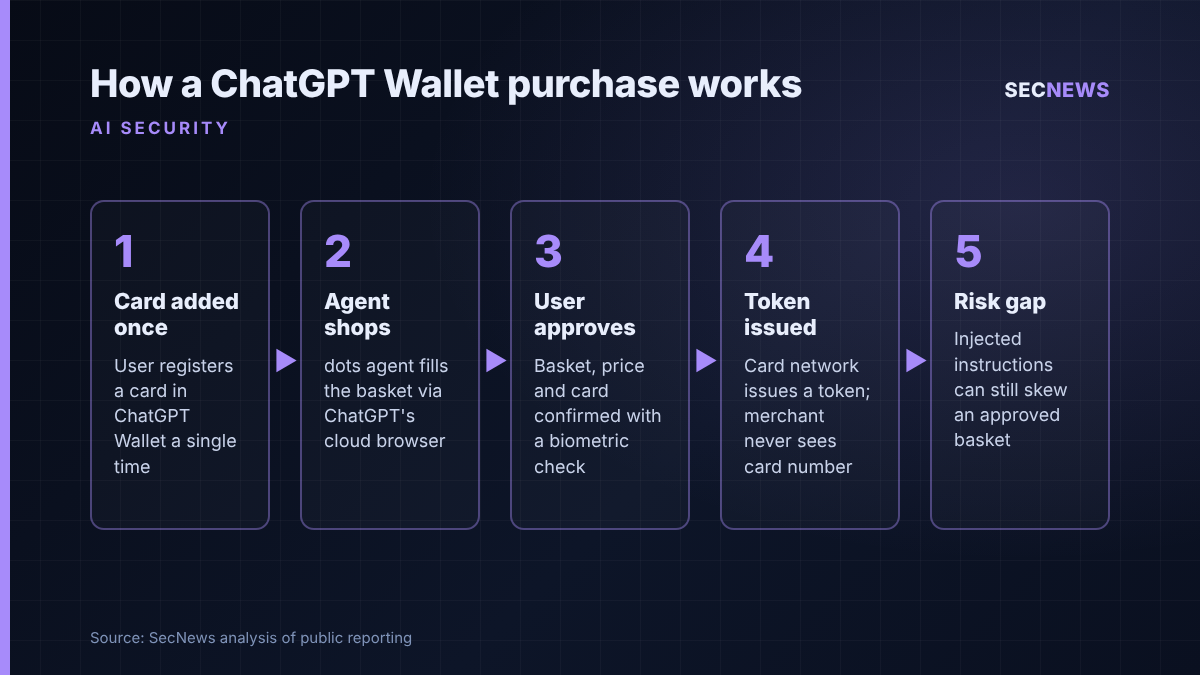
A user registers a card once. At checkout, ChatGPT displays the basket, price and selected card, and the purchase goes ahead only after a biometric or device check (Face ID, for instance). The card network then issues a payment token, a stand-in card number with its own expiry date and security code, and the charge is posted to the real card behind it. According to OpenAI, card rewards and dispute protections still apply where eligible.
Initially, only adult US ChatGPT Pro subscribers with eligible US-issued cards can use it. OpenAI has said it wants to let users hand over purchases more fully in future, with spending parameters and pre-approvals, but it has given no date. It also published a Commerce Partner Playbook for merchants and named fraud and payments partners including Forter, Signifyd, Adyen and Stripe.
The technical picture
Three security ideas are at work. The first is tokenisation. Because only a network token is exposed, a breached agent session or retailer does not leak a reusable card number. OpenAI tells merchants the customer consents to one transaction only, so the credential must not be reused, and the Payment Account Reference (PAR) links the token to the account.
The second is agent identity. The agent shops through ChatGPT’s cloud browser, which resembles the checkout bots retailers have spent years blocking. OpenAI asks merchants to configure their CDN or web application firewall to recognise requests signed with Web Bot Auth, a scheme for cryptographically verifying bot traffic. It is also starting to pass user signals, such as country estimated from IP address, network prefix, locale, time zone and user agent, in the standard HTTP Forwarded header so that risk engines have something to score.
The third is human approval of every purchase, which is both the main control and the main weakness. OpenAI concedes that some sites may block agent purchases by accident and that fraud systems may decline genuine ones, and its playbook leaves fraud decisions, fulfilment and support with the merchant.
The Cloud Security Alliance (CSA), in a research note published on 15 November, argues that the wallet fixes credential exposure but leaves the authorisation problem much as it was. Hidden instructions planted in product pages, reviews or search results could nudge a shopping agent towards another seller, an extra item or a look-alike product. If the user then skims the confirmation and approves, the record shows a valid authorisation even though the outcome is not what they wanted. The biometric approval becomes strong evidence that the cardholder agreed to the exact basket, which makes a claim of an unauthorised transaction hard to win.
Why it matters for UK organisations
The wallet is US-only, but this is not just an American problem. Any UK retailer that sells to American customers could already see signed agent traffic at its checkout. Whether it is admitted or blocked is often left to an unexamined CDN or bot management default.
Payment regulation is also catching up. According to CSA, an HM Treasury consultation in July 2026 on payment services reform asked whether the rules on consent, authentication and liability for unauthorised payments should change to cover AI agents. It closed on 6 October, and no government response had been published when CSA wrote. An agent acting on manipulated instructions, but with a genuine biometric approval, sits awkwardly in any regime built around whether the customer authorised a payment.
There is an enterprise angle too: staff may add company cards to personal agent wallets, and expense systems typically cannot yet tell agent spending apart from human purchases. CSA also points out a concentration risk: if many merchants allow-list a small number of AI platform signing keys, a single key compromise would affect them all at once, not just one shop.
Expert view
Technically, OpenAI has made the right choice. Tokenised, single-use credentials and per-purchase approval are far better than the alternative we have seen in the wild, where people hand agents their stored card details or banking passwords. When we test e-commerce platforms, card data handling is often where the serious findings are, and this removes a whole class of them.
But prompt injection is still unsolved, and this launch moves it from a data leakage problem to a money problem. The approval screen is a security control that relies on a person reading carefully at the moment they are least likely to. A manipulated basket that differs from what the user asked for by one seller name or one product variant will get through.
The evidence gap concerns me more. The most useful record in any dispute is what the user asked for, what the agent saw on the page and what the confirmation showed. That record is held by the AI platform, and OpenAI’s merchant guidance does not mention chargebacks, disputes or liability. In my experience, losses end up with whoever cannot prove what happened, and right now that is the merchant and the consumer.
What to do now
- Make the bot decision deliberately. Review CDN, WAF and bot management settings to see how Web Bot Auth-signed agent traffic is currently handled, and record the decision with a named owner. This falls under the Cyber Essentials secure configuration control.
- Update fraud models. Ask your payment or risk provider whether it ingests the new Forwarded header signals, and start tagging transactions that carry agent signals so you can measure agent dispute rates instead of guessing.
- Keep dispute-grade evidence. Retain signed request headers, relayed signals, PAR values and order confirmation snapshots for agent orders. They will be your main defence in a dispute.
- Lock down corporate cards. Change card and acceptable use policies to ban company cards from consumer agent wallets, enforcing this with issuer controls where offered. This reflects the Cyber Essentials user access control principle of limiting privilege.
- Build caps into your own agents. If you develop purchasing agents, enforce hard spending limits and price expectations in code, and show a confirmation that compares the basket with the original instruction rather than the basket alone.
- Watch the policy. Follow the Treasury consultation response and card scheme rule changes, especially before any move to standing delegation without per-purchase approval.
Bottom line
ChatGPT Wallet is a sensible piece of payments engineering that keeps card numbers away from AI agents. It does not stop an agent being talked into a bad purchase, and it puts the evidence needed to settle such disputes in the hands of the AI platform. UK merchants should decide how to treat agent traffic now, before a CDN default or a lost dispute decides for them.
Sources
- Help Net Security: ChatGPT Wallet lets agents pay without seeing your card number
- PYMNTS: OpenAI Gives AI Agents a Wallet Without Seeing the Card
- OpenAI Developers: Accept payments (Commerce Partner Playbook)
- Cloud Security Alliance: Agents at the Checkout: Loss Allocation in Frontier-Lab Payment Wallets