OpenAI and Cisco have open-sourced Shirudo, a Linux runtime in which AI agents draft small eBPF “shields” that block an exploit path on a live server until the real fix is installed. For UK operations teams buried under this autumn’s patch backlog, it is a promising compensating control, but it is not a patch and should not be treated as one.
What happened
On 23 November 2026 OpenAI and Cisco jointly announced Shirudo, an open-source project aimed at what both companies describe as the gap between learning about a vulnerability and getting the fix onto every affected machine. The name is Japanese for “shield”, and that is also what the project calls each of its protections. A shield is a narrowly scoped program loaded into the Linux kernel that refuses the specific behaviour a flaw depends on, while the service carries on running.
The headline demonstration involves Java4Shell, the OpenJDK Base64 decoding bug that has kept Java teams busy since mid-November. According to OpenAI, Codex generated a shield that inserted an input check into Java’s Base64 decoder, which was then hooked into a live Elasticsearch process. The exploit attempt was rejected and Elasticsearch stayed up, with no restart. As Help Net Security notes, the tool’s own developers designed and ran that test.
Cisco’s announcement, written by president and chief product officer Jeetu Patel, says the agent-driven approach has also produced code that detects and blocks attempts against the recent PHP flaw. The code is on GitHub under a BSD 2-Clause licence, while its kernel-side BPF code carries a BSD/GPL dual licence.
The technical picture
eBPF lets small, verified programs attach to hook points inside a running kernel. Many defenders know it from Cilium, the Kubernetes project created by Isovalent, which Cisco now owns. Shirudo builds on Tetragon, Isovalent’s eBPF security engine, which was open-sourced in 2022. The difference is that Shirudo is built for agents to drive.
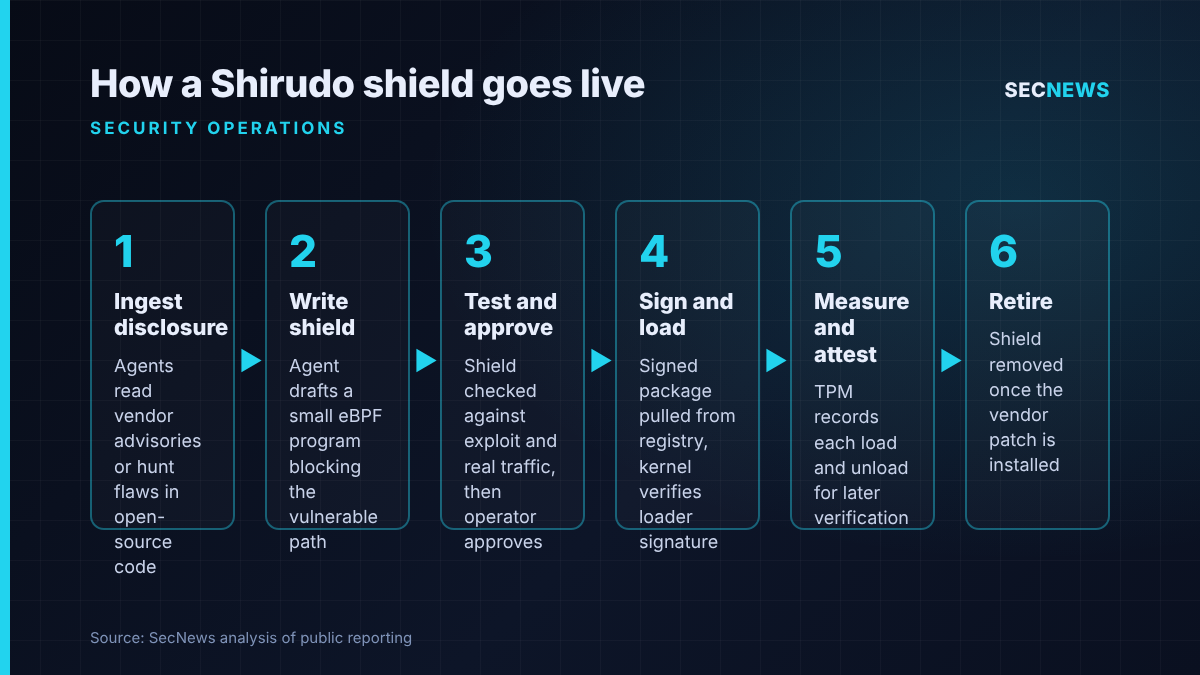
The workflow Cisco describes runs roughly as follows. Agents read vendor disclosures or hunt for flaws in open-source code, map each one to the assets and attack paths it touches, then write a small shield. They test that the shield stops the exploit and that normal traffic still works. An operator has to approve it before enforcement, and the shield is meant to be removed once the vendor patch lands.
The trust model is where the project is most interesting from a SecOps point of view. According to the project documentation, the signing key lives solely on the operator’s host. Shields travel as signed packages through an OCI-compatible registry, and the design deliberately does not trust that registry. Once a target has been initialised, its kernel only accepts BPF programs through a signed loader, so the signature is checked before the normal eBPF verifier runs. Each load and unload is recorded in a TPM measurement register, and operators can request a signed attestation, using a fresh nonce, to prove what was actually running on a host at a given moment.
There are practical limits. Help Net Security reports that production use needs a Linux kernel carrying Shirudo’s own patches plus a TPM 2.0 chip. That is likely to rule out appliances, older virtual machines and anything where you do not control the kernel.
Why it matters for UK organisations
Cisco argues that AI models are now finding serious flaws faster than defenders can absorb them, and that exploitation of the PHP and Java4Shell bugs began within a day of disclosure, if not earlier. Cisco Security CTO Thomas Graf and Isovalent’s Liz Rice went further, arguing that exploitation now often precedes the fix, which they describe as time to exploitation having “become negative”.
For UK organisations the compliance picture matters. Version 3.3 of the Cyber Essentials infrastructure requirements still says updates fixing critical or high-risk vulnerabilities, or anything scoring CVSS 7 or above, must be installed within 14 days of release. A shield does not change that. At best it is a compensating control that reduces risk during those 14 days, or covers the stretch when a fix exists but you cannot yet find a change window for a production database.
The other UK consideration is governance. Letting an agent write code that runs inside the kernel of production servers is a significant change to your control environment. Auditors will want to see who approved each shield, when, and how fast it can be rolled back. The TPM records help, but only if someone checks them.
Expert view
Compensating controls are not new. The Register notes that Rimini Street has relied on them for years, VMware offers virtual patching, and Palo Alto Networks and Rapid7 sell automation to build them. What is new here is pushing that logic into the kernel, generating the control with an AI model, and releasing the whole thing as open source. Neither vendor is purely altruistic: wider adoption could lift demand for Codex, and Cisco owns the eBPF expertise underneath.
In my experience, the hard part of virtual patching has never been writing the rule. It is being confident the rule covers every route to the vulnerable code without breaking legitimate behaviour. When we test environments that rely on WAF rules or IPS signatures as stopgaps, we regularly find a variant the rule misses, or a stopgap still in place a year after the patch it was meant to cover. A shield written by a model and tested against one public exploit deserves the same scepticism.
That said, the design choices are sound. Signed loaders, an untrusted registry, measured loads and explicit retirement when the patch arrives address the obvious objection that an agent-writable kernel is itself a new attack surface. If they survive independent review, Shirudo could suit Linux-heavy estates that cannot patch quickly.
What to do now
- Keep patching as the primary control. Treat any shield as temporary cover inside the 14-day Cyber Essentials security update window, not a substitute for it. Track each shield against the patch that retires it.
- Evaluate in a lab first. Use the VM quickstart or Isovalent’s self-guided lab to understand the build, sign, load and attest cycle before going near production.
- Check prerequisites. Inventory which Linux hosts have TPM 2.0 and a kernel you control. That defines your realistic scope.
- Write down approval and rollback rules. Decide who can approve a shield, how it is tested against real workloads, and how it is unloaded.
- Feed it into detection. A shield blocking an exploit is a signal that someone tried it. Route those events into your SIEM and hunt for related activity, rather than assuming the attempt failed everywhere.
- Protect the signing key. The operator host becomes a crown jewel. Apply the Cyber Essentials user access control and secure configuration principles to it.
Bottom line
Shirudo is a serious attempt to give defenders back some of the time AI-driven discovery has taken from them, and its signing and attestation model is better thought through than most launches of this kind. But it has been publicly demonstrated against one exploit in a vendor-run test, it needs patched kernels and TPMs, and it does nothing to change UK patching obligations. Watch it, trial it, and keep patching.
Sources
- OpenAI: OpenAI and Cisco introduce Shirudo
- Cisco Blogs: Expanding the Defender’s Window with Self-defending Infrastructure
- Shirudo documentation: How it works
- The Register: Cisco and OpenAI pitch eBPF kernel plugins as the way to tame the patchpocalypse
- Help Net Security: Linux patches can take weeks, and OpenAI and Cisco built Shirudo to help in the meantime
- The Hacker News: OpenAI and Cisco Unveil AI-Assisted Linux Security Tool to Block Exploits Before Patching
- NCSC: Cyber Essentials Requirements for IT Infrastructure v3.3