Anthropic has moved Enterprise Frontier Safeguards, its scheme for spotting Claude misuse without holding customer data, from private testing into public beta. The design is not new, but the beta turns it into a real operating commitment, and UK security teams will be the ones answering the alerts.
What happened
On Monday 23 November 2026 Anthropic opened a public beta of Enterprise Frontier Safeguards (EFS) to business customers that meet its eligibility criteria. The company’s Claude account on X described it as zero data retention that still “looks for misuse across many requests”.
To be clear about what is fresh: EFS itself was first announced on 1 September 2026, after enterprise customers pushed back against a 30-day minimum retention period Anthropic attached to its most capable models, starting with Fable 5. That September post set out the architecture and promised a phased rollout. What changed this week is availability. After a private beta with more than 100 organisations, including Bridgewater, Salesforce and Stripe, eligible customers can now enrol, and the operational detail has appeared in Anthropic and cloud provider documentation.
Anthropic does not charge for EFS. Customers pay their cloud provider for the storage, key management and data transfer it consumes.
The technical picture
The problem EFS tries to solve is one most defenders will recognise from fraud and insider risk. A classifier that inspects each prompt in isolation cannot see an attack that has been split into dozens of small, innocent looking tasks. Anthropic’s September threat report described an operation against around 50 organisations in which one agent farmed out work to several others running in parallel and kept stolen credentials between sessions. Spotting that pattern requires a history of activity to correlate, which is exactly what zero data retention customers refuse to leave with the vendor.
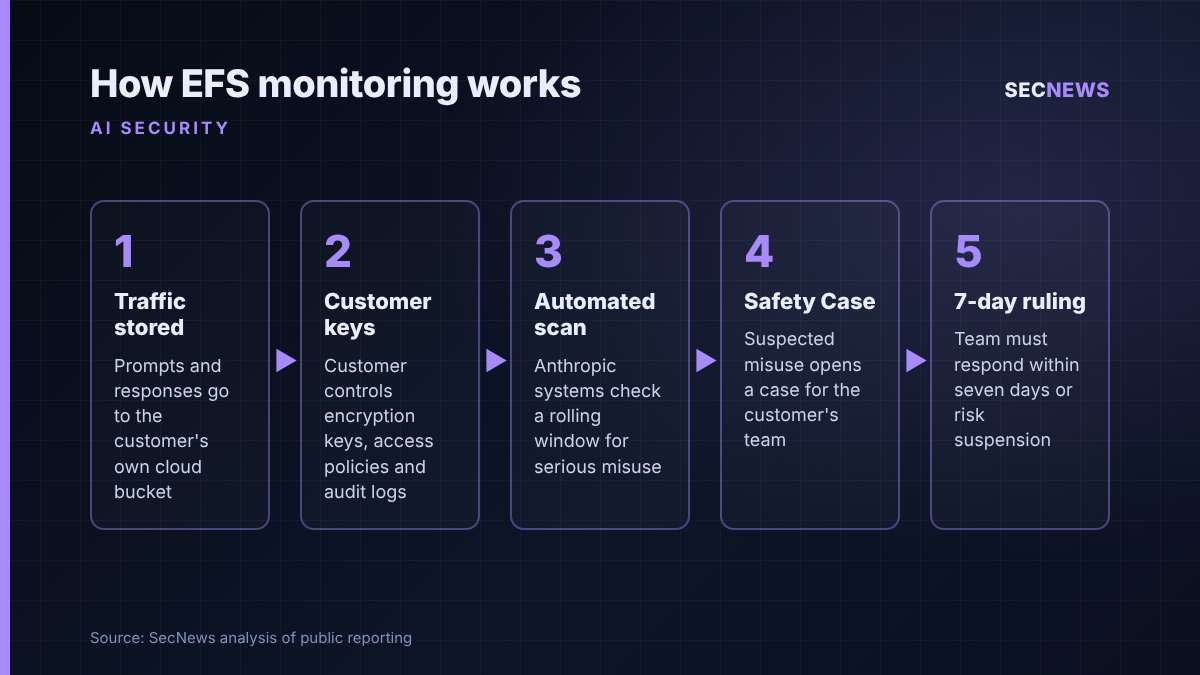
EFS resolves the tension by moving the history rather than deleting it. Prompts and responses are written to a storage bucket in the customer’s own cloud account, such as Amazon S3 or Google Cloud Storage, under keys and access policies the customer controls. Anthropic’s automated systems analyse a rolling window of that traffic for signs of serious misuse, including attempts to build offensive cyber or biological capability and indications of stolen or leaked credentials. Anthropic says the data is excluded from training and its staff do not review it.
When the monitoring finds something, it raises a “Safety Case”. According to The Daily Brief, which worked from Anthropic’s documentation, every case records an ID, a misuse category (cyber and bio are examples), the affected workspace and message IDs, and the customer must rule on whether a violation occurred. Interesting Engineering reports that cases contain findings rather than the underlying prompts, and can be pulled through storage or an API into a SIEM.
The response window is seven calendar days, a figure reported by both The Next Web and The Daily Brief. Miss it and access may be suspended. The Daily Brief also notes that Anthropic does not send a notification when a case opens, so someone has to watch for it.
Anthropic’s own platform, Amazon Bedrock and Google Cloud routes are included in the beta; Microsoft Foundry, named in September, is still being worked on. The Daily Brief, citing AWS’s guide, adds that Bedrock fails closed: lose access to the customer’s key or bucket for a full day and the covered models are switched off for that configuration.
Why it matters for UK organisations
For UK banks, insurers, law firms and healthcare providers, retention has been the sticking point with frontier models. Leaving prompts full of client data or privileged material with a US vendor for 30 days raises awkward questions under UK GDPR, outsourcing rules and client contracts. EFS keeps that data in infrastructure the organisation already governs, which should simplify data protection impact assessments and third-party risk reviews.
It does not make the obligations disappear; it relocates them. The bucket becomes a new store of sensitive data that falls within subject access requests, legal holds and retention schedules. The Daily Brief reports that on Bedrock a readable 30-day copy of inputs and outputs sits in the customer’s bucket, and that the automated analysis happens in the AWS us-east-1 and eu-west-1 regions, which matters for anyone mapping data flows and international transfers. UK firms should confirm the processing locations for their own deployment rather than assume.
There is also a resilience angle that operational resilience teams will want to look at. A service that stops when a key is disabled or a bucket policy is tightened by an unrelated change is a new dependency, and one that sits squarely in the security team’s lap.
Expert view
I think this is a sensible design, and it reflects something we have argued for years: the organisation that owns the data should own the evidence. Wells Fargo’s CISO, Munish Kumar Sharma, summed up the bargain in the launch material: “We keep custody of our data while Anthropic operates the detection.”
But custody cuts both ways. Under the old model, misuse detection was the vendor’s problem. Under EFS, the vendor detects and your team adjudicates, against a deadline, with your access to the model at stake. In my experience, the controls that fail are rarely the clever ones. They are the alert queue nobody owns, the key that a tidy-up script disabled, and the storage bucket whose permissions drifted. EFS adds all three.
Be clear about the scope, too. This monitoring targets abuse of your Claude estate, such as a compromised API key being used to orchestrate attacks or an insider using agents for something they should not. It is not a substitute for controlling what your own agents can reach, and it will not tell you whether a prompt injection in a document has quietly steered an agent.
Finally, it is a beta: settings, eligibility and timelines can still change.
What to do now
- Find out if you are eligible. Ask your Anthropic or cloud account team in writing, and record which interim retention arrangement currently applies to you.
- Inventory your Claude traffic. Map every workspace, account, region and route, including Foundry, which has no EFS path yet.
- Assign an owner for Safety Cases. Name a primary and a backup, set an internal target well inside seven days, and feed new cases into your SIEM, since you will not be told when one appears.
- Treat the bucket and key as critical assets. Apply least privilege, alert on any change to key state or bucket policy, and include both in change control (Cyber Essentials: secure configuration and user access control).
- Update your data protection paperwork. Revisit the DPIA, records of processing and retention schedules to cover the new store and its processing locations.
- Pilot on non-production first. Test with synthetic data and confirm what happens to service if the key or bucket becomes unavailable.
Bottom line
The public beta of Enterprise Frontier Safeguards gives regulated UK organisations a credible route to frontier Claude models without leaving their prompts on a vendor’s servers. The price is responsibility: a bucket, a key and a review queue that your team must run to a deadline. Plan for that work before switching anything on.
Sources
- Anthropic: Developing Enterprise Frontier Safeguards with our customers
- The Next Web: Anthropic can now watch for Claude misuse without keeping firms’ data
- PYMNTS: Anthropic Expands Availability of AI Safety Monitoring With Zero Data Retention
- Interesting Engineering: Anthropic’s new safeguards hunt cyber threats without storing data
- The Daily Brief: EFS Moves Claude Fable Prompts and Replies to Your Storage