CrowdStrike has signed a definitive agreement to buy Zscaler in an all-stock deal that values the zero trust specialist at about $43.9bn. The talks first reported last week are now a signed transaction with fixed terms, voting commitments and a closing window that runs well into 2027.
What happened
On Monday 23 November 2026, CrowdStrike and Zscaler announced that their boards had unanimously approved a merger agreement under which CrowdStrike will acquire Zscaler entirely in shares. We reported on 21 November that the two companies were in talks; this is the material new development, because there are now binding terms on the table.
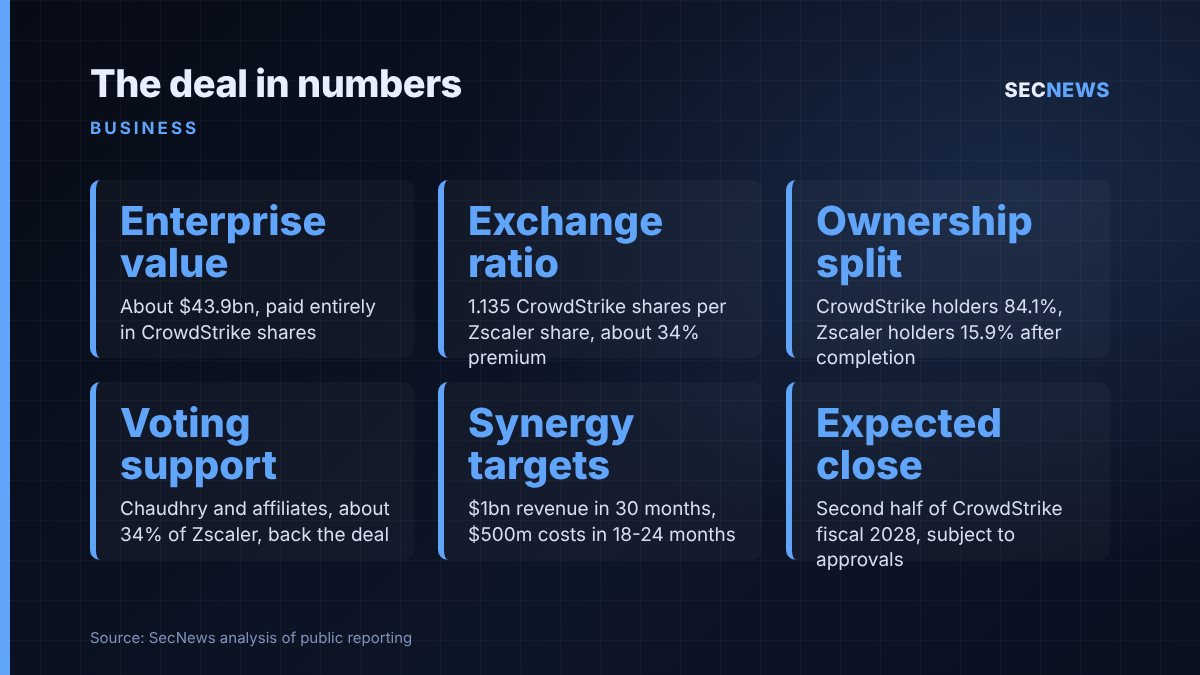
Each Zscaler share will be swapped for 1.135 CrowdStrike shares. Based on CrowdStrike’s closing price on 20 November, that implies roughly $260.41 per Zscaler share, a premium of about 34%, and an enterprise value of approximately $43.9bn. Once the deal completes, existing CrowdStrike investors are expected to own about 84.1% of the combined business and Zscaler investors about 15.9%.
Zscaler founder and chief executive Jay Chaudhry, together with his affiliates, holds around 34% of Zscaler’s shares and has signed voting agreements backing the transaction. That gives the deal a large head start at the Zscaler shareholder vote. Chaudhry will continue to run the Zscaler business and join CrowdStrike’s board after completion.
The companies expect to close during the latter half of CrowdStrike’s 2028 financial year, once Zscaler shareholders approve and the required regulatory clearances and customary conditions are met. Until then the two firms will operate independently. TechCrunch put the likely close at around this time next year.
The announcement landed on the same day CrowdStrike reported what chief executive George Kurtz called “the best quarter in CrowdStrike’s history”. For the three months to 31 October, revenue rose 28% to $1.58bn, ending annual recurring revenue (ARR) reached $6.26bn, up 27%, and net new ARR hit a record $419.2m. Free cash flow was also a record at $474.4m. Zscaler separately reported first quarter revenue up 20% to $949.3m and ARR of about $3.88bn.
Investors reacted in opposite directions. According to International Business Times, published via Yahoo Finance, Zscaler stock gained over 13% before the US market opened, while CrowdStrike dropped by more than 8%, a familiar pattern when a buyer pays a premium in its own stock.
The detail
The strategic logic is straightforward. CrowdStrike’s Falcon platform is built around a sensor on endpoints and cloud workloads, extended into identity and data protection. Zscaler’s Zero Trust Exchange sits inline between users, applications and, increasingly, AI agents, enforcing access policy across more than 200 service locations. CrowdStrike says the combination will let Falcon own both control points: where an agent runs and where its traffic goes.
The companies already work closely together, sharing over 2,000 customers and 16 product integrations. CrowdStrike says around 8,000 Zscaler customers do not yet buy from it, and it plans to sell Zscaler products under its Falcon Flex licensing model so customers can draw on both portfolios through one contract. Device and network telemetry are due to converge in Falcon Next-Gen SIEM.
The financial targets are ambitious. CrowdStrike expects the combined company to start with more than $10bn of ARR, to reach about $1bn of annualised revenue synergies within 30 months of closing, and to strip out $500m of annualised costs within 18 to 24 months, mainly from data centre, vendor and operational consolidation. It also claims the deal will widen its addressable market by more than $185bn in calendar 2029. These are management projections, not guarantees, and because the price is fixed in shares, the cash value of the offer will move with CrowdStrike’s share price until completion.
Why it matters for UK organisations
Many large UK enterprises, financial services firms and public bodies already run one or both platforms, often as the backbone of their endpoint detection and remote access strategy. A merger of this size changes the commercial conversation for them, even though nothing changes technically for many months yet.
The first issue is concentration. Organisations that deliberately split endpoint and secure access across two vendors to avoid a single point of failure will soon find both under one roof. For regulated firms in particular, operational resilience rules already push boards to understand where critical services depend on a small number of suppliers, and this deal shrinks that list.
The second is contract leverage. Bundled licensing through Falcon Flex may well bring discounts, but it also raises switching costs. Renewals falling due during the next 12 to 18 months deserve care, because roadmaps, pricing and support models can shift after completion.
Neither company has said which competition authorities must clear the deal. Reuters, as cited by TheStreet, reported that analysts see possible antitrust concerns, though opposition is far from certain. In my view a review by the UK Competition and Markets Authority is plausible given the UK customer base, but that is speculation at this stage.
Expert view
In my experience, consolidation in security tooling rarely delivers its promised single pane of glass on the timetable shown to investors. Integrating a sensor-based endpoint platform with a globally distributed inline proxy is a serious engineering task, and the announcement offers no dates for unified telemetry or joint policy.
There is a genuine defensive upside. When we test environments, attackers routinely exploit gaps between endpoint and network visibility: a compromised laptop talks to a cloud service, and the two halves of the story sit in different consoles owned by different teams. Correlating those signals natively could shorten investigations and make AI agent activity easier to police.
The risk is the mirror image. A single vendor controlling both the agent on every device and the path every connection takes becomes an extraordinarily attractive target, and any faulty update or service failure has a wider blast radius. Boards should treat this as a resilience question, not only a procurement one.
What to do now
- Map your exposure. List every CrowdStrike and Zscaler product in use, who owns it, and what fails if each one is unavailable for a day.
- Review renewal dates and terms. Look for change of control, price protection and termination clauses before signing multi-year bundles during the transition.
- Revisit concentration risk. Record the combined dependency in your third-party risk register and test whether your business continuity plans assume the two vendors fail independently.
- Keep fallback options real. Make sure you could restore remote access and endpoint protection if a single provider faltered. This supports the Cyber Essentials controls on malware protection, secure configuration and firewalls.
- Ask for the roadmap in writing. Request clear commitments on data residency, support and product continuity, particularly for UK public sector and regulated workloads.
- Do not rush. Nothing changes operationally until completion, so avoid early migrations driven by sales pressure.
Bottom line
What was a rumour on Friday is now a signed $43.9bn all-stock deal, backed by a third of Zscaler’s votes and timed to close in CrowdStrike’s 2028 fiscal year. For UK security leaders, the immediate tasks are commercial and resilience planning rather than technical change: understand the combined dependency, protect your negotiating position and keep an exit path open while the regulators and shareholders have their say.
Sources
- CrowdStrike (SEC filing): CrowdStrike to Acquire Zscaler, Bringing Network Security and Zero Trust to the Falcon Platform
- CrowdStrike (SEC filing): CrowdStrike Reports Third Quarter Fiscal Year 2027 Financial Results
- International Business Times via Yahoo Finance: CrowdStrike Agrees To Buy Zscaler For $43.9 Billion. Shares Move In Opposite Directions.
- TechCrunch: CrowdStrike to acquire Zscaler for $44 billion
- TheStreet: CrowdStrike’s $43.9 billion deal has a surprising catch