Attackers abused a flaw in Optimizely’s experimentation platform on Monday 16 November to plant a card skimmer and crypto-stealing code inside scripts served to visitors of the BBC, HSBC and TalkTalk websites. Optimizely says the hole is closed, but nobody yet knows how many payment cards were taken.
What happened
For most of Monday 16 November, some of the best-known websites in Britain were quietly handing their visitors malicious code. It did not come from the BBC, HSBC or TalkTalk themselves. It arrived through Optimizely, the digital experience company whose Web Experimentation product lets marketing teams run A/B tests and change live pages without a code release.
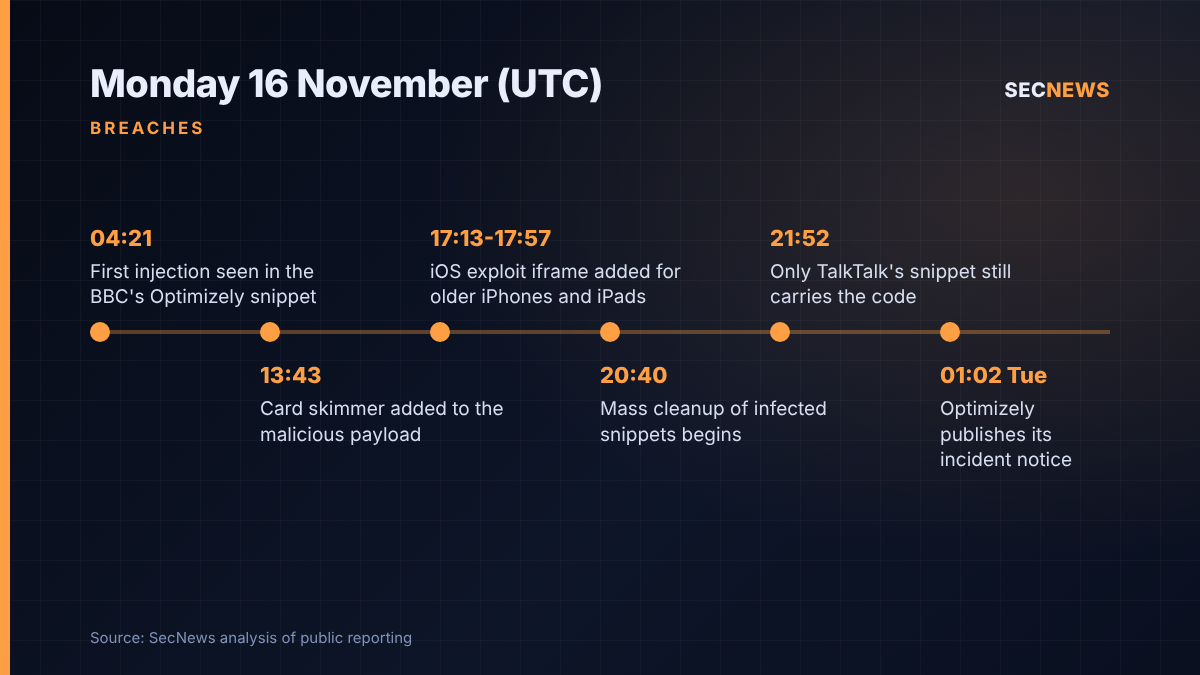
An unauthorised party exploited a weakness in the account signup flow for Optimizely’s Experimentation product and used it to insert a loader into customer projects. Because each site pulls its Optimizely snippet from the vendor’s own content delivery network, the tampered code arrived with a valid Optimizely certificate and looked entirely routine to browsers. The first injection was recorded at 04:21 UTC in the BBC’s snippet. A cleanup began at around 20:40 UTC and, at 21:52 UTC, TalkTalk’s snippet was the last one still carrying the code.
Optimizely confirmed the incident on Monday evening and published an incident notice at 01:02 UTC on 17 November. In its statements, the company said it had blocked the vulnerable path, deployed a fix, removed the injected code, ended sessions, revoked tokens and contacted affected customers directly.
The scale emerged from research by Scott Helme and his colleagues at Report URI, a firm that monitors the scripts websites run. Its team examined 1,611 Optimizely snippets and found tampered code in 188, belonging to 178 organisations, and warns the true figure is probably larger. Other named organisations include CNN, Zoom, Salesforce, GitLab, IKEA, Equifax, Air France-KLM and IG. The Record reports that 32 of the affected sites were in finance or banking. Salesforce told BleepingComputer it had disabled Optimizely scripts across its instances as a precaution.
The technical picture
The attacker wrote a small loader into the Project JavaScript field, where customers add their own custom code, and left the rest of each snippet alone. The loader fetched a payload called track.js from an attacker domain, 1688360[.]cc. Researchers saw three variants: a direct call, a base64-obscured address, and one carrying a full copy of the payload in case the domain was blocked.
The payload changed several times during the day and did four things:
- Wallet swapping. It replaced Bitcoin, Ethereum, Solana, Dogecoin and Litecoin addresses on the page and in the clipboard with the attacker’s. Blockchain tracing put receipts at roughly $7,000 by Monday evening, though StepSecurity notes some wallets predate the attack.
- Card skimming. From about 13:43 UTC it captured card numbers, expiry dates and security codes typed into a site’s own forms. Card fields hosted in a provider’s cross-origin iframe, such as Stripe or Adyen, were out of reach.
- Data theft. It could exfiltrate screenshots and any cookies lacking the HttpOnly flag.
- iOS exploitation. Older iPhones and iPads were pointed at the Coruna and DarkSword exploit kits, and after a further iframe was added between 17:13 and 17:57 UTC, pages on iOS 18.6 or earlier reloaded every 60 seconds to retry the exploit. Cynet describes this as conditional delivery rather than a confirmed compromise of a real handset.
The same actor was active before Monday. According to The Hacker News, the injector had been planted via Kissmetrics, StorifyMe and Minute Media scripts since the previous week and first surfaced on Turkish websites in September. Smartsheet’s snippet was reinfected after an initial clean, suggesting the attacker kept write access for a time.
Why it matters for UK organisations
This is a breach of the website supply chain rather than of any single victim’s servers. The BBC, HSBC and TalkTalk did not need to be hacked for their visitors to be exposed. Any UK organisation loading Optimizely, or any similar tag or personalisation script, into pages that collect payment or login data inherited the risk without changing its own code.
The UK GDPR questions follow quickly. If a skimmer ran alongside your own card form, personal data was very likely processed by an unauthorised party, and the 72-hour ICO reporting clock starts once you are aware of a breach that poses a risk to individuals. Organisations must establish which pages loaded the tampered snippet, for how long, and which transactions they handled. Firms subject to PCI DSS 4.0 should note that requirements 6.4.3 and 11.6.1 cover precisely this: an inventory of payment-page scripts and detection of unauthorised changes to them.
Expert view
In my experience, the marketing stack is the least-tested part of a typical corporate website. When we scope a web application test, the client’s own code gets weeks of attention while the dozen tags loaded by the growth team are waved through as “vendor managed”. A tool designed to let non-developers rewrite live pages is, by definition, a tool that can rewrite live pages, and whoever controls it controls what your customers’ browsers run.
The delivery channel is what worries me most. Allow-listing cdn.optimizely.com in a Content Security Policy would have done nothing, because the malicious code came from that host. A strict connect-src blocking unknown destinations would have helped, as would keeping card capture inside the payment provider’s iframe. Optimizely’s notice is also thin: it gives no mechanism for the flaw, no count of altered projects and no word on whether the attacker retains access. Customers need that before they can close their own investigations.
What to do now
- Check every Optimizely project. Review Project JavaScript and experiment code for references to 1688360, the .icu stage domains, atob( or anything your team did not write. A clean snippet now says nothing about what it delivered on 16 November.
- Search your logs. Look for traffic to 1688360[.]cc, webshell[.]lol and 136.113.106[.]136 back to the early hours of 16 November.
- Rotate access. Audit every person, integration and API token with write rights over your Optimizely projects, then issue fresh credentials (Cyber Essentials: user access control).
- Assess card exposure. Where card numbers are typed into a form you host, assume any taken on 16 November are compromised, speak to your acquirer and decide on ICO notification.
- Tighten the browser boundary. Invalidate sessions held in non-HttpOnly cookies, deploy strict script-src and connect-src policies, and keep third-party tags off checkout and login pages (Cyber Essentials: secure configuration).
- Patch devices. Ensure managed iPhones and iPads run iOS 18.7.3 or 26.3 or later (Cyber Essentials: security update management).
Bottom line
One weakness in a marketing tool turned the websites of at least 178 organisations, including some of Britain’s biggest brands, into skimming platforms for a day. Optimizely has closed the hole, but the job of working out which customers were exposed now sits with every organisation that loaded its snippet. Treat third-party scripts on sensitive pages as production code, because attackers already do.
Sources
- BleepingComputer: Optimizely hack infected CNN, Fox News, BBC, Salesforce sites with malware
- The Record: Website management platform Optimizely confirms hackers put malicious code into customer sites
- ITPro: Optimizely hack: Everything we know so far
- The Hacker News: Hijacked Optimizely Scripts Served Card Skimmer and iOS Exploit Kits to CNN, BBC and Zoom Visitors
- The Register: Optimizely hack turns world’s biggest websites into malware dispensers