New analysis from Blackpoint Cyber names the remote access trojan behind the ROMULUS ClickFix operation as CNCMachineRMS, smuggled in through a fake Stardock installer and a signed binary. For SOC teams, the useful part is not the malware’s name but the repeatable behaviour it leaves on an endpoint.
What happened
On 18 November 2026, Blackpoint Cyber’s Adversary Pursuit Group published research tying the previously unnamed implant pushed by ROMULUS to a known family, CNCMachineRMS. The Hacker News reported the findings on 20 November. ROMULUS itself is not new: Forescout Research first described it in October as a delivery service that uses ClickFix lures, the fake “verify you are human” pages that coax a visitor into pasting a command into PowerShell or the Windows Run box. We covered an earlier phase of the same operation last month, when the crew was hiding its loader behind a signed Siemens Software Center executable.
What has changed is the payload and the wrapper. Blackpoint says ROMULUS is now handing out CNCMachineRMS and LegionLoader through separate chains, which suggests a service model in which different customers get different malware from the same front end. The researchers rate the CNCMachineRMS link as high confidence, citing a matching file hash, strings unique to the family and matching storage structures. They are careful to say this shows shared tooling rather than proof that one operator sits behind every campaign.
The same implant has also reached victims through ChatGPT Custom GPTs used as signposts to malicious sites, according to The Hacker News. LevelBlue SpiderLabs had documented CNCMachineRMS in August at the end of a separate BabaDeda loader chain that abused a signed IBM SPSS tool, so the family has now turned up at the end of more than one delivery chain.
The technical picture
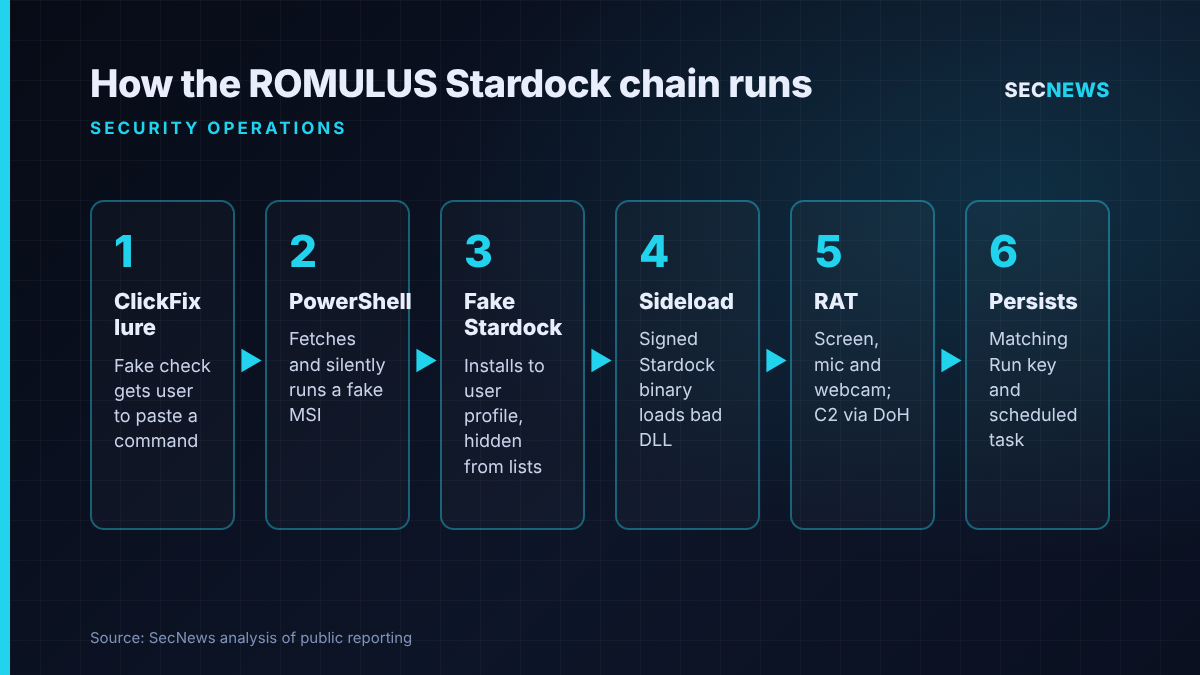
The chain Blackpoint unpicked starts with the usual ClickFix trick. The pasted command runs an obfuscated PowerShell stager that downloads an installer named IconEdit2Turb.msi from an address written in decimal IP notation, removes the Mark of the Web and runs the package silently through msiexec.
The MSI poses as the Stardock Smart DeElevation Tool. It installs under the user’s LocalAppData folder, so no administrator rights are needed, and sets a property that hides it from the installed programs list. It then launches the genuine, signed DeElevate64.exe. The attackers have altered that executable’s companion library so it pulls in a malicious DLL, I++u.dll, inside the trusted Stardock process. That loader decrypts roughly 341 KB of shellcode concealed in a NuGet-style package file, runs it in memory through a Windows callback function and unpacks a proprietary archive holding a small controller script and the final trojan.
Once running, CNCMachineRMS gives the operator remote desktop control, live screen streaming, microphone and webcam capture, file management, host reconnaissance and the ability to fetch more payloads on demand. It resolves its command server over DNS over HTTPS, which sidesteps the corporate resolver and any DNS filtering applied there. Persistence comes in a matched pair: a Run key and a scheduled task, both called “Stardock DeElevation Tool”, which the controller checks and rebuilds on a short timer. Blackpoint saw no hands-on activity after infection, but LevelBlue’s earlier work found the same family carrying commands to add local accounts to privileged groups, so a hit should be treated as a live intrusion.
Why it matters for UK organisations
ClickFix is now a mainstream initial access route, and it is not confined to overseas targets. In its round-up of parallel campaigns, The Hacker News lists fake Cloudflare checks on a lookalike domain impersonating UK retailer Howdens, one of several spoofed sites used to deliver CrashHandler RAT and other remote access malware. Lures that borrow a familiar British brand will land well with staff here.
The technique also undermines two assumptions many UK SOCs still lean on. First, that a user without local admin cannot install anything meaningful: this chain lives entirely in the user profile. Second, that a signed, reputable binary is safe to ignore: the malicious code runs inside one. Add DNS over HTTPS for command traffic and the network team’s DNS logs may show nothing at all.
Expert view
In my experience, the interesting thing about ClickFix is that it moves the exploit from the software to the person. There is no vulnerability to patch here. The user is asked, politely, to run the attacker’s code, and they do. That is why I would not spend much SOC time chasing this week’s filenames. ROMULUS has already rotated from a Siemens wrapper to a Stardock one in a month, and Blackpoint lists several other fake installers. Hash and filename indicators will age quickly.
The behaviour, by contrast, is stubborn. Blackpoint makes the point that the underlying malware architecture is a steadier way to cluster activity than the loaders wrapped around it, and I agree. When we test detection coverage, the gaps we find most often are in parent-child process logic and in DLL load monitoring, not in signature feeds. A browser or explorer.exe spawning PowerShell that then calls msiexec against a freshly downloaded package is rarely legitimate. A signed vendor executable running from a user’s AppData folder and loading an unsigned library next to it is rarer still. Those are the rules worth writing and tuning.
I would not read too much into the Custom GPT angle either. It is a signpost to a malicious page, not an AI attack.
What to do now
- Hunt for the process chain. Query EDR for PowerShell launched from Explorer or a browser that then starts msiexec with quiet flags, especially against files in temp or download paths. Flag downloads from URLs that use decimal IP addresses.
- Watch signed binaries in odd places. Alert on signed executables running from LocalAppData that load unsigned or recently written DLLs from the same folder. Search for the “Stardock Smart DeElevation Tool” install path and for paired Run keys and scheduled tasks sharing a name.
- Close the DNS blind spot. Block or proxy DNS over HTTPS at the egress, and investigate any non-browser process talking to public DoH resolvers.
- Restrict what users can run. Use application allowlisting (WDAC or AppLocker) to block execution and MSI installs from user-writable paths. This maps directly to the Cyber Essentials malware protection and secure configuration controls.
- Limit the Run box and scripting. Where the business allows it, restrict PowerShell for standard users, enable script block logging and consider disabling the Run dialog through Group Policy.
- Brief your staff. Tell users plainly that no genuine website will ask them to paste a command to prove they are human. Include brand impersonation examples relevant to your sector.
- Load current indicators. Import Blackpoint’s published hashes, domains and IP addresses into your SIEM for a retrospective search, while accepting they will date quickly.
Bottom line
ROMULUS has swapped its disguise and its payload now has a name, but the trick underneath is the same: persuade a user to launch the chain, then hide inside something signed. Organisations that detect the behaviour rather than the branding will catch the next variant too. Those relying on reputation and signatures will be a month behind every time.