Ruby’s maintainers have shipped emergency releases fixing seven memory-safety bugs, led by a case-conversion heap overflow nicknamed Ruby2Shell (CVE-2026-132825). The researchers who named it plan to publish a Rails exploit on 25 November, so UK teams running Ruby services, GitLab or GitHub Enterprise Server have a short window to patch.
What happened
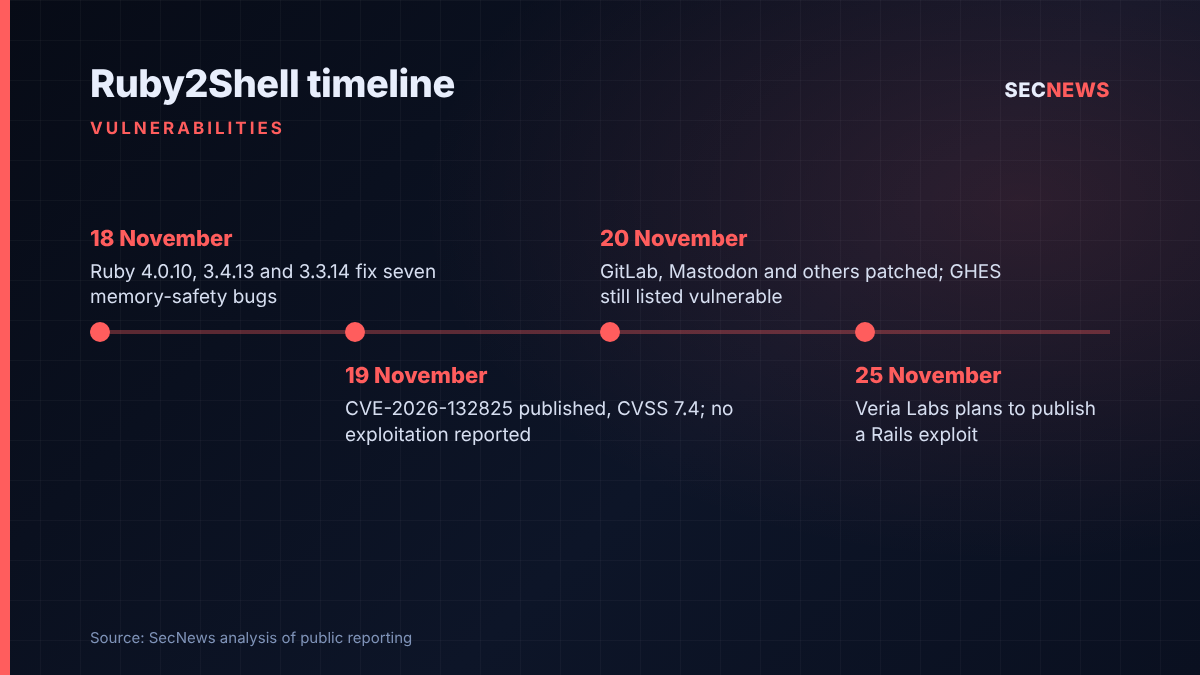
On 18 November 2026 the Ruby core team released Ruby 4.0.10, 3.4.13 and 3.3.14. The accompanying advisory covers seven flaws in two areas of the interpreter: the regular expression engine and the code that changes the case of strings. The team states that it knows of proof-of-concept code showing several of the bugs can be turned into remote code execution, and it “strongly recommend[s] upgrading”. Ruby 3.2 and every older branch are end of life and will receive no fix.
When the advisory went out, CVE numbers had been requested but not issued, so the bugs were listed under GitHub Security Advisory identifiers. MITRE published the record for the headline bug, CVE-2026-132825 (GHSA-34m4-m9fh-gqp5), on 19 November; it carries a CVSS 3.1 score of 7.4. Veria Labs, which says it independently found the flaw and was first to show code execution, has branded it Ruby2Shell. Ruby’s own credits for the same advisory name Stephan Lipp of Ada Logics and Anthropic.
As of 19 November, watchTowr’s tracker recorded no exploitation in the wild, and the flaw does not appear in CISA’s Known Exploited Vulnerabilities catalogue. Veria Labs has, however, said it will publish a proof of concept against stock Rails on 25 November, with a delay if big vendors are still unpatched by that date.
The technical picture
Most of Ruby’s legacy single-byte encodings (Windows-1252 and ISO-8859-1 among them) have no capital form of the German sharp s (ß), so uppercasing it produces two characters, “SS”. According to Veria Labs’ write-up, the conversion loop only checks that there is room for one byte before writing both. The output buffer is sized at the input length plus a small fixed margin, so a long enough run of ß characters pushes a single byte past the end of the heap allocation. That stray byte is always an “S” or “s”, and the attacker controls the buffer size through the length of the input.
The vulnerable path is reached through ordinary methods such as upcase, swapcase, casecmp? and case-folding downcase. Strings in UTF-8, Ruby’s default, take a different code path and are unaffected. Veria Labs says the defect dates back to Ruby 2.4.0.
Where the researchers differ in emphasis is on how exploitable the bug really is. Veria Labs claims that Rails and classic-style Sinatra applications expose the bug to unauthenticated requests in their default configuration, while plain Rack and other frameworks are not exposed unless application code itself upcases legacy-encoded input. watchTowr’s FAQ also lists default Rails and classic Sinatra as affected, and states the general condition: an application must handle attacker-supplied text in a single-byte encoding and then change its case. Speaking to SecurityWeek, watchTowr’s Yordan Ganchev said reliable exploitation would depend on heap layout, allocator choice and application preconditions, and described the full route to code execution as “a complete odyssey”. In his view, the most likely outcome of malformed requests is denial of service and service disruption.
The other six bugs include a double free and an integer-driven heap overflow in regex compilation, a further integer overflow in case conversion and a heap overflow in Regexp#to_s. Most of the regex issues matter mainly where an application compiles user-supplied patterns.
Why it matters for UK organisations
Ruby rarely appears on board-level risk registers, yet it underpins a lot of UK infrastructure: Rails-based e-commerce and SaaS products, internal tooling and, above all, self-hosted developer platforms. GitLab and GitHub Enterprise Server are common in UK financial services, government suppliers and software houses precisely because they keep source code on premises. These products bundle their own Ruby, so upgrading the operating system’s Ruby package does nothing for them.
Veria Labs’ tracker, last updated on 20 November, lists GitLab (19.6.1, 19.5.8 and 19.4.10), Chatwoot 4.20.1, Mastodon 4.7.6 and older supported branches, OpenProject 17.9.8 and 17.8.3, and a fresh Discourse base image as patched. GitHub Enterprise Server, up to and including 3.22.5, is still marked vulnerable with no fixed release. Given the source code and CI secrets behind a typical GHES instance, that is the gap I would watch most closely.
The end-of-life point is also significant. In my experience, Ruby 2.x and 3.0 to 3.2 interpreters linger in container base images and forgotten virtual machines long after the application team has moved on. None of those will be fixed, and the flaw reaches back to 2.4.0.
Expert view
Both camps are probably right about different things. watchTowr’s scepticism about turning a one-byte overflow with a fixed value into reliable remote code execution across the internet is well founded: heap grooming against a busy production process is hard, and modern mitigations such as ASLR raise the bar further. But if a working exploit for default Rails is published as planned, the economics change. Once a chain is public, the hard engineering has been done once for everyone, and opportunistic scanning usually follows within days.
Even the conservative reading justifies action. A remote crash in a customer-facing Rails service is an availability incident, and if your application really does process Latin-1 or Windows-1252 text, as many legacy integrations, CSV importers and older European-language systems do, you are inside the stated preconditions.
When we test Ruby estates, the recurring weakness is not the framework but the inventory. Teams know their Gemfile.lock intimately and have no idea which interpreter build is baked into the image their workers run. This bug sits in the interpreter, so dependency scanners that only read lock files may report clean while the runtime remains exposed.
What to do now
- Find every Ruby runtime. Check web servers, Sidekiq or similar background workers, scheduled jobs and container images, not just application repositories. This supports the Cyber Essentials requirement to know your software estate.
- Upgrade the interpreter to 4.0.10, 3.4.13 or 3.3.14, then rebuild images and restart processes. Updating gems alone will not fix this (Cyber Essentials security update management).
- Patch bundled products. Apply GitLab 19.6.1, 19.5.8 or 19.4.10 and the vendor fixes for Mastodon, Chatwoot, OpenProject and Discourse. Track GitHub’s advisories for a GHES release and, until it lands, make sure the appliance is not reachable from the internet.
- Retire Ruby 3.2 and older. There will be no fix; isolate these systems and plan migration as a priority.
- Review code paths that change the case of external input held in single-byte encodings, especially import routines and legacy integrations.
- Prepare to detect. Watch for crash loops and unusual worker restarts in Rails services from 25 November, when Veria Labs plans to publish its exploit.
Bottom line
Ruby2Shell is not yet being exploited, and there is genuine expert doubt about how easily it can be weaponised. That is precisely why it is worth patching now, calmly, rather than next week under pressure. The fix is routine; the hard part is finding every place Ruby runs, including inside appliances you did not build. Treat GitHub Enterprise Server as the open question until GitHub ships a release.