Teleport, the identity and infrastructure access vendor, has paused its public bug bounty after concluding that outside reports now mostly repeat what its own AI tooling already found. The money is going to commissioned penetration testing and red teaming instead, and that choice deserves a careful look from UK security teams.
What happened
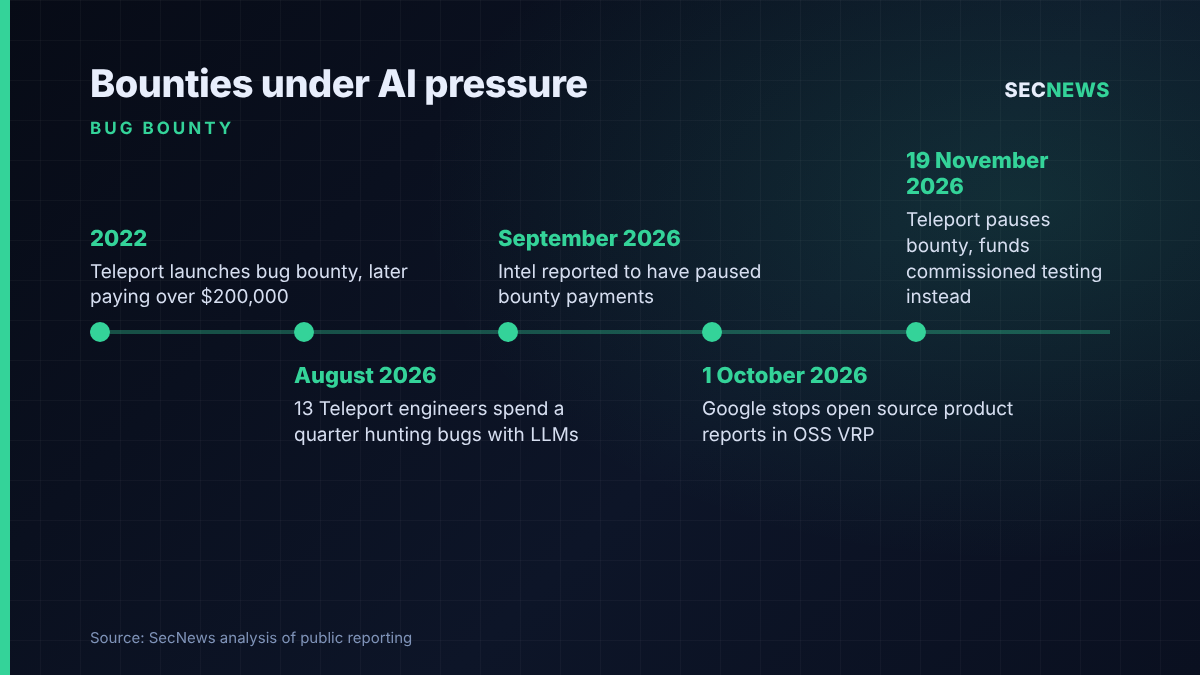
On 19 November 2026 Teleport announced in a short company blog post that it is pausing its bug bounty programme. According to the post, written by Rob Picard, the scheme has run since 2022 and paid researchers more than $200,000 in total.
The reason Teleport gives is blunt. It says the quality of submissions has fallen over the last two years as AI security tools have improved, and that nearly every report it now receives duplicates an issue its internal teams had already surfaced with AI and triaged, frequently as a false positive.
Teleport says it will redirect both the bounty pool and the fees it paid for the bounty platform into more frequent engagements with three specialist firms: Calif, Doyensec and Persistent Security. The post does not name the platform, give a restart date or say whether a no-reward disclosure route stays open, so researchers should check the company’s security policy before sending anything.
At the time of writing I could find no independent press coverage of the pause. Everything above comes from Teleport’s own announcement.
How it works
The pause makes more sense when read alongside an earlier Teleport post from August 2026. In it, the company described giving 13 of its software engineers a full quarter to sweep its codebase with frontier language models and coding agents, an exercise it calls “pressure washing”. Teleport reported finding and fixing dozens of bugs, including almost twice as many high severity issues in that single quarter as it had found across 2024 and 2025 combined.
Two of its lessons matter here. First, elaborate multi-agent harnesses underperformed: they produced so much noise that human triage became the constraint. Simple, targeted prompts pointed at one component at a time, with an expert steering the model, did better. Second, one of the most interesting flaws of the period came from Calif during a parallel red team exercise using the same models. Teleport’s own conclusion was that the models amplify experts rather than replacing them.
Put those together and the logic of the pause is clear. If an in-house team running AI tools has already harvested the shallow and medium-depth bugs, the marginal external report is likely to be either a duplicate or an unverified machine-generated claim. A paid engagement with a known firm buys depth, context and accountability instead of volume.
Teleport is not alone. The curl project closed its bounty earlier this year after a flood of AI-written false positives. TechTarget reported in October that Intel had paused bounty payments while still accepting reports through its vulnerability disclosure programme, and from 1 October Google stopped taking product vulnerability reports through its open source reward programme, citing a surge of mostly invalid automated submissions.
Why it matters for UK organisations
Teleport’s software is used by engineering and platform teams to broker access to servers, Kubernetes clusters, databases and cloud consoles, so it sits on a sensitive path in many estates, including UK ones. Customers do not lose security testing because of this decision, but they do lose one source of independent, public scrutiny. That is worth raising at the next supplier review.
The bigger issue is the UK’s own disclosure landscape. Many British organisations never ran a paid bounty; they rely on a vulnerability disclosure policy, often modelled on the NCSC’s guidance, plus an annual penetration test. If vendors start treating outside research as low value, the remaining good-faith researchers could become less willing to report at all. That pressure lands on a community that still has no settled legal safe harbour. Reporting by The Record in May described the planned Computer Misuse Act defence as narrow, limited to accredited individuals, and covering only a small fraction of the sector.
The organisations most exposed are those that cannot afford in-house AI programmes or frequent red teaming.
Expert view
I have some sympathy with Teleport. When we test mature products, the findings that matter rarely come from automated scanning; they come from someone who understands the trust boundaries and keeps asking awkward questions. A bounty that has turned into a triage queue of duplicates is a poor use of scarce engineering hours, and moving that budget to named testers who know the product is a defensible call.
But I would warn against copying it without the foundations Teleport claims to have. The company backed the decision with a dedicated quarter of internal AI-assisted review and a standing relationship with specialist firms. Most organisations have neither. For them, closing the front door to outside reporters removes a free early warning while the attack side keeps getting faster.
A paid engagement is also bounded in time and scope. A tester works to a statement of work over a few weeks; the wider research community looks at whatever it likes, whenever it likes, including the forgotten subdomain nobody put in scope. In my experience, the reports that embarrass organisations most are the ones about assets they did not know they owned.
The fair criticism of the bounty industry is about triage, not about researchers. Reproducing a claim still takes the same effort it always did, whoever or whatever wrote the report.
What to do now
- Keep a disclosure route open regardless. Publish a security.txt file and a short vulnerability disclosure policy with a monitored contact, a response target and a clear statement that good-faith reporters will not face legal action from you.
- Raise the bar for reports, not the drawbridge. Ask for reproducible steps, affected versions and evidence of impact. Reject untested claims quickly with a standard response.
- Run your own AI-assisted review on critical code. Start small, one component at a time, with an experienced engineer steering, as Teleport describes. Feed confirmed findings into normal patching.
- Buy depth where it counts. Commission testing of your identity, remote access and privileged access paths, using CHECK or CREST-accredited providers where appropriate, and ask testers to cover AI-related attack paths.
- Ask suppliers the question. For access and identity products such as Teleport, ask how the vendor now receives outside reports and how often it is independently tested.
- Do not neglect the basics. Cyber Essentials controls on secure configuration, security update management and user access control still close most of the doors that disclosed bugs point to.
Bottom line
Teleport’s pause is a signal that AI is changing what a bug bounty is worth to a vendor that already scans itself hard. It is not proof that crowdsourced research is finished. UK organisations should tighten triage and invest in expert testing, but keep a welcoming, legally safe route for outsiders, because the bug nobody internal thought to look for still tends to arrive from outside.
Sources
- Teleport: We Are Pausing the Teleport Bug Bounty Program
- Teleport: We Had 13 Engineers Spend Three Months Finding Vulnerabilities with LLMs
- TechTarget: Bug bounty reckoning: AI slop forces enterprise strategy shift
- Help Net Security: AI slop submissions force Google to freeze its open-source bug bounty
- The Record: UK plans for cybercrime law reform would protect almost no one, experts warn