Star Blizzard broke into one organisation’s Google Workspace tenant, harvested its staff directory and relationships, then appears to have posed as one of its employees to compromise another organisation in the same professional circle months later. The case shows why a single cloud account takeover can quietly become a supply chain of trust for an espionage crew.
What happened
A newly published incident case study describes how Star Blizzard turned one cloud breach into the starting point for the next. Late in 2025 the group took over a Super Admin account in a US organisation’s Google Workspace tenant. It stayed for months, took the company’s cloud storage and exported the full employee list. Once evicted, it did not move on. Google assesses that it likely used what it had learned about the victim’s people and contacts to go after a second US organisation in 2026.
The second break-in started with a message on an encrypted chat app from someone who appeared to work at the first victim. The lure was a document supposedly describing a technical problem. The link led to a credential and token phishing page, and the attackers walked away with a bulk download of the targeted user’s cloud drive.
The write-up comes from Google’s Mandiant incident responders and the Google Threat Intelligence Group (GTIG), published on 17 November 2026. They track the actor as COLD RELIC, formerly COLDRIVER and UNC4057, a cluster also known as Callisto and Gossamer Bear. GTIG says it has seen new phishing by the group as recently as this month, so this is a live operation rather than a historical curiosity.
The technical picture
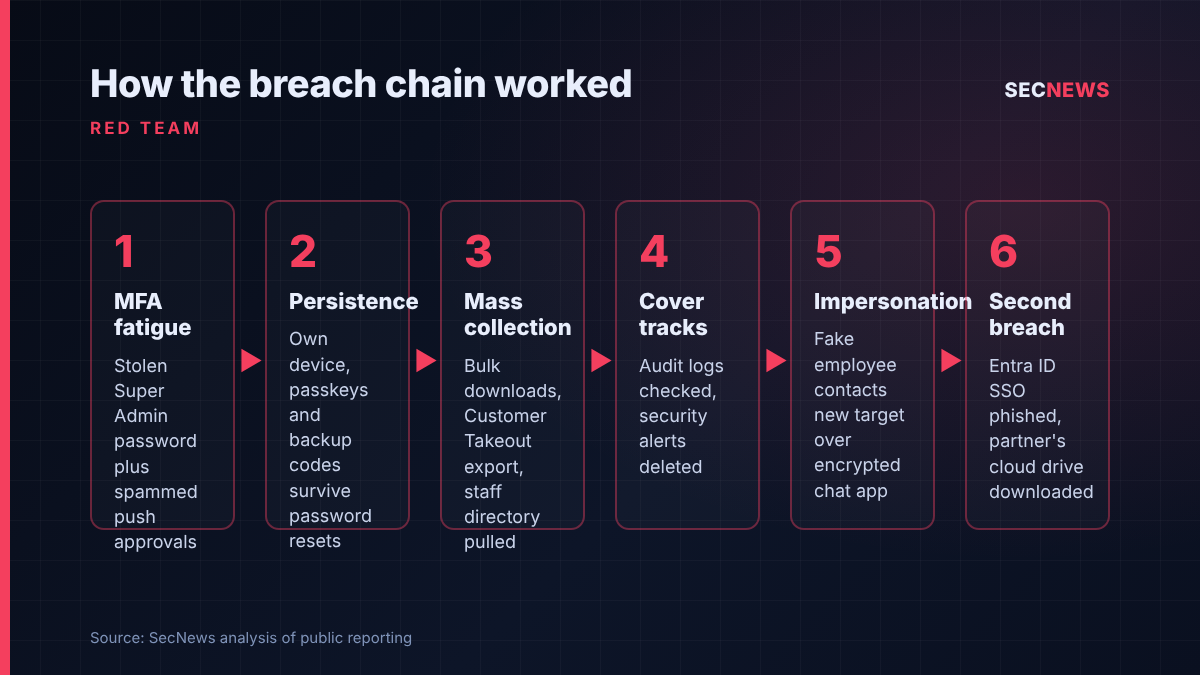
Very little in this intrusion involves malware. It is an identity operation from start to finish, and each stage abuses a legitimate administrative feature.
Initial access. The attackers held valid credentials for a Super Admin account and got past multi-factor authentication by spamming push approvals until the user accepted one. They signed in through residential proxies chosen to geolocate close to the victim, which defeats the impossible-travel style of alerting many teams still lean on.
Persistence. Once inside, they enrolled their own device, added passkeys and generated MFA backup codes. According to the case study, those attacker-enrolled passkeys kept working after password and session resets. In at least one case a victim spotted the intrusion and reset passwords, but did not revoke live sessions, so the attackers simply carried on.
Collection. With tenant-wide privileges they mass-shared files to an account they controlled, downloaded drive content directly and kicked off a Customer Takeout export, the organisation-level version of Google Takeout that can lift data across an entire domain. They also synced mailboxes to outside email clients via OAuth grants.
Defence evasion. This is the part that should worry any blue team. The operators queried the admin audit and investigation logs to see what defenders could see, then edited and deleted the security alerts that recorded their own entry. That is counter-forensics carried out inside the victim’s own admin console.
The pivot. At the second target, Microsoft Entra ID acted as the single sign-on provider for Google Workspace. Phishing the Entra ID account was therefore enough to reach the user’s cloud drive, and the attackers registered a fresh MFA device in the SSO platform to keep their foothold. One clue tying the cases together was a phishing redirector, uploaded to VirusTotal in June 2026, with a query parameter referencing the first victim organisation. After the second compromise, the messaging account behind the approach was renamed to a new persona, which GTIG suspects was being lined up for further targets in the same professional circle.
Why it matters for UK organisations
This is not a far-off American problem. In December 2023 the UK government publicly named Star Blizzard as the group behind years of attempts to interfere in British politics. The NCSC judged it almost certainly subordinate to Centre 18 of the FSB, the Russian security service. The government statement listed spear-phishing of parliamentarians from several parties since at least 2015, the hack and leak of UK-US trade documents before the 2019 general election, and the compromise of the Institute for Statecraft think tank. It also named universities, journalists, the public sector and NGOs as targets. Two members were sanctioned at the time.
The new case study shows the same group getting better at exploiting trust between organisations. For UK think tanks, defence suppliers, law firms, academic departments and charities that sit in tight professional networks with government, the risk is no longer limited to their own staff being phished. A partner’s breach can hand an attacker your names, your email threads and enough context to make a message from a “colleague” completely convincing.
Expert view
When we run identity-focused red team exercises, push-based MFA is still one of the softest controls we meet, and backup codes and passkey enrolment are rarely monitored at all. What stands out here is how disciplined the operators were: choosing nearby residential exit points, checking the audit trail before acting and deleting the alerts that named them. That is exactly how a good red team behaves, and it is a useful benchmark for testing your own detection.
The lesson I would draw for incident responders is blunt. A password reset is not containment. If your account compromise runbook does not revoke sessions, refresh tokens, OAuth grants, passkeys, backup codes and registered devices in both the identity provider and the SaaS platform, you are probably leaving the door open. In my experience many organisations only test the first of those steps.
What to do now
- Remove push approval for privileged accounts. Move Super Admins and Global Administrators to FIDO2 hardware security keys. This supports the user access control requirements in Cyber Essentials.
- Control new authenticators. Require out-of-band or admin approval before new MFA devices or passkeys are registered, and alert on every passkey and device enrolment, backup code use and admin role change.
- Watch for tenant-wide exports. Alert on Customer Takeout creation, user list downloads, bulk Drive downloads and sudden spikes in external sharing.
- Protect the alerting itself. Treat deleted security alerts, or unexpected audit log queries, as high severity.
- Fix your containment runbook. Revoke sessions, tokens, OAuth apps, passkeys and devices across Google Workspace and Entra ID, not just passwords. Rehearse it.
- Review OAuth grants. Look for mail clients such as Thunderbird or external mail services holding broad mailbox scopes.
- Tackle residential proxies. Enrich sign-in logs with proxy and VPN reputation data, and restrict admin logons from consumer ISP ranges.
- Brief high-risk staff. Tell people in policy, research and partner-facing roles to verify unexpected document shares, especially over messaging apps, through a separate channel. Consider Google’s Advanced Protection Program for the most exposed individuals.
Bottom line
Star Blizzard has shown it can treat one victim’s cloud tenant as a map of whom to target next. For UK organisations that work closely with government, the security of a partner’s Google Workspace or Microsoft 365 tenant is now part of their own attack surface. Phishing-resistant MFA for admins, tight control over new authenticators and a containment process that genuinely evicts the attacker are the controls that would have broken this chain.
Sources
- Google Cloud: COLD RELIC, a case study in impersonation and compromise
- The Hacker News: Russian COLD RELIC hackers use stolen Google Workspace data to breach second US organisation
- CyberPress: Russian hackers hijack Google Workspace accounts to steal data and target other companies
- GOV.UK: UK exposes attempted Russian cyber interference in politics and democratic processes