Compliance automation vendor Vanta has agreed to buy Pillar Security, a small Israeli firm that tests and polices AI agents, in a deal Calcalist values at about $150m. For UK organisations already using Vanta to manage ISO 27001 or SOC 2 evidence, it signals that AI agent controls are about to land inside the GRC platform, with a bill attached from January 2027.
What happened
On 9 November 2026 Vanta announced a binding deal to take over Pillar Security, which sells runtime protection for AI applications and agents. Neither company has published a price or a closing date. Israeli business title Calcalist, which first reported the price, puts the deal at roughly $150m in a mix of cash and shares, and Vanta and Pillar have not confirmed that figure.
Ziv Karliner and Dor Sarig founded Pillar in 2023. According to Calcalist it has raised around $9m, including a seed round led by Shield Capital in April 2025, and employs a little over 20 people. Those staff are expected to become Vanta’s research and development centre in Israel, with both founders staying on to run the AI security business.
The buyer is considerably larger. Vanta says it now has more than 20,000 customers, compared with 16,000 in the first quarter of this year, and in April it reported passing $300m in annual recurring revenue. Vanta has run its EMEA operation from a London headquarters in Fitzrovia since September 2025, a sign of how much the UK market matters to it.
The detail
Vanta’s pitch is that compliance tooling, built around periodic reviews and policy documents, cannot keep up with software agents that take actions on their own. Chief executive Christina Cacioppo said, in comments reported by Calcalist, that customers, regulators and auditors want proof that AI “does what it says on the tin”. Pillar is the part of the platform meant to supply that proof.
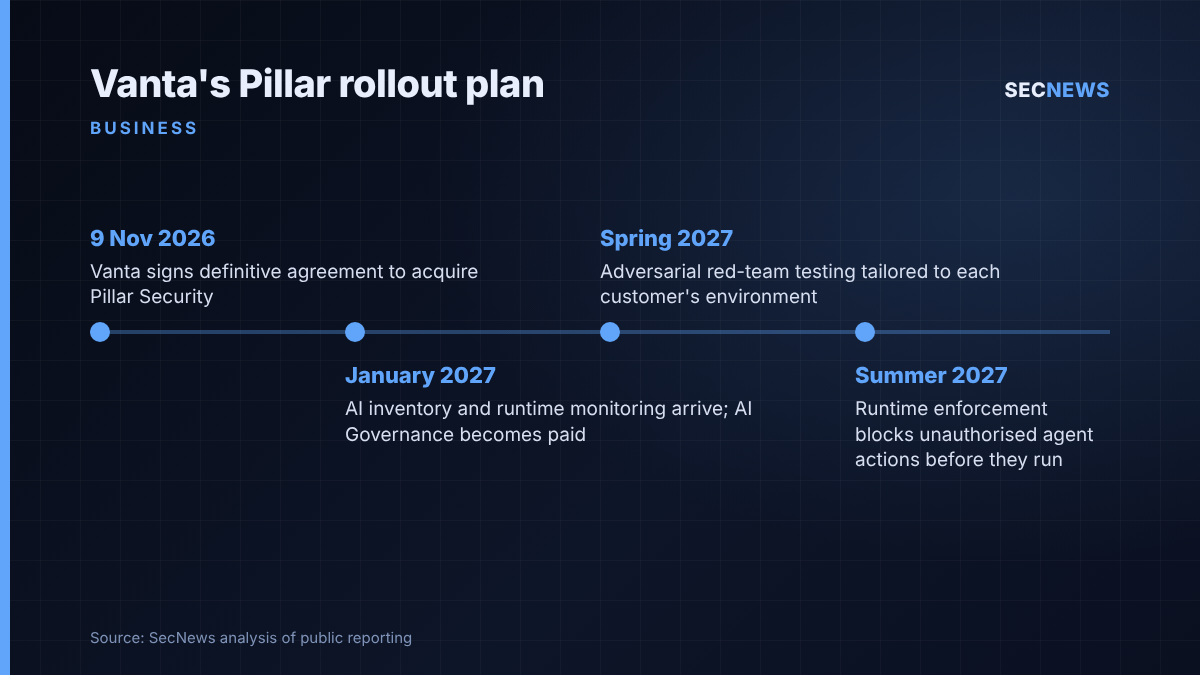
Vanta has published a staged plan for folding Pillar’s technology into its product during 2027:
- January 2027: an AI inventory that finds agents, models, apps and Model Context Protocol (MCP) servers, linking each to an owner, approved use, data access and vendor; plus runtime monitoring that flags suspicious behaviour and guardrail breaches.
- Spring 2027: adversarial red-team testing tailored to each customer’s environment.
- Summer 2027: runtime enforcement that stops an agent before it carries out an unauthorised action, then records an audit trail.
The commercial point is in the small print. Vanta says its AI Governance product, launched into early access in July, becomes a paid offering in January 2027. That is the same month inventory and detection arrive, and roughly six months before blocking does. As The Daily Brief points out, anyone signing in January is buying visibility and evidence, with enforcement still on the roadmap.
Pillar also brings a research team. Its staff have reported flaws in AI tools, including Google’s Gemini CLI and the n8n automation platform, and they maintain SAIL, a framework for securing AI agents that Pillar says maps 91 risks across seven lifecycle stages and aligns with ISO, NIST and OWASP guidance.
Why it matters for UK organisations
For UK buyers, the deal is part of a convergence that has been building all year. GRC platforms are moving from recording controls to operating them, while security vendors are pushing into AI governance from the other side. The result is that the tool your compliance team uses for audit evidence may soon also sit in the request path of your production AI agents.
That matters for three reasons. First, procurement: AI controls are likely to become a priced tier on a platform many UK scale-ups and SaaS firms already depend on for customer assurance, so budget conversations need to happen before January rather than after. Second, accountability: if a guardrail blocks an agent partway through a business process, someone has to own that decision, and that is an operational role, not a compliance one. Third, regulation: UK firms selling into Europe face the EU AI Act, and according to The Daily Brief, Vanta’s July launch aligned its impact assessments with ISO/IEC 42001 and that Act. Being able to produce evidence of how agents actually behaved, not just what the policy says, is where auditors are heading.
There is also a supply chain angle. Pillar sells cloud, self-hosted and hybrid deployments, whereas Vanta is a SaaS platform. Neither company has said what happens to Pillar’s standalone product or existing contracts. Any UK organisation already running Pillar guardrails in its own environment should treat this as a change-of-control event.
Expert view
In my experience, the first finding on almost any AI-related engagement is that nobody has a complete list of what is running. Pillar’s own example, reported by Refresh Miami, of a Fortune 300 company with 400 AI systems its security team did not know about, will sound familiar to anyone who has scoped a test recently. An inventory that maps agents and MCP servers to owners and data access is genuinely useful, and arguably more valuable in the short term than enforcement.
I would be more cautious about enforcement. What counts for an inline control is how often it wrongly blocks and how much delay it introduces, not how neatly it feeds an audit report. When we test agentic systems, the interesting failures are usually chains of individually permitted actions that add up to something nobody intended, and those are hard to express as a simple policy. A compliance-led product will need to prove it can catch that without breaking legitimate workflows.
Consolidation is not bad news in itself: runtime findings and audit evidence in one place removes manual stitching. But absorbed specialists often lose the deployment flexibility early customers chose them for, so negotiate accordingly.
What to do now
- Build your own AI inventory now. List every agent, model endpoint and MCP server, with an owner and the data each can reach. You need this whichever vendor you choose, and it maps directly to the Cyber Essentials requirements for secure configuration and user access control.
- Apply least privilege to agents. Treat agent identities like service accounts: scoped permissions, no standing admin rights, credentials rotated and logged.
- If you use Vanta, ask your account manager in writing for the January 2027 price, whether early access converts to paid automatically, and whether runtime enforcement is included or sold separately.
- If you use Pillar, request a dated commitment on standalone availability, support, renewal pricing and self-hosted deployments, plus a data export right if the product is withdrawn.
- Decide who owns a blocked agent. Agree between GRC, security engineering and the business who investigates alerts and approves exceptions before any inline control goes live.
- Trial before you commit. Run one real agent through competing tools for a week and measure false positives and added latency.
Bottom line
Vanta’s purchase of Pillar is a modest deal by price, but it shows where the GRC market is going: from documenting AI risk to intervening in it at runtime. UK organisations should welcome better visibility, plan for a new line on the compliance budget, and not pay for blocking capabilities until they actually ship.
Sources
- Vanta: Vanta + Pillar: The System of Runtime Action for AI Governance
- Calcalist (CTech): Vanta to acquire Israeli AI security startup Pillar for $150 million
- Refresh Miami: AI security startup Pillar to be acquired by Vanta
- Channel Insider: Vanta Signs Pillar Security Deal: Inside Its AI Protection Plans
- The Daily Brief: Vanta to Acquire Pillar Security for Reported $150M
- UKTN: Vanta opens new London headquarters