Zurich Insurance Group has almost doubled the capital benefit it expects from buying Beazley, the London specialty insurer that helped build the modern cyber insurance market. The Swiss group now says cyber is one of the two lines where the combined business fits best, which matters for UK firms that buy cover and the brokers who place it.
What happened
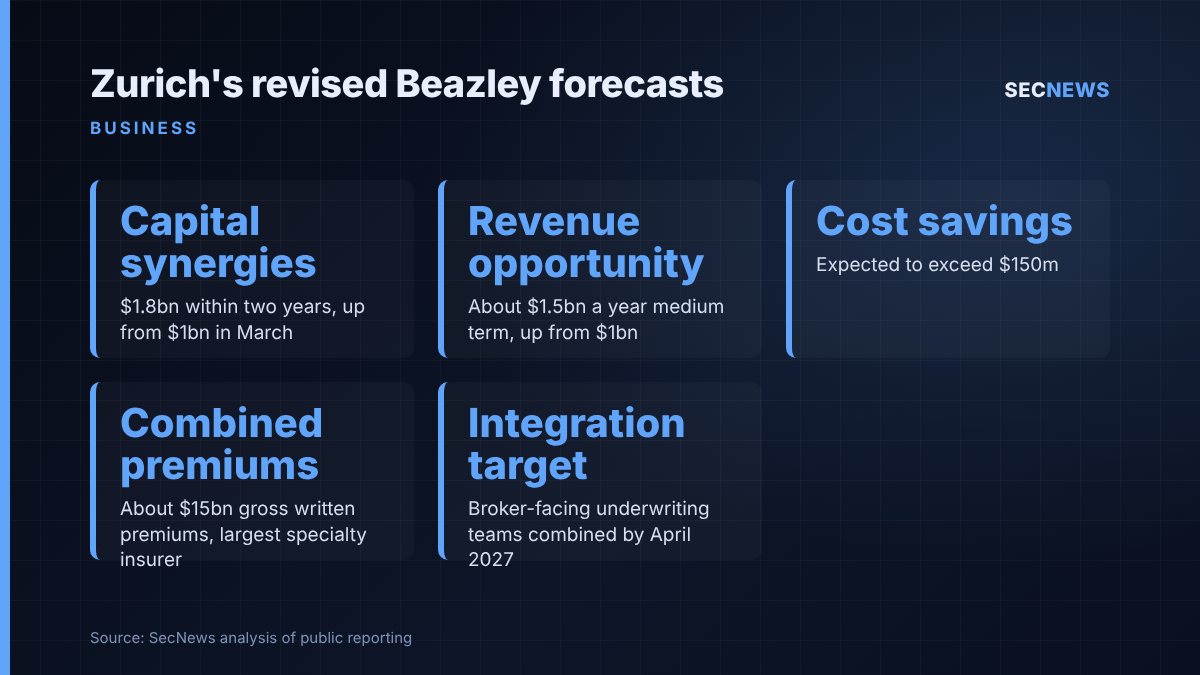
At its Investor Day on 17 November 2026, Zurich revised its forecasts for the Beazley acquisition, which completed on 1 October. The group now expects capital synergies of $1.8bn (about £1.37bn) within the first two years. Its estimate in March was $1bn. It has also raised the medium-term revenue opportunity from roughly $1bn to about $1.5bn a year, and cost savings are expected to exceed $150m.
Several outlets reported that Zurich put the upgrade down to less client overlap between the two businesses than it had assumed before getting inside the deal. Chief executive Mario Greco told Bloomberg News, as carried by Insurance Journal, that the overlap was “very very limited”, and argued that this is not a standard integration. Insurance Business reported that Zurich named cyber and construction as the two lines where the combined capabilities complement each other most clearly. It also pointed to Beazley’s underwriting record, with a combined ratio that has beaten the market over the past three years.
There are leadership changes too. Kristof Terryn, who runs Zurich’s Europe and Middle East business, has been named chief executive of Beazley and Zurich Global Specialty. Adrian Cox, who led Beazley for about five years, is leaving. Integration of the underwriting teams that brokers deal with is targeted for April 2027. Insurance Journal put the takeover at around $11bn. Zurich says the enlarged group will be the world’s largest specialty insurer, writing about $15bn in gross premiums.
The detail
Synergy upgrades rarely make the security press, but this one is relevant because of what Beazley brings. The firm wrote its first standalone cyber policy in 2008 and helped lead the market’s growth. In 2023 it issued the first cyber catastrophe bond, a way of passing systemic cyber risk to capital market investors. By the end of 2025 it had placed $670m of cyber cat bonds and more than $1bn of cyber excess-of-loss cover, according to The Stack. It also runs Beazley Security, a consultancy, and sells cover that packages security services alongside the policy.
In capital terms, a larger capital synergy figure means the combined balance sheet is expected to support more risk for the same capital. For a line like cyber, where the fear is a single event hitting thousands of policyholders at once, that headroom matters. It gives the enlarged group more freedom to keep writing cyber business, to retain more of it, or to buy reinsurance and alternative capital more efficiently. Zurich has said its international client network will be the base for the combined cyber offering.
The deal does not make the pressures on cyber underwriting go away. Late last year Cox told investors that the US cyber market was “now unprofitable”, citing a very active claims environment, according to The Stack. He also argued that a much bigger reinsurance market is vital to hedge systemic exposure. Those views now sit inside a group with far more capital behind them.
Why it matters for UK organisations
Beazley is a London-based insurer with deep roots in the UK specialty market, and many UK organisations buy cyber cover through London brokers. When one of its biggest cyber underwriters comes under new ownership and new leadership, buyers should expect change at some point, even if nothing moves at their next renewal.
Three things are worth watching. First, appetite: more capital could mean steadier capacity for UK cyber risks, which is welcome after several years of tightening and loosening. Second, wordings and service: as underwriting teams are folded together ahead of April 2027, policy forms, panel incident response firms and claims processes may be aligned with Zurich’s way of working. Third, concentration: the merged group becomes a bigger share of the market, so a change in its underwriting stance carries more weight for everyone else.
For UK security leaders, the practical point is that insurers price on evidence. Cyber underwriters typically ask detailed questions about controls such as multi-factor authentication, backups and patching. A larger group with more data will be in a stronger position to tell good risks from bad ones, and to price accordingly.
Expert view
In my experience, the insurance proposal form has done more to push basic controls into smaller organisations than many awareness campaigns. When underwriters ask whether remote access is protected by MFA or whether backups are kept offline, finance directors listen, because the answer affects the premium. A well-capitalised underwriter that sees cyber as a core line, rather than a side bet, is likely to keep asking those questions and to ask them more precisely.
There is a risk on the other side. Integration periods create uncertainty, and policyholders sometimes find that the people they built relationships with have moved on. If your incident response plan names a specific breach coach or forensics firm that comes through your insurer’s panel, check that it is still valid after renewal. When we run tabletop exercises, out-of-date insurer contact details are among the most common gaps we find.
It is also worth being realistic. Synergy numbers are investor-facing forecasts, not promises to customers. Zurich is telling shareholders it can do more with the capital it bought. Whether that becomes broader cover or simply better returns will only be clear over the next couple of renewal cycles.
What to do now
- Talk to your broker before renewal. Ask whether your cyber programme includes Beazley or Zurich capacity, and what the integration timetable means for your policy form, limits and panel providers.
- Re-check incident response contacts. Confirm the breach hotline, panel firms and notification steps in your policy still match your incident response plan, and update the plan if they do not.
- Get your control evidence in order. Underwriters will keep asking about MFA, patching, backups and privileged access. These map directly onto Cyber Essentials controls: user access control, security update management, secure configuration and malware protection. Holding the certification, or Cyber Essentials Plus, makes those answers easier to prove.
- Read the systemic and war exclusions. Larger insurers are paying close attention to widespread events. Make sure you understand what your wording says about state-backed attacks and failures at third-party providers.
- Avoid over-reliance on one carrier. For larger programmes, ask your broker how concentrated your tower is with the merged group and whether spreading it out would make sense.
Bottom line
Zurich’s upgraded forecasts show it sees Beazley’s cyber franchise as central to the deal. For UK buyers, a better-capitalised lead underwriter could mean steadier capacity, but integration will bring changes to wordings, panels and people over the coming year. Organisations that can show strong, evidenced controls will be best placed to benefit.
Sources
- Insurance Journal: Zurich Insurance Boosts Revenue, Capital Gain From Beazley Deal
- Insurance Business: Zurich lifts Beazley capital synergy estimate 80% after deal close
- Business Insurance: Zurich Insurance sees greater capital synergies from Beazley takeover
- Insurance Post: Zurich almost doubles Beazley synergy value
- ad-hoc-news: Zurich Insurance stock lifts Beazley capital synergies to $1.8 billion
- The Stack: Zurich eyes evolving cyber market with $10 billion Beazley bid