California’s privacy regulator has fined Hertz $1.55m for ignoring browser-based opt-out signals and for a cookie banner that quietly switched advertising trackers back on. For UK organisations the specific law is Californian, but the failures are the same ones that now carry PECR fines of up to £17.5m here.
What happened
On 17 November 2026 the California Privacy Protection Agency, which now brands itself CalPrivacy, announced that Hertz will pay $1.55m to settle allegations that it broke the California Consumer Privacy Act (CCPA). The Enforcement Division alleged that the rental firm did not process opt-out preference signals such as Global Privacy Control (GPC), did not tell consumers how it handled those signals, and put unnecessary obstacles in the way of people trying to stop the sale or sharing of their data. The order covers the Hertz, Dollar and Thrifty brands.
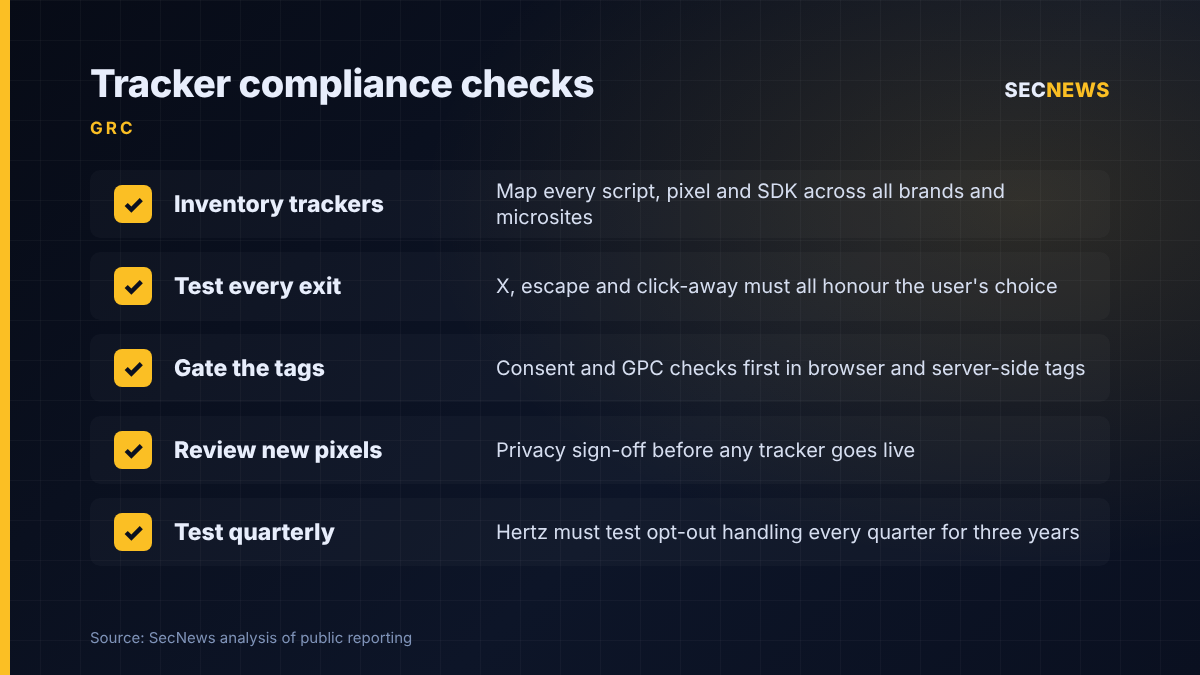
According to The Record, Hertz agreed to the penalty and committed to changing its practices in a court filing. For three years it must keep an inventory of its trackers, review every new tracker before it goes live, test opt-out handling each quarter and publish how many opt-outs reach it through preference signals.
The same day, the agency ordered outdoor clothing maker C.C. Filson Co. to pay $217,987 and to stop device-based selling and sharing of personal information with advertising technology companies within 30 days. The suspension lasts until Filson can show its audits, testing and training meet the required standard.
The technical picture
An opt-out preference signal, most commonly GPC, is an instruction sent by the browser or device telling every site that the user does not want their data sold or shared. Under the CCPA it carries the same weight as a click on a “Do Not Sell or Share” link.
The allegations describe a familiar pattern. Trackers on the Hertz family of websites and apps passed rental search details and identifiers to ad platforms including Meta, Google and TikTok. The signal was not checked before those tags fired. On Dollar.com and Thrifty.com there was a further flaw in the consent tool itself: advertising cookies that a user had switched off were reactivated if the user dismissed the “Manage Cookies” window with the X icon rather than pressing “Save Changes”.
This is not CalPrivacy’s first move against tracking. In February 2026 it fined a sports media and technology company whose platforms are used by schools and youth sports groups $1.10m over cookies, SDKs and opt-out failures, according to Alston & Bird, and in September 2025 California, Colorado and Connecticut regulators announced a joint sweep on GPC compliance. The National Law Review analysis also points out that California’s Opt Me Out Act, which takes effect in January 2027, will require browsers to offer an opt-out preference signal, so the number of signals arriving at websites is likely to rise sharply.
Why it matters for UK organisations
Any UK retailer, travel firm or publisher with Californian customers falls under the CCPA if it meets the Act’s thresholds, and the Hertz case shows the regulator will look at the technical behaviour of a site, not just its privacy policy.
The wider point is closer to home. The UK model is different: under regulation 6 of the Privacy and Electronic Communications Regulations (PECR), non-essential cookies and similar technologies need prior consent rather than an opt-out. The ICO’s April 2026 update on its online tracking strategy was blunt that, until the government changes the rules, “all online advertising purposes still require consent.” A banner that turns tracking back on when the user closes it is a consent failure under PECR just as surely as it is an opt-out failure in California.
What has changed is the price of getting it wrong. Section 115 and Schedule 13 of the Data (Use and Access) Act 2025, which overhaul the Commissioner’s PECR enforcement powers, came into force on 5 February 2026 under the Act’s sixth commencement regulations. As law firms Mishcon de Reya and Bratby Law have set out, the maximum PECR penalty rose from £500,000 to £17.5m or 4% of worldwide annual turnover, whichever is higher, and the old requirement that a cookie breach be serious and likely to cause substantial damage or distress before a fine could be issued has gone.
The ICO says 992 of the UK’s top 1,000 websites passed its most recent checks, and in January 2026 it closed investigations into several data management platforms without further action after they improved their practices.
Expert view
In my experience, privacy compliance and security testing are treated as separate disciplines, and that is exactly how cases like this happen. The privacy team signs off a consent management platform, marketing adds tags through a tag manager, an agency builds a microsite for a promotion, and nobody tests the whole chain from the browser’s point of view. When we assess web estates, we routinely find third-party scripts loading before any consent decision has been made, and sister brands running older templates that never received the fixes applied to the main site.
The X-button detail is the kind of defect that a functional test of the “Save” path will never catch, because nobody writes a test case for the user who simply closes the box. That is a testing gap, not a legal one. It also underlines a point the National Law Review analysis makes well: a consent vendor does not carry your liability. Whatever the platform’s defaults, the organisation whose name is on the site is the one that gets fined.
The three-year remedy is the governance lesson: inventories, pre-launch review and quarterly testing are now being written into orders, and boards should expect to be asked for evidence.
What to do now
- Inventory every tracker. Scan all domains, subdomains, apps and campaign microsites, including secondary brands, and record each script, pixel and SDK with its owner and purpose.
- Test every exit from the consent dialogue. Check the X, the escape key, clicking outside the box and back navigation, and confirm no non-essential tags fire before or after a refusal.
- Put consent and signal checks first in the tag manager. Apply them to server-side tags as well as browser tags, so nothing reaches an ad platform without passing the gate.
- Honour GPC wherever US privacy laws apply. Test in production with the signal enabled and log signal-based opt-outs so you can evidence them.
- Control changes. Require privacy review before any new pixel or SDK goes live, and treat consent platform configuration as part of change management, with a named owner.
- Re-test regularly. Run automated consent and tracker tests at least quarterly, and add them to the scope of web application assessments.
Bottom line
The Hertz order is a Californian penalty under a Californian law, but the failures behind it are universal: trackers no one fully mapped, a consent tool no one tested from the user’s side, and brands left behind when the main site was fixed. With PECR fines in the UK now on a par with UK GDPR, the same mistakes on a British website are no longer a low-cost risk. Treat cookie and tracker behaviour as something you test, not something you assume.
Sources
- The Record: California fines Hertz $1.5 million for breaking state data privacy law
- National Law Review: CalPrivacy enforcement news, Hertz pays $1.55 million for ignoring opt-out signals
- Alston & Bird Privacy Blog: CalPrivacy goes to the board with digital advertising focused enforcement
- legislation.gov.uk: Data (Use and Access) Act 2025 (Commencement No. 6) Regulations 2026
- Mishcon de Reya: Fines for cookie contraventions more likely as a result of law change
- Bratby Law: DUAA in force
- ICO: Online tracking strategy update, April 2026