Attackers are exploiting a critical UnrealIRCd bug that lets ordinary users on linked IRC networks issue commands with the authority of a server. A fix and a no-restart hot-patch have been available since 7 November, so any network still exposed is running on borrowed time.
What happened
The US Cybersecurity and Infrastructure Security Agency (CISA) added CVE-2026-114713, a flaw in the widely deployed UnrealIRCd chat server, to its Known Exploited Vulnerabilities (KEV) catalogue on Friday 13 November 2026. The listing confirms that the bug is being abused in the wild, not merely discussed.
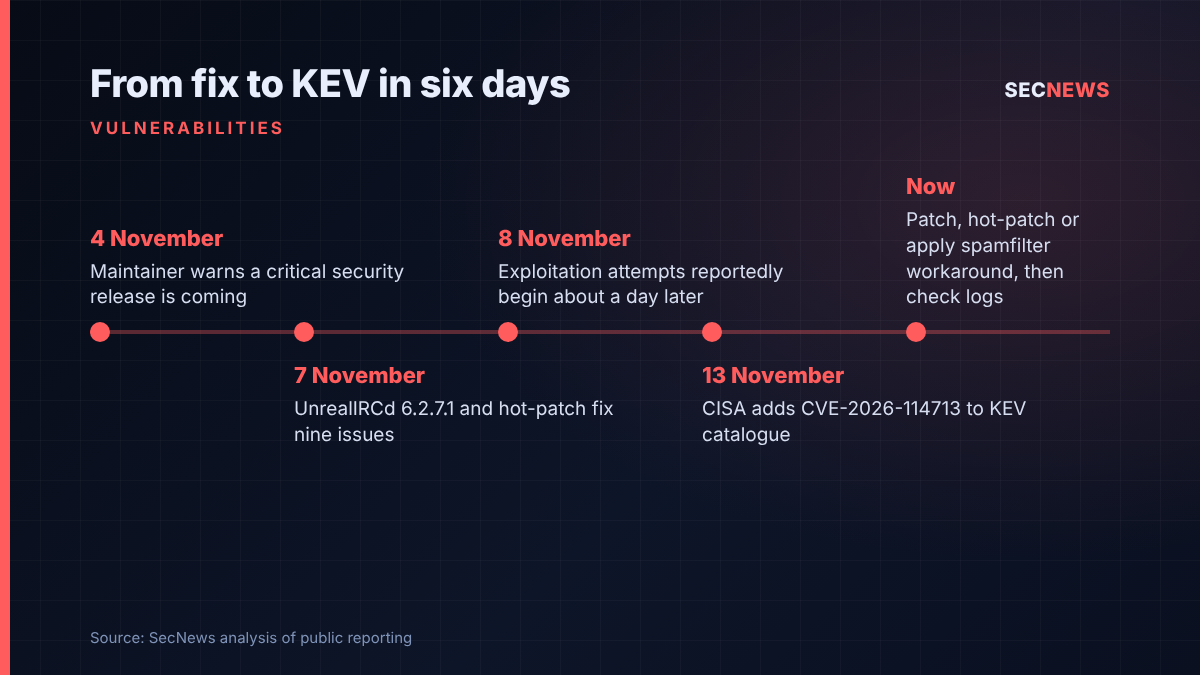
The timeline is short. On 4 November, UnrealIRCd maintainer Bram Matthys, who posts as Syzop, gave administrators advance notice that a security release was coming on Saturday 7 November and that one of its fixes was rated critical. Version 6.2.7.1 duly arrived on 7 November, closing nine security issues in total, with CVE-2026-114713 the most serious. According to The Hacker News, exploitation attempts started roughly a day after that release. Matthys’s advisory calls it the “most critical issue” found in the project in 15 years.
Neither CISA nor the project has said who is behind the activity or what they want.
The technical picture
The vulnerability sits in UnrealIRCd’s labeled-response module, which implements an IRCv3 feature. Labeled responses let a client attach a “label” tag to a command so that it can match the server’s replies to the request that triggered them. It is a convenience for modern clients and bots.
The bug is an escaping failure. The module did not properly neutralise the contents of that label tag before using it in traffic passed between servers. On a single standalone server that matters less, but on a network of two or more linked servers it is serious: a user can smuggle content into the server-to-server link, and the receiving server treats it as if it came from a trusted peer. The project’s own release note describes the result as normal users being able to run commands with server or IRC operator (IRCOp) authority. CVE Brief’s summary of the record goes further and states that no account is needed.
Server-level authority on an IRC network is broad. Linked servers trust one another to manage modes, channels and bans. A forged server command can, in principle, give an outsider the same reach as the network’s own operators. There is a small scoring inconsistency: The Hacker News and Security Affairs list CVSS 8.6 (high), while one CVE Brief section shows 9.5. Whichever figure you use, the vendor calls it critical and the CISA listing settles the urgency.
Versions 6.0.0 to 6.2.7 are affected; the end-of-life UnrealIRCd 5 is also affected. The fix is to upgrade to 6.2.7.1 or later, or to apply the hot-patch bundle (bundle-20261107), which on almost all UnrealIRCd 6 networks loads without restarting the daemon (Windows servers need the full upgrade). Matthys has also published a spamfilter-based workaround, which he advises applying first, though it only protects networks where every server runs 6.0.4 or newer. The 7 November release also notes that several of the fixed bugs were found with AI assistance, which fits the wider rise in AI-found vulnerabilities this autumn.
Why it matters for UK organisations
It would be easy to treat IRC as a museum piece, and for most UK enterprises it will not appear on the asset register at all. That is exactly the problem. In my experience, IRC daemons turn up in places nobody is actively watching: chat infrastructure for open-source projects, hosting providers that offer IRC as a community service, gaming and hobby networks, university societies, and internal operations or bot channels that an engineer set up years ago and nobody has touched since.
Some of those servers sit on infrastructure that also does more important work. A compromised IRC network gives an attacker a trusted voice in channels where developers and administrators talk, where bots take commands, and where links are clicked without much thought. For firms relying on open-source components, a breached project chat network is also a supply chain concern.
The KEV listing has no formal force in the UK. Its patch deadline of 16 November for US federal civilian agencies under BOD 26-04 applies only to those bodies. But KEV is one of the most reliable public signals that a flaw is being used in real attacks, and UK defenders should prioritise their patching with it. The principle is simple: fix what is being exploited first.
Expert view
Three things stand out to me. The first is speed. Exploitation reportedly began about a day after the fix was published. Once a fix is public, the code changes show attackers where to look, and a monthly patch cycle cannot keep up.
The second is the trust model. IRC server links were designed for a world where the servers in a network trust each other completely. Any bug that lets a client’s input cross that boundary unescaped turns an ordinary user into a peer. When we test chat, messaging and federation systems, the most damaging findings usually involve exactly this kind of trust boundary.
The third is the hot-patch model, which deserves credit. The project gave advance notice, shipped a fix on a weekend with a mechanism that avoids downtime, and published a workaround.
I would add one caution. The public details of the attacks are thin. Do not assume that because nothing obvious has happened on your network, nothing has happened. Server-level commands can be used quietly.
What to do now
- Find your IRC servers. Search asset inventories, cloud accounts and external attack surface tools for UnrealIRCd, and listening services on common IRC ports. Include community, lab and legacy hosts. This maps to the Cyber Essentials requirement to know and manage what you run.
- Patch immediately. Upgrade to UnrealIRCd 6.2.7.1 or later, or load the hot-patch bundle if a restart is inconvenient. The maintainer says to patch every server in the network, not just the hubs. Cyber Essentials expects high and critical fixes within 14 days, and an exploited flaw should be done well inside that.
- Treat the workaround as a stopgap. The maintainer advises applying the spamfilter mitigation first, but it does not cover the other eight issues, so still upgrade or hot-patch.
- Review for abuse since 7 November. Check server and operator logs for unexpected server-originated commands, mode changes, new or altered operator privileges, bans or kills you did not issue, and unusual activity on server links.
- Rotate link and operator credentials if you find anything suspicious, and treat bots and services that act on channel commands as potentially exposed.
- Retire what you do not need. If an IRC server has no clear owner or purpose, switch it off. Removing unnecessary services is basic secure configuration under Cyber Essentials.
Bottom line
CVE-2026-114713 is a niche product with a serious bug, now confirmed under attack. The fix has been available since 7 November, it can usually be applied without downtime, and there is a workaround for anyone stuck. The real risk for UK organisations is not the patch but the IRC server nobody remembers running. Find it, fix it or turn it off this week.
Sources
- The Hacker News: Attackers Exploit UnrealIRCd Flaw That Enables Server-Level Command Injection
- UnrealIRCd: Project news, UnrealIRCd 6.2.7.1 released with hot-patch
- CVE Brief: CVE-2026-114713 UnrealIRCd
- oss-security: UnrealIRCd 6.2.7.1 released and hot-patch (CVE-2026-114713)
- CISA: Known Exploited Vulnerabilities Catalog
- Security Affairs: U.S. CISA adds Check Point and UnrealIRCd flaws to its Known Exploited Vulnerabilities catalog
- Senthorus: Cybersecurity Week in Review, 9 to 15 November 2026