A House of Lords committee has told ministers that the UK is badly underprepared for crises that cascade from one sector into the next, with cyber attacks high on the list. It wants a dedicated resilience minister, wider cyber regulation than the Cyber Security and Resilience Bill provides, and a state-backed insurance safety net for catastrophic cyber events.
What happened
On Monday 16 November 2026 the Lords National Resilience Committee, led by crossbench peer Baroness Coussins, published Are we ready? Building a culture of resilience. Its central finding, after a nine-month inquiry, is blunt: UK emergency planning is still organised around single events, such as a storm, a power cut or a cyber incident, rather than the chain reactions that real crises tend to produce.
In the committee’s example, a grid attack stops trains, water pumping and deliveries until shelves empty. Baroness Coussins said “a cyber-attack can quickly morph into a power cut”, which is why peers want joined-up plans rather than a stack of separate strategies.
The timing matters. The Record notes the report arrived eight days before MPs are due to consider the Lords amendments to the Cyber Security and Resilience Bill. The committee accepts that the Bill would set useful baseline requirements, but says its scope is limited and that legislation is lagging behind the risks the inquiry uncovered. It accuses ministers of complacency and calls on them to be far more candid with the public about hostile activity from Russia, China and Iran below the threshold of open conflict, including cyber attacks and threats to undersea cables and pipelines.
A Cabinet Office spokesperson said the government would review the report carefully, citing its Be Ready preparedness campaign launched on 22 October.
The detail
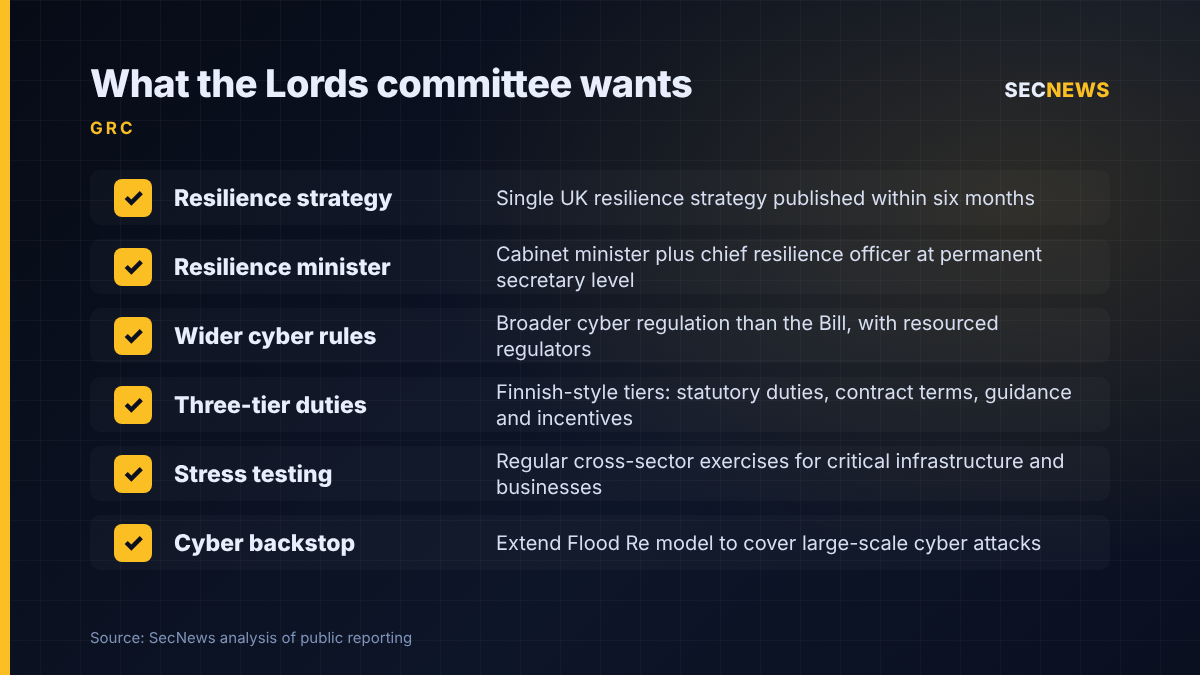
For governance and compliance teams, the most significant recommendations are structural. Peers want one national resilience strategy inside six months, a Cabinet minister with resilience as their sole brief, a permanent secretary-grade chief resilience officer, and a yearly prime ministerial statement to Parliament.
On cyber specifically, peers want cyber regulation extended to more organisations, with regulators given the resources and capacity to enforce it. Onlookers have noted that most of the public sector sits outside the Bill. Evidence to the inquiry was stark. Michael Brunton-Spall, deputy director of cyber services at the Government Cyber Unit, described the government and wider public sector as having “extremely low levels of resilience”. Paddy McGuinness, a former deputy national security adviser, told peers the government’s plans were not adequate to the severity of the threat.
The report also tackles the private sector, which owns more than 80% of critical national infrastructure but, in the committee’s view, sits on the fringes of national planning. According to Insurance Business, peers propose a three-tier model, rather than a blanket duty, drawn from Finland’s security-of-supply approach:
- Tier one: organisations the country cannot do without would face legal duties to plan for disruption and keep running, backed by periodic stress tests.
- Tier two: suppliers bidding for public sector work would find resilience conditions built into the contract.
- Tier three: everyone else, small firms included, would be steered by advice plus carrots: lower premiums and tax breaks for organisations that meet the standard.
Peers also want critical infrastructure tested the way financial regulators stress-test banks and insurers, through recurring exercises that cut across food supply, energy, water and medicines. On insurance, it recommends extending Flood Re beyond its planned 2039 end date and adapting its model to provide better cover for hard-to-insure risks, explicitly including large-scale cyber attacks. Insurance Business reports that ABI members’ cyber claims payouts reached £197m in 2024, a 230% annual rise, and the committee cites a £14.7bn annual cost of cyber attacks to UK organisations.
Why it matters for UK organisations
None of this is binding, and the government has so far promised nothing beyond a review. Insurance Business reports that Angela Eagle, giving evidence as a minister, told peers ministers would rather businesses act voluntarily than face new legal duties. Peers also note that many of their warnings repeat those of a previous Lords committee in December 2021.
Even so, the direction of travel is hard to ignore. The Cyber Security and Resilience Bill would extend the NIS regime to managed service providers, data centres and designated critical suppliers, and the Lords have twice defeated the government on amendments, including a requirement to review the regime. This report adds parliamentary weight to the argument that the Bill is a floor, not a ceiling. If a tiered model of the kind described here were adopted, organisations that supply critical services, or hold government contracts, could find continuity planning and stress testing moving from good practice to a contractual or statutory obligation.
A government-backed backstop for catastrophic cyber losses would help with systemic events the private market struggles to price, but any such scheme would almost certainly come with security conditions attached.
Expert view
The cascading-failure framing is the right one, and it is the part most organisations still get wrong. When we test incident response plans, the cyber playbook and the business continuity plan are often written by different teams, assume different outages and never meet. The ransomware plan assumes power and suppliers are fine; the continuity plan assumes the network is. Real incidents rarely respect that boundary.
I am more sceptical about how quickly any of this lands: statutory duties on private firms and a cyber reinsurance pool are not quick wins. The practical value of the report for most security leaders is as a lens: it tells you what regulators, auditors and insurers are likely to ask about next, namely dependency mapping, tested recovery and evidence that controls actually work.
What to do now
- Map your dependencies end to end. List the suppliers, cloud services and utilities your critical services rely on, including fourth parties where you can, and identify single points of failure.
- Exercise cascading scenarios. Run tabletop exercises in which a cyber incident coincides with loss of power, connectivity or a key supplier, and involve both security and continuity teams.
- Get ahead of the Cyber Security and Resilience Bill. If you are an MSP, data centre operator or likely critical supplier, start gap analysis now against 24-hour initial and 72-hour full incident reporting.
- Prove your basics. Use Cyber Essentials or Cyber Essentials Plus as a baseline, with particular attention to secure configuration, patch management and user access control, which insurers and auditors increasingly expect you to evidence.
- Test recovery, not just backup. Restore critical systems from offline or immutable backups on a schedule and record how long it actually takes.
- Review insurance with your broker. Check how your cyber and business interruption cover responds to supplier failure and widespread outages, and what security conditions apply.
Bottom line
The Lords committee has put into parliamentary language what many security professionals already know: the UK prepares for incidents one at a time, while attackers and accidents do not. The report has no legal force, but with the Cyber Security and Resilience Bill returning to the Commons and pressure building for broader regulation, organisations that start treating resilience as something they must evidence, rather than describe, will be in a far stronger position whatever ministers decide.
Sources
- The Record: British government ‘complacent’ on cyber threats from hostile states, peers warn
- Insurance Business UK: Lords call for Flood Re-style safety net for cyber as they warn UK is unready for cascading crises
- Scottish Legal News: Lords committee warns of UK’s grave unreadiness for emergencies
- DIGIT: Is the UK unprepared for major cyber disruption?
- Precursor Security: Cyber Security and Resilience Bill clears the Lords
- UK Parliament: Are we ready? Building a culture of resilience (House of Lords National Resilience Committee)