The King has formally opened Ribble House in Samlesbury, the permanent home of the UK’s National Cyber Force. For employers across the North West, the more pressing question is what a large, well-funded, security-cleared employer on their doorstep does to the regional talent market.
What happened
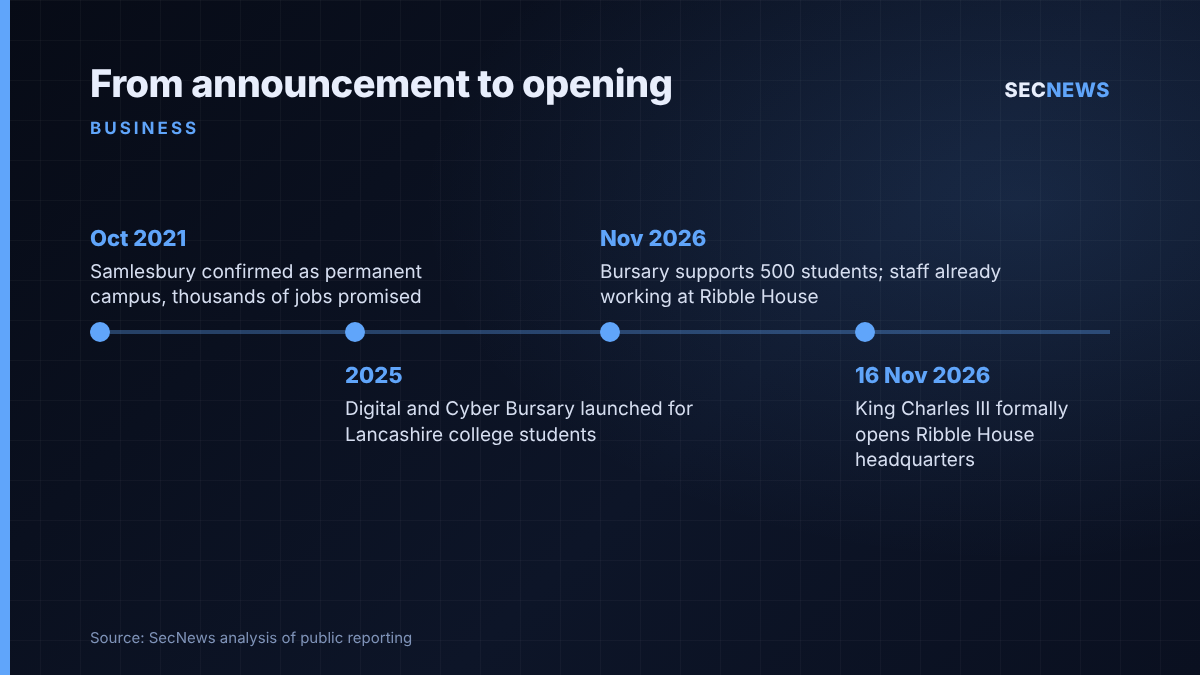
On Monday 16 November 2026, King Charles III officially opened the new headquarters of the National Cyber Force (NCF) at Ribble House, near the village of Samlesbury in Lancashire. The NCF is the joint unit that runs the UK’s offensive cyber operations. Its staff come from GCHQ, MI6, the Ministry of Defence and Dstl, the government’s defence science laboratory. According to The Record, staff are already working in the building, and the government has committed £5 billion to the NCF through to 2030.
The opening completes a decision made five years ago. In October 2021 the then Defence Secretary, Ben Wallace, confirmed Samlesbury as the permanent campus and promised it would bring “thousands of highly skilled jobs and expertise to the North West”. Neither the government nor GCHQ has published a headcount for the site this week, and the NCF does not routinely discuss its work in public.
The official messaging was firmly regional and economic. GCHQ’s announcement framed the building as a driver of regional employment, training and economic growth. Director GCHQ Anne Keast-Butler said the NCF was “perfectly placed to boost the development of the North West Cyber Corridor”. Defence Secretary Wes Streeting, quoted by The Record, called it “a major investment in the North West”. The King also met members of the Lancashire Cyber Partnership, which GCHQ credits with helping to grow the county’s cyber economy.
The detail
The first point is the skills pipeline. According to GCHQ, 500 students at Lancashire colleges are now funded through the Digital and Cyber Bursary, a scheme launched in 2025 to give young people a route into cyber and digital qualifications. That is a deliberate attempt to grow local supply rather than simply poach people from Manchester or London.
The second is the type of people on site. The King met locally recruited staff and people who joined through the Armed Forces Cyber Direct Entry Scheme, a route that takes technically able recruits straight into specialist military cyber posts. The NCF is clearly growing its own talent as well as hiring experienced staff.
The third is the money. The £5 billion figure, reported by The Record as committed through 2030, is a headline number for the force as a whole rather than a construction budget or a regional spending pledge. No breakdown of local supplier spend, contract values or job numbers was published alongside the opening.
The Samlesbury site sits within a wider cluster. In 2021 the government pointed to GCHQ’s existing Manchester office and the region’s fast-growing digital sector as reasons for the choice. The North West Cyber Corridor is the label officials now use for that wider concentration of defence, intelligence and commercial security activity.
Why it matters for UK organisations
For security businesses and in-house teams nearby, the first effect is competition for people. A national security employer offers mission, stability and training that commercial firms find hard to match, and roles requiring developed vetting are scarce enough that candidates who hold clearance can command a premium. Consultancies, managed security providers and banks in Manchester, Preston and Lancaster will increasingly be fishing in the same pond.
That competition cuts both ways. Intelligence and military cyber staff do not stay in government for ever, and a mature cluster tends to produce a steady flow of experienced, cleared people moving into industry. Over time that should deepen the regional pool of senior talent, particularly in threat intelligence, vulnerability research and incident response.
The second effect is on suppliers. A large secure site generates demand well beyond cyber specialists: facilities management, secure construction and fit-out, software engineering, training providers and recruitment. Much of that work will flow through existing defence frameworks and prime contractors, but regional small and medium-sized firms that can meet the security requirements are well placed to pick up subcontracted work.
Third, there is the skills market. The bursary scheme shows that further education colleges in Lancashire are now a recognised part of the national security pipeline. Training providers and employers who partner with those colleges have a chance to shape what is taught and to meet promising students early.
The timing matters too. The Record noted that a House of Lords committee warned on the day of the opening that the UK is not ready for severe risks, hostile state cyber attacks among them. That political pressure is likely to keep public spending on cyber capability flowing.
Expert view
In my experience, the arrival of a major government cyber employer reshapes a local market within a couple of years. The first thing you notice is that good mid-level testers and analysts start receiving more approaches, and salaries in the immediate area drift upwards.
The firms that do well in that environment tend to stop trying to outbid the state and instead offer what it cannot: variety of work, faster progression, client-facing experience and flexibility. They also plan for the return flow. People leaving intelligence or military cyber roles bring discipline, operational experience and often clearance.
I would add a note of caution on the supplier side. Defence supply chains reward patience and paperwork. Firms that assume a new headquarters means quick contracts are usually disappointed; those that invest in their own security posture, build relationships with prime contractors and are ready when frameworks open tend to win the longer-term work.
What to do now
- Review retention before you need to. If you employ security staff in Lancashire or Greater Manchester, look at pay benchmarks, training budgets and career paths now, rather than after your best people are approached.
- Get your own security baseline in order. Any firm hoping to supply defence or government customers should hold Cyber Essentials as a minimum, and ideally Cyber Essentials Plus. That means firewalls, secure configuration, user access control, malware protection and patching, independently verified.
- Prepare for vetting requirements. Work out which roles might need security clearance on government projects and understand the lead times, so clearance does not become the bottleneck when an opportunity appears.
- Engage with the local skills pipeline. Talk to Lancashire colleges and the Lancashire Cyber Partnership about placements, apprenticeships and curriculum input.
- Plan for ex-government hires. Build an onboarding route for people leaving intelligence or military cyber roles, covering commercial consulting skills, client handling and any restrictions they carry.
- Watch the frameworks, not the headlines. Track defence and public sector procurement notices and prime contractor supplier programmes, rather than expecting direct contracts from the NCF itself.
Bottom line
The opening of Ribble House turns a 2021 promise into a working site, and it confirms the North West as the centre of gravity for the UK’s state cyber capability. The money and jobs detail remains thin, so treat bold claims with care. But for security employers and suppliers in the region, the practical implications are already clear: sharper competition for talent, a growing skills pipeline and steady, if slow-moving, supply chain opportunities for firms that prepare properly.