According to new Cybernews research, only 62 of 500 leading AI companies give security researchers a public route for reporting vulnerabilities. For UK organisations feeding staff and customer data into AI tools, that gap matters, and the UK’s own AI security code already says it should not exist.
What happened
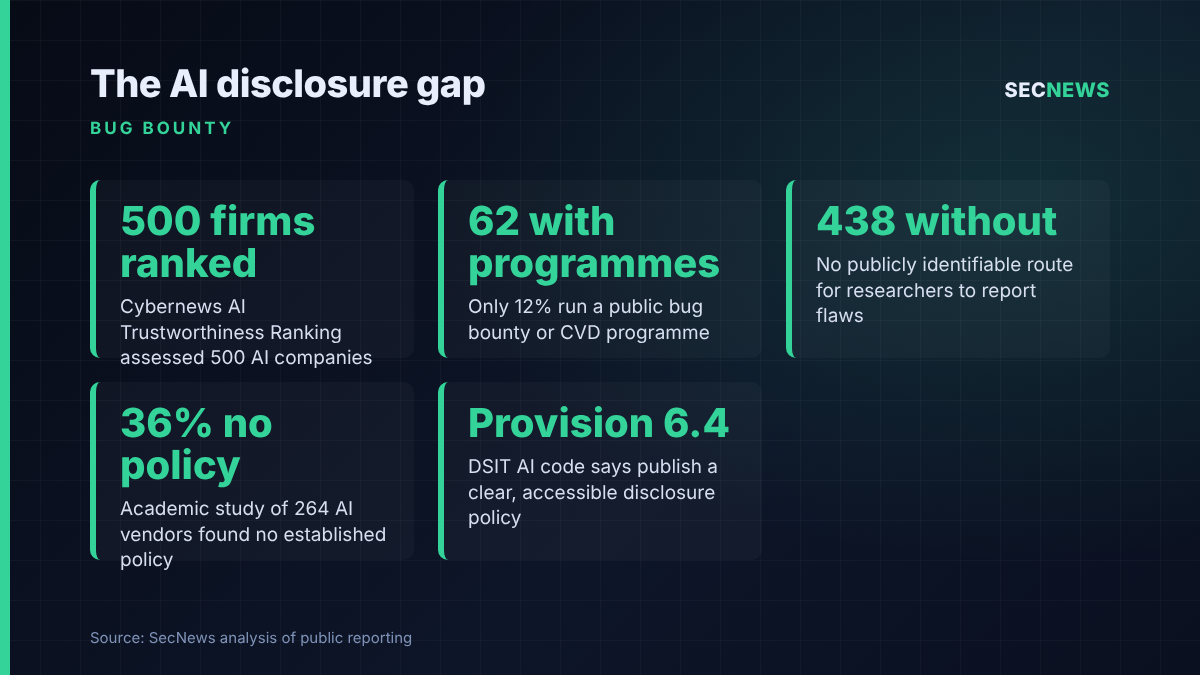
Cybernews has published findings drawn from its AI Trustworthiness Ranking, reported by The IT Nerd on 17 November 2026, which scores 500 AI companies. According to Cybernews, just 12% of them (62 firms) run a bug bounty or coordinated vulnerability disclosure (CVD) programme that anyone can find. The other 438 had nothing that could be identified publicly.
The firms that do have public programmes are mostly the big names: OpenAI, Google, Microsoft, Meta, Anthropic, Mistral AI, Perplexity AI and Hugging Face. Some widely used products are on the other side of the line. Cybernews names Midjourney, ElevenLabs, DeepSeek, Cursor, Runway and Suno among the companies with no publicly identifiable reporting route. The IT Nerd summed it up: most major AI companies still have no visible way for researchers to report flaws.
The timing is pointed. The findings were reported about two weeks after OpenAI raised its own payouts on 2 November. It now offers up to $30,000 for standard critical findings, and up to roughly $172,000 for exceptional ones once bonuses are added. So the top of the market is paying more for bugs, while most of the field gives a researcher with a serious finding nowhere obvious to send it.
The detail
The method matters. As set out when the ranking launched in August, Cybernews works only from public sources. It scores companies on security, data privacy, organisational transparency and public perception. Security makes up a fifth of the overall score, and part of that is simply checking whether a bug bounty exists. That means the study measures what a company publishes, not what it actually does behind the scenes.
That caveat cuts both ways. Some companies counted as “no programme” do take reports privately. Cursor is a good example. In July, SecurityWeek reported that AI security firm Mindgard had struggled for weeks to reach anyone at Cursor about a code execution flaw. Cursor’s CISO eventually invited Mindgard into a HackerOne bounty programme, but the report then sat for months without a fix, and Mindgard went public. A programme that outsiders cannot see gives no help to a researcher who cannot find the door, and in that case it did not produce a fix either.
The Cybernews figure is also broadly in line with academic work. A study by Yangheran Piao, Jingjie Li and Daniel W. Woods, accepted for USENIX Security 2026, looked at the disclosure policies of 264 AI vendors. It found that 36% had no established policy and only 18% mentioned AI-specific risks. Jailbreaks and hallucinations were the issues most often ruled out of scope. The two studies measure different things, but both show an industry that has not settled how outsiders should report AI flaws.
Why it matters for UK organisations
In January 2025, DSIT published its Code of Practice for the Cyber Security of AI, which the government plans to submit to ETSI as the basis for a global baseline standard. Provision 6.4 sits under Principle 6, “Secure your infrastructure”. It says developers and system operators “shall implement and publish a clear and accessible vulnerability disclosure policy”. The code is voluntary, so “shall” marks a requirement for those who choose to follow it, not a legal duty. Even so, it is the clearest statement of what the UK government expects from AI suppliers, and by Cybernews’s count most of the market does not meet it.
The code also says system operators must pass security information and updates on to end users. Under its definitions, a UK business that builds a third-party model into its own service counts as a system operator. If your upstream supplier has no intake channel, flaws may never reach it, and you cannot pass on fixes that never get made.
There is a data protection side too. Staff paste contracts, HR cases and customer records into these tools every day. Under UK GDPR, the controller still has to show it chose processors that provide sufficient guarantees. “The vendor has no way to receive a security report” is a hard thing to defend to the ICO after an incident.
Expert view
When we test an AI-enabled application, the first thing I look for on the vendor side is a security.txt file and a disclosure policy. Neither costs much. A VDP is not the same as a bug bounty. It is a promise to listen, triage and not threaten the person reporting, and the NCSC already gives every organisation a free toolkit for building one. An AI company that has raised millions but cannot publish a contact address and a scope statement is telling you something about its security culture.
I would add two cautions. First, a public programme is a minimum, not proof of security. OpenAI’s own sprint data shows how much triage and fleet-wide deployment still lag behind discovery. Second, AI flaws do not fit neatly into traditional scopes. Prompt injection that leaks another tenant’s data is a real vulnerability, even if the vendor’s policy says model behaviour is out of scope. In my experience, the vendors worth trusting say clearly where they draw that line rather than keeping quiet about it.
For UK researchers, the Computer Misuse Act still has no statutory defence for good-faith research, though ministers have promised reform. Probing a service whose owner has published no rules of engagement carries real legal risk, so the lack of a VDP does not just slow fixes down. It discourages people from looking at all.
What to do now
- List your AI suppliers. Include tools staff adopted without approval. Shadow AI is a supply chain risk, and you cannot assess a vendor you do not know about.
- Check each one for a disclosure route. Look for /.well-known/security.txt, a published VDP or a bounty listing. Record the result in your supplier risk register.
- Write it into contracts. For new or renewing AI suppliers, require a published VDP in line with provision 6.4 of the DSIT code, plus a commitment to tell you about security-relevant updates.
- Limit data exposure where there is no route. Restrict what data flows to vendors without one, and use your data loss prevention controls to enforce it. This maps to the Cyber Essentials secure configuration and access control themes.
- Publish your own VDP. If you ship AI features, use the NCSC Vulnerability Disclosure Toolkit, publish security.txt, and state plainly whether prompt injection and data leakage are in scope.
- Plan for a second-hand report. Decide who triages a researcher’s report about a supplier’s model embedded in your product, and how you will escalate it.
Bottom line
A security contact and a disclosure policy are the cheapest controls in the book, yet according to Cybernews most AI companies have neither on show. UK buyers should treat that as a procurement red flag and use the DSIT code as the yardstick when they ask about it.
Sources
- Cybernews: Only 12% of the top AI companies have a bug bounty program
- The IT Nerd: 88% of top AI companies lack public vulnerability reporting programs
- GOV.UK (DSIT): Code of Practice for the Cyber Security of AI
- DesignRush: Gemini Tops Cybernews AI Trust Ranking of 500 Companies
- arXiv: Exploring AI Vendors’ Bug Bounty and Responsible Disclosure Policies
- SecurityWeek: Unpatched Cursor Vulnerability Exposes Users to Code Execution
- eSecurity Planet: OpenAI Expands AI Security Testing and Raises Bug Bounties
- NCSC: Vulnerability Disclosure Toolkit