The NCSC has told boards that alerts and monitoring will never catch every intrusion, and that directors should back proactive threat hunting. It wants boards to ask for evidence of detection gaps found and fixed, not verbal reassurance.
What happened
On 17 November 2026 the NCSC published a blog post aimed squarely at boards, arguing that security monitoring on its own leaves organisations blind to some attacks. The post, written by the centre’s Communities Business Lead, says directors should expect their organisation to search actively for signs of compromise that existing alerts have not flagged, and to treat what those searches reveal as board-level information.
The message is short and deliberately non-technical. Boards are not expected to run hunts or understand the mechanics. They are expected to ask pointed questions, demand proof that weaknesses in detection are being found and owned, and watch whether that capability improves over time.
The NCSC frames the test it wants every board to apply in one line: when a new attacker technique is published, the organisation should be able to answer one question: “could we detect this technique if it was used against us?” If nobody can answer, the centre suggests, there may be a gap in visibility or detection that nobody has measured.
The detail
The guidance draws a clear line between monitoring and hunting. Monitoring relies on detections someone has already written; hunting starts from a hypothesis about how an attacker might behave and then goes looking in the organisation’s own data for evidence. The NCSC is clear that hunting complements a working SOC or managed detection service rather than replacing it.
A central theme is the shift away from indicators of compromise. IP addresses, domains and file hashes are easy to share and easy to load into tools, but attackers rotate them quickly. Behaviour, described in the industry as tactics, techniques and procedures (TTPs), lasts far longer: an IP address may change overnight, while a technique for moving through a network can stay relevant for much longer. The board blog builds on an earlier, more technical post by NCSC chief technical officer Ollie Whitehouse, which argued that organisations and their providers should be able to consume, create, share and detect TTPs, and which put it bluntly: “you can’t hunt what you can’t see.”
That second point, observability, is where the guidance gets practical. A hunt can only test a hypothesis if the relevant activity is logged and the defenders can query it. The NCSC notes that a hunt which finds no attacker can still be valuable, because it may show that the data needed to answer the question simply does not exist. Whitehouse’s earlier post singles out user account activity, devices, applications, cloud services and shadow IT as typical blind spots.
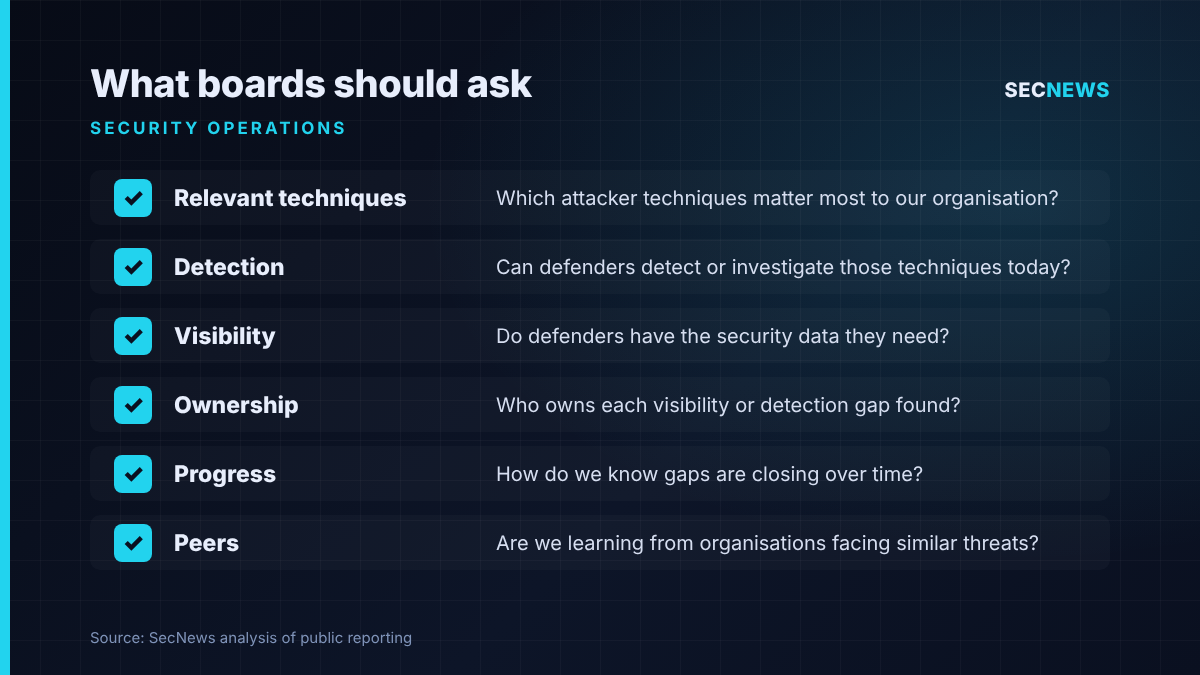
For boards, the centre offers six questions, covering which techniques matter most to the organisation, whether defenders can detect or investigate them, whether they have the data to do so, who owns any gaps, how progress is tracked, and whether the team learns from peers facing the same threats. It also lists the evidence a board should expect to see: techniques tested, gaps found, named owners and remediation status.
Notably, the NCSC says organisations do not necessarily need a dedicated hunting team or a new product. It encourages them to start with the people, data and providers they already have, and to make better use of threat intelligence by turning it into testable questions.
Why it matters for UK organisations
The timing is not accidental. In its State of the Cyber Nation report on 3 November, the NCSC judged it highly likely that hostile use of AI will increase the scale and efficiency of ransomware, social engineering and exploitation within two years. NCSC chief executive Dr Richard Horne warned that long-tolerated weaknesses can now be found and exploited at a scale once unimaginable.
The blog also sits inside a wider programme. The NCSC’s annual review describes a pilot National Detect Strategy that aims, by 2030, to have defenders detecting known vulnerabilities and attacker TTPs across critical systems, with stronger defender communities at its core. A HUNT initiative has already run guided threat hunts involving more than 160 participants from government and industry.
There is a governance hook too. The government’s Cyber Governance Code of Practice places incident planning, response and recovery, and assurance and oversight, among the five principles directors are expected to own. Asking for evidence of detection capability is a straightforward way for a board to show it is exercising that oversight rather than delegating it entirely to the security function.
Expert view
In my experience, the most uncomfortable moment in a red team debrief is rarely the initial foothold. It is the point where the client’s SOC realises that the activity was logged, sometimes even alerted on, but nobody had a detection or a process that turned it into an investigation. The NCSC is right to say that the question boards should ask is not “are we monitored?” but “could we see this specific behaviour?”.
The emphasis on behaviour over indicators is overdue at board level. Many managed service reports still lead with counts of blocked IPs, which say little about whether an intruder using legitimate admin tools would be spotted. When we test, the gaps tend to cluster around identity and cloud control planes, exactly the areas the NCSC flags.
I also welcome the line that a hunt with no findings is not a failed hunt. Boards should reward teams for surfacing logging gaps rather than treating them as embarrassing. The weakness in the guidance is that it says little about resourcing: hunting takes skilled time, and many mid-sized organisations buy monitoring precisely because they lack that time. The suggestion to lean on existing providers is sensible, but boards will need to check what their contract actually includes.
What to do now
- Put the NCSC’s six questions on the next board or risk committee agenda and ask the security lead, or your managed provider, to answer them in writing.
- Pick three to five attacker techniques relevant to your sector from recent NCSC and partner advisories, and ask whether each could be detected and investigated today.
- Audit your logging coverage, prioritising identity providers, cloud management activity, remote access and administrative tools. This underpins the secure configuration and user access control themes in Cyber Essentials, and goes beyond them.
- Check your managed detection contract for proactive hunting, how often it happens and how findings are reported back.
- Create a simple gap register with an owner and target date for each visibility or detection gap, and review it quarterly at board level.
- Join a defender community, such as a sector ISAC or an industry forum, and feed lessons back in.
Bottom line
The NCSC is asking boards to stop accepting “we are monitored” as an answer. A modest, evidence-led hunting habit, built on decent logging and honest reporting of gaps, will tell directors far more about their real exposure than another dashboard of blocked threats.
Sources
- NCSC: Why threat hunting should matter to every board
- NCSC: Strengthening national cyber resilience through observability and threat hunting
- NCSC Annual Review 2026: The National Detect Strategy
- NCSC: Cyber chief: UK facing AI-powered attacks on critical infrastructure within two years
- NCSC: Cyber Governance Code of Practice
- Infosecurity Magazine: NCSC: Observability and Threat Hunting Must Improve