Java4Shell (CVE-2026-114938) is a memory corruption bug in the OpenJDK Base64 decoder. Researchers say it can give an attacker with no account code execution on Jenkins, Keycloak and other platforms, though fixes are out, no attacks are confirmed and the hardware conditions are narrow.
What happened
On 17 November 2026 the research firm Calif published details of a flaw it calls Java4Shell, tracked as CVE-2026-114938. Oracle and the OpenJDK project shipped fixed runtimes the same day. The bug sits in a speed-optimised routine that decodes Base64 text, and malformed input can make that routine write past the end of its buffer. Calif says that with careful heap manipulation the corruption can leak memory or lead to remote code execution. It reports pre-authentication compromise of default Jenkins and Keycloak installs.
The US Cybersecurity and Infrastructure Security Agency (CISA) has since urged organisations to patch immediately. It warned that crafted Base64 could crash the JVM and allow “unauthenticated remote code execution”. Canada’s Cyber Centre also issued an alert. At the time of writing nobody has confirmed attacks in the wild, and the CVE is not in CISA’s Known Exploited Vulnerabilities catalogue.
Calif names the following applications as exploitable without a login in their default configuration: Keycloak, Atlassian Jira and Confluence, JFrog Artifactory, Jenkins and PingFederate. It says code execution also worked after authentication against Apache Kafka Broker, Apache Solr, Elasticsearch, Gerrit and Spinnaker, as well as sample applications built on Spring Boot and Apache Struts.
The technical picture
To speed up Base64 decoding, HotSpot swaps in hand-tuned machine code on x86-64 processors that support the AVX-512 VBMI instruction extensions. According to The Hacker News, a malformed string ending in a stray padding character makes that fast path write 62 or 63 bytes beyond the output buffer. The runtime does reject the bad input, but only after the write has already happened. Because the decoder runs before any login check, an attacker can reach it through ordinary pre-authentication fields such as HTTP Basic headers, SAML artifacts and CSRF tokens.
The overflowing bytes are fixed, so early analysis predicted only a crash. Calif instead grooms the heap so that the overflow enlarges a neighbouring array, then uses that array for arbitrary writes and a second array for reads, a primitive it calls JavaBleed. Each target needs its own memory layout and timing, so there is no universal exploit.
Independent labs have mostly confirmed the easy half. VulnCheck says crashing a vulnerable JVM is trivial and repeated requests can keep it down. Reliable code execution needs heap grooming plus a separate information leak to defeat address space layout randomisation. Blackpoint Cyber crashed a test Spring Boot service with roughly 28,000 unauthenticated requests in about 20 seconds, but did not reproduce code execution.
The affected builds are Java 17.0.6 onwards, plus Java 21, 25 and 27, the Java SE 8 Performance Pack build and several GraalVM releases. Standard Java 8 and 11 do not contain the vulnerable code. Exposure also depends on the processor: Intel Xeon from Ice Lake onwards and AMD Zen 4 or newer are in scope, and ARM64 is not. The same container image can therefore be vulnerable on one host and safe on the next.
Scores differ: Calif rates it 9.2 (CVSS 4.0), Oracle 8.1 (CVSS 3.1) and Red Hat 9.8 provisionally.
Why it matters for UK organisations
UK enterprises, public bodies and suppliers use the applications on Calif’s list everywhere. Jenkins is a common build server and Keycloak a common identity provider, so both tend to sit close to source code, secrets and single sign-on. Even without code execution, crashing either is a cheap, repeatable outage.
The bigger problem is visibility. Java4Shell is a flaw in the runtime, not a library, so dependency scanners that read Maven or Gradle manifests will not catch every instance. Vulnerable JVMs hide inside vendor appliances, bundled product runtimes and container base images, and a host that has had its package upgraded can still be running the old JVM until the service restarts.
There is also a compliance angle. Cyber Essentials requires high and critical updates to be applied within 14 days of release. With vendor scores ranging from 8.1 to 9.8, this one falls within that rule, and any business certified to the scheme or supplying government under it should plan on that basis.
Expert view
I would put Java4Shell in the “patch fast, panic slowly” category. The name invites comparison with Log4Shell, but the mechanics are very different. Log4Shell was a logic flaw that a single string could exploit on almost any platform. This is a memory corruption bug that needs specific silicon, a specific JDK line and a target-specific exploit chain. VulnCheck and watchTowr both expect exploitation to be narrow rather than indiscriminate, and I agree.
Narrow is not the same as safe, though. Calif says AI assistance helped it build a first working exploit in about two hours. According to The Register, the firm also claims the flaw leaked before coordinated disclosure, and Akamai’s Jan Schaumann criticised the publicity around the launch. A malformed trigger input also sat in a public OpenJDK pull request from 9 September.
When we test estates like these, the weak point is rarely the patch. It is knowing where every JVM lives. I expect this to be one of those vulnerabilities that turns up again and again in forgotten appliances long after the headline systems are fixed.
What to do now
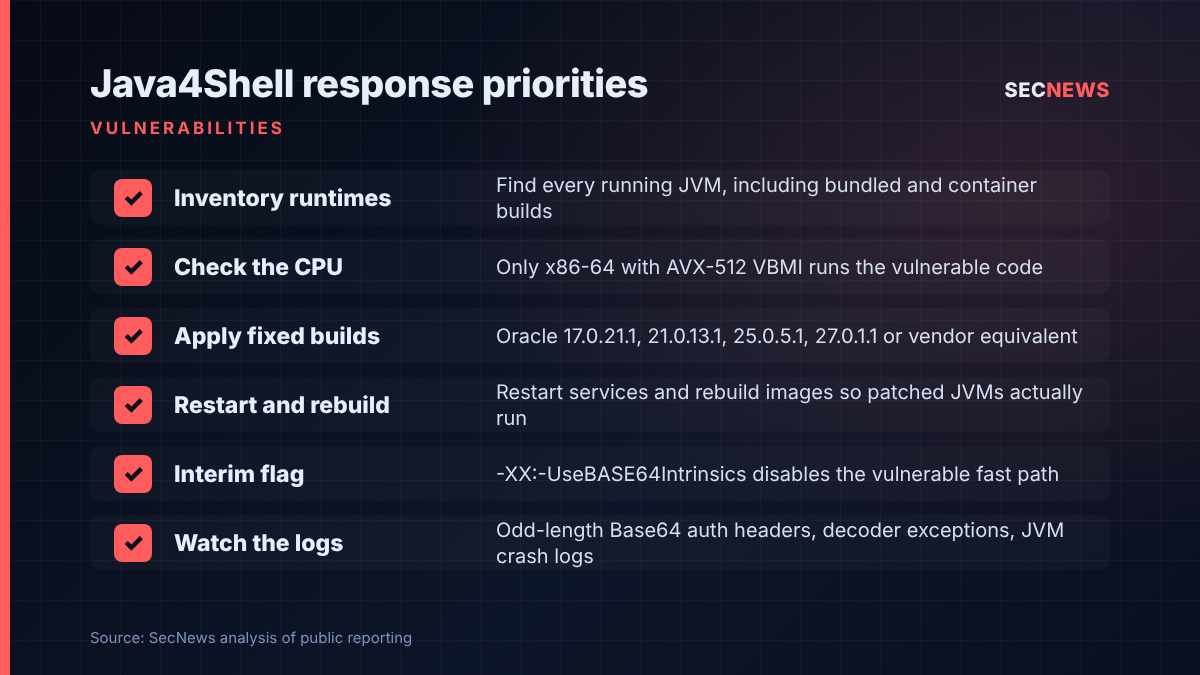
- Inventory runtimes, not just packages. Record the vendor and version of every running JVM, including bundled and containerised ones, as reported by the process itself.
- Prioritise by exposure and hardware. Start with internet-facing identity, CI/CD and collaboration services on x86-64 hosts that report the avx512vbmi CPU flag.
- Apply fixed builds. Oracle’s fixed releases are 17.0.21.1, 21.0.13.1, 25.0.5.1 and 27.0.1.1. Amazon Corretto and Azul Zulu have shipped fixes. Red Hat, Eclipse Temurin, Microsoft and BellSoft builds were still pending at the time of reporting, so watch for them.
- Restart and rebuild. Restart services after updating, rebuild container images from patched bases, and confirm the running version. This is the Cyber Essentials security update management control in practice.
- Use a temporary mitigation if you cannot patch yet. Starting the JVM with -XX:-UseBASE64Intrinsics disables only the vulnerable fast path. Upwind warns that one alternative flag stops the JVM from starting at all, so test any flag before rolling it out.
- Watch for probing. Look for long Base64 login header values that end in “=” with a length not divisible by four, bursts of Base64 decoder exceptions, and unexplained JVM crash logs or restart loops. Cloudflare has already shipped a WAF rule.
- Chase your suppliers. Ask vendors of Java-based appliances and SaaS platforms for a written statement on their status.
Bottom line
Java4Shell is real, but exploiting it for code execution takes far more effort than the name implies. Even so, an unauthenticated crash is easy and the affected runtimes sit under some of the most sensitive services in a typical UK estate. Find every JVM, patch within the Cyber Essentials window, restart what you patch, and watch the logs.
Sources
- The Hacker News: Java4Shell Flaw (CVE-2026-114938) Enables Pre-Auth RCE in Jira, Jenkins, Keycloak and More
- Help Net Security: Java4Shell OpenJDK flaw: Exploitation is tricky and hinges on specific CPUs
- The Register: Oracle reveals fix-this-ASAP-grade Java4Shell bug
- The Hacker News: CISA Urges Immediate Patching of Java4Shell Flaw
- Cloudflare Radar: Java4Shell: remote code execution in OpenJDK
- Sonatype: Critical OpenJDK RCE CVE-2026-114938: What to Know