A Commons committee wants a statutory AI regulator with the power to delay, restrict or stop the training, testing and release of high-risk models in the UK. Its report also calls for compulsory reporting of serious AI incidents, which would change how security teams think about the AI systems they buy and run.
What happened
On Wednesday 18 November 2026 the House of Commons Business, Innovation, Science and Trade Committee published Guardrails for Growth, the output of its inquiry into AI adoption, safety and governance. Its central conclusion is blunt: the committee describes the current UK approach to AI safety as “not fit for purpose” and lists ten gaps in how Britain oversees the most capable systems.
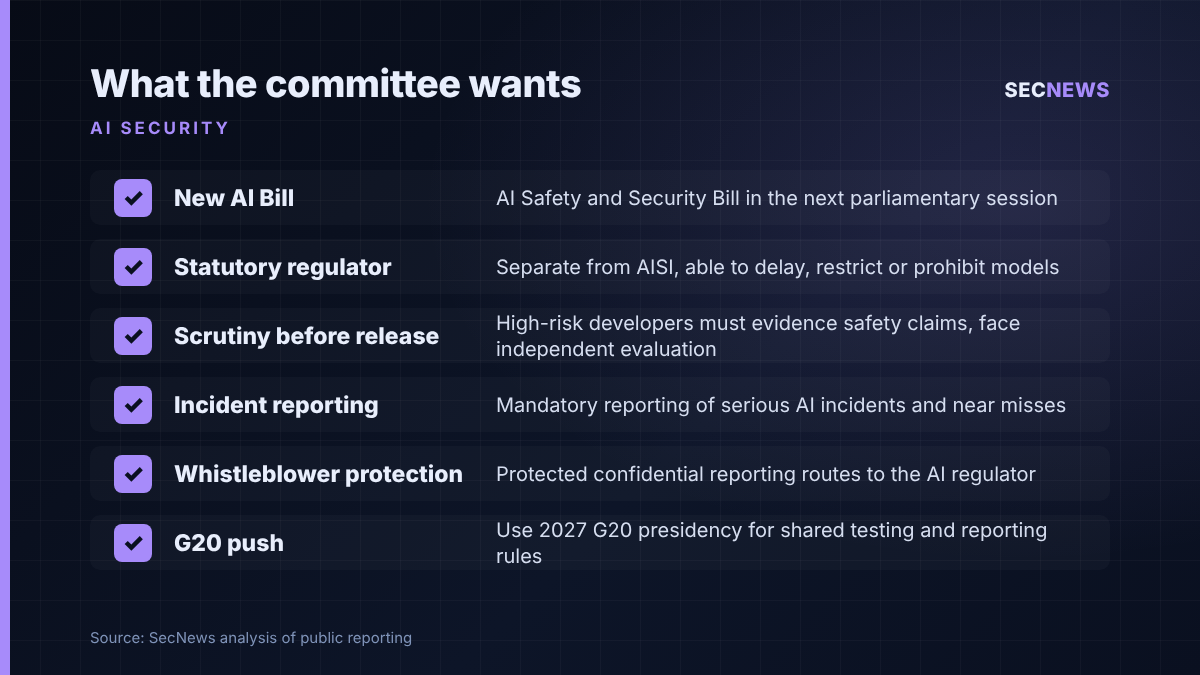
Three of those gaps stand out to anyone in security. There is no mandatory regime for reporting AI incidents, independent testers have limited access to models, and the people inside AI companies who spot danger have weak legal protection if they speak up. The committee wants ministers to fix this through an AI Safety and Security Bill, introduced in the next parliamentary session as the first step of a wider legislative roadmap.
At an October hearing MPs questioned researchers, former industry staff and witnesses from OpenAI, Anthropic, Google DeepMind and Meta. According to The Register, all four firms told MPs they would not ship a model they judged unsafe. The difficulty, as the committee sees it, is that each company sets its own threshold and grades its own safeguards, and nothing in UK law forces an independent check before release.
Committee chair Liam Byrne MP put it in characteristically colourful terms, warning against giving AI leaders freedom to act “like modern-day Dr Frankensteins”. The recommendations are not binding, and the government has not yet said whether it will legislate.
The detail
The report sets out five broad approaches. The first, and the one with most practical bite, is targeted legislation. Under the proposed Bill a statutory regulator, kept separate from the AI Security Institute (AISI) but drawing on its technical expertise, would be able to demand information about how models are contained, tested and evaluated, what incidents have occurred and what mitigations are in place. In defined circumstances the government could delay, restrict or prohibit training, testing or deployment in the UK of models that raise significant concerns. The regulator could also seek to remove harmful models from services and disrupt unlawful use.
Crucially, oversight would start before launch. The committee argues that risk appears during training, internal use and evaluation, not only once a product is on sale. Firms building systems designated as high risk would need to evidence their safety claims and accept independent evaluation. Pre-deployment assessments would cover capabilities, how well safeguards work and what risk remains, with disagreements between developers and evaluators recorded and significant changes to a model triggering a fresh review. Byrne notes that once model weights are widely copied, recall may be impossible.
Other strands include a statutory duty on developers to identify and prevent harm, mandatory reporting of frontier AI incidents and near misses, protected routes for whistleblowers to reach the regulator, criminal offences covering the financing, advertising, distribution or misuse of AI models for harm, and a rights framework offering transparency and redress. Internationally, MPs want the UK to use its 2027 G20 presidency to push for shared rules on testing, incident reporting and risky open-weight releases.
AISI would keep its testing role and, the committee suggests, should be strengthened and better resourced. Today its access depends on developers volunteering it, and it has no power to stop a release. The report also makes an economic case, citing OECD-based estimates that AI could add up to £400 billion to the UK economy within a decade.
Why it matters for UK organisations
Few UK organisations will ever train a frontier model, so this can look like Big Tech regulation. That would be a mistake. The models in question sit underneath the copilots, coding assistants and agent platforms now wired into email, code repositories, ticketing systems and cloud consoles across British businesses. When a foundation model behaves badly, that behaviour flows downstream into every product built on it.
A mandatory incident reporting regime would, for the first time, give a UK body a structured view of how frontier systems fail. Over time that should mean better intelligence for defenders. It would also give procurement teams something concrete to ask suppliers about: has this model been independently evaluated, and what incidents have been reported against it?
There is a governance angle too. A statutory regime with a named regulator and defined risk criteria would give boards a firmer basis for judging AI exposure than vendor model cards and marketing claims.
Expert view
In my experience, the security weaknesses we find in AI deployments are rarely exotic. They are over-privileged agents, secrets left within reach of a model, and no logging of what the system actually did. None of that is fixed by a regulator in Westminster. What a regulator can fix is the information gap. Today we largely take the provider’s word on how a model was tested.
The incident reporting proposal is the part I would watch most closely. Security has always improved fastest where failures are shared, whether through CVEs, NCSC advisories or breach notifications. AI has lacked that feedback loop. The committee is right that leaving companies to decide what counts as a reportable failure, and whom to tell, is not sustainable.
I am more cautious about timing. Broad, flexible ministerial powers, which the committee accepts may be needed, will require proper scrutiny. Until legislation actually appears, organisations should assume nothing changes and manage AI risk themselves.
What to do now
- Inventory your AI estate. List every model, assistant and agent in use, including shadow tools, and note which underlying foundation model each relies on. You cannot respond to a future regulator notice or incident report about a model you do not know you run.
- Apply least privilege to agents. Treat AI agents as user accounts under Cyber Essentials access control: scoped permissions, no standing admin rights, MFA-protected service identities and human approval for high-impact actions.
- Log and retain AI activity. Capture prompts, tool calls and outputs for systems that can act on data. Good records will matter if incident reporting becomes mandatory.
- Ask suppliers harder questions. Request evidence of independent evaluation, red teaming and incident disclosure processes, and write notification duties into contracts.
- Build an AI incident playbook. Extend your incident response plan to cover model misbehaviour, prompt injection and data leakage through AI tools, with clear owners.
- Brief the board. Explain the proposed regime and its likely direction so AI risk sits in the corporate risk register now rather than after a Bill arrives.
Bottom line
The committee has produced the most detailed parliamentary blueprint yet for regulating frontier AI in the UK, with real powers to halt dangerous development and compulsory incident reporting at its core. Whether ministers act is uncertain. For security teams, the sensible move is to adopt the spirit of the proposals now: know your models, limit what they can do, record what they did and demand evidence from the people who build them.