France’s data protection regulator has fined life insurer Macif Vie €5m after inspectors found around 1.8 million customer passwords sitting unhashed in its databases. No breach was ever confirmed, which is exactly why UK organisations under the identical UK GDPR security duty should pay attention.
What happened
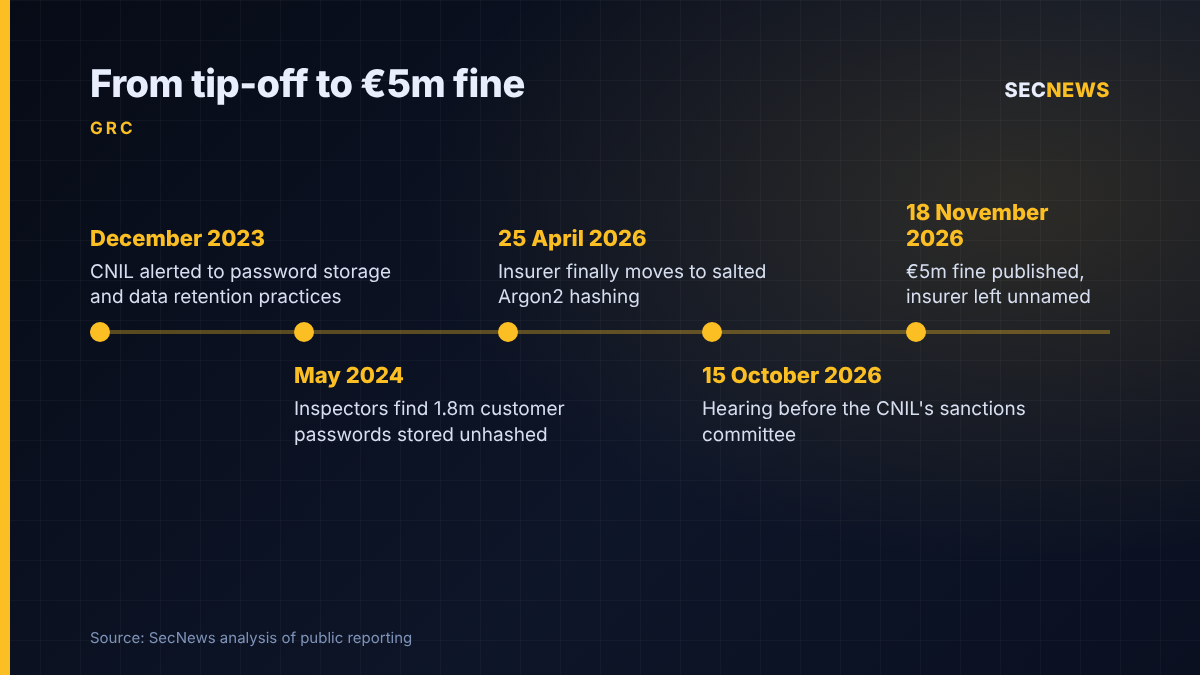
On 18 November 2026 the CNIL, France’s data protection authority, published a decision imposing a €5m fine on a life assurance company for a series of failings under the GDPR. The decision itself, adopted by the CNIL’s sanctions body (the formation restreinte) on 12 November and numbered SAN-2026-016, does not name the firm. However, the specialist outlet MLex identified it as Macif Vie after the hearing on 15 October, and French technology site Clubic reports that the Macif group confirmed to BFM Tech that it was the company concerned.
The case began with an alert in December 2023 about password storage and retention of portal data, followed by an inspection at the company’s Niort offices in May 2024. The findings fell under two articles: Article 32, which requires security appropriate to the risk, and Article 5(1)(e), the storage limitation principle.
The rapporteur initially sought €9m, based on the turnover of the wider Macif group, before reducing the proposal to €7m during the hearing. The formation restreinte settled on €5m. Because the insurer had already corrected the problems, no compliance order was attached, and the CNIL agreed to publish without naming the company, describing the decision as educational in purpose. The insurer has two months to appeal to France’s Conseil d’État. According to Clubic, Macif said it wished to reassure customers that none of their data had been disclosed.
The technical picture
The headline failing is about as basic as security gets. At the time of inspection, roughly 1.8 million passwords used by customers to log in to their personal accounts were held in clear text, with no hashing applied at all. Anyone with access to the underlying databases could read them. Of those, 730,289 also appeared in a log table recording login attempts, duplicating them in a second location.
The first fix did not go far enough. Around two months after the inspection, the insurer began hashing passwords using ORA_HASH, an Oracle database function, without a salt. The CNIL considered this function obsolete for password protection. It was only on 25 April 2026, after the sanction report had been served, that the company moved to Argon2 with a salt, the approach the CNIL recommends in its developer guidance.
The second Article 32 finding concerned access to data. A database holding details of the 1.3 million customers with live life assurance contracts was reached through a single generic application account whose credentials were shared by eight staff. A shared administrator password for a database tool was also in use. The CNIL did not object to staff needing access; its concern was that a common login made it impossible to establish who had viewed, changed or deleted records.
The retention findings complete the picture. Contact form messages, some containing full IBANs typed in by customers, were kept in the live database back to November 2010. Connection logs stretched back to 2003, despite the company’s own policy setting a one-year limit, and still held passwords belonging to 8,628 customers recorded since July 2019. One complaint did not stick: the CNIL accepted that a password policy of 8 to 15 characters with mixed case and a digit was adequate, because accounts were locked after repeated failed attempts.
Why it matters for UK organisations
Article 32 of the UK GDPR is, for practical purposes, the same text the CNIL applied here. A UK insurer, retailer or local authority with the same set-up would face the same legal analysis from the Information Commission, which took over from the Information Commissioner’s Office on 30 September 2026 under the Data (Use and Access) Act 2025. The regulator’s name has changed; the duty to protect personal data with appropriate technical and organisational measures has not.
The most important point in the decision is that no attack was needed. The insurer argued that no security incident had compromised the data. The CNIL’s answer, as reported by Clubic, was that the exposure mattered “whether or not this vulnerability was exploited by an attacker”. Many UK boards still assume enforcement follows a breach. Here a regulator imposed a seven-figure fine purely for the state of the controls, prompted by a tip-off rather than a leak.
It also shows how long remediation can drag on: the gap between inspection and proper hashing was close to two years.
Expert view
In my experience, plain-text passwords are rarely the result of a single bad decision. They usually come from an old customer portal built before anyone thought hard about credential storage, followed by years in which nobody owns the code well enough to change it. When we test legacy applications, the password table is often the last thing anyone has looked at, and logging is where the real surprises live: debug or audit logs that capture full request bodies, credentials included, and then sit untouched for years.
The shared account finding deserves as much attention as the passwords. Generic database logins are endemic in internal estates, especially where an application service account has quietly become the way support staff run queries. They destroy accountability and make insider misuse almost impossible to investigate.
The interim move to an unsalted, fast hash is a lesson in its own right. Fixing a finding in a way that technically removes plain text but leaves the data easy to crack is not remediation; regulators are now looking at whether the fix is sound, not just whether something changed.
What to do now
- Find every password store. Check customer and staff authentication databases, and confirm passwords are hashed with a modern, salted, deliberately slow algorithm such as Argon2, scrypt or bcrypt. Treat unsalted or general purpose hashes as a finding to fix urgently.
- Search your logs for credentials. Review application, web server and database logs for captured passwords, tokens or full request bodies, purge what you find and fix the logging configuration so it cannot recur.
- Remove shared accounts. Give every person a named account with only the access their role needs, and keep service accounts for applications only. This maps directly to the Cyber Essentials user access control requirements.
- Enforce your own retention policy. Compare the documented retention period for portal messages and logs with what is actually stored, and schedule automated deletion or archiving.
- Add multi-factor authentication to customer portals holding financial or sensitive data, reducing the value of any credential that does leak.
- Track remediation to completion. Make sure fixes from audits, penetration tests or regulator contact are verified by someone independent, not simply closed.
Bottom line
A €5m fine with no confirmed breach is a clear signal that European regulators will penalise poor security controls on their own merits. UK firms subject to the same Article 32 duty should assume the Information Commission can take the same view, and check their password storage, logs and shared accounts before someone else does.
Sources
- Next: La CNIL sanctionne Macif Vie à hauteur de 5 millions d’euros pour des mots de passe en clair
- Clubic: La CNIL inflige 5 millions d’euros d’amende à la Macif
- PPC Land: CNIL fines unnamed life insurer €5m over 1.8m passwords stored in plain text
- legislation.gov.uk: The Data (Use and Access) Act 2025 (Commencement No. 9 and Transitional and Saving Provisions) Regulations 2026