Ukrainian police, working alongside the FBI, have detained four alleged key members of a ransomware crew that rang company staff while posing as IT support and collected more than $40.5m from at least 28 victims. No UK organisations have been named, but the playbook is one that UK help desks and SOCs have every reason to study closely.
What happened
On 18 November 2026 the National Police of Ukraine announced that four key members of an international ransomware organisation had been served notices of suspicion and were in custody. The announcement capped an investigation that the force’s Cyber Police Department and Main Investigative Directorate say they pursued for over two years in partnership with the FBI, under procedural oversight from the Office of the Prosecutor General.
Police raided 66 addresses at the same time, in Kyiv and 11 regions, with US law enforcement present and tactical units in support. They took computers, phones, bank cards, close to $370,000 in cash and a further €20,000. The suspects face charges of membership of a criminal organisation and of unauthorised interference with information systems, which carry a maximum of 15 years in prison.
In an interview with Censor.NET, Maksym Tsutskiridze, the acting head of Ukraine’s police, said at least 28 companies had paid the group over $40.5m (about UAH 1.8bn), and stressed that the full scale of the damage is still being established. Police describe a core of at least 27 people from Ukraine, Kazakhstan, Russia and elsewhere, tied to a wider network of more than 60 across eight jurisdictions, some of whom previously belonged to Conti.
To be clear about scope: neither the police statement nor the coverage so far names any UK victim. Targets listed by police were oil and gas, pharmaceutical, industrial and logistics firms, financial institutions and infrastructure operators. Ukrainian court records, first reported by the French publication LeMagIT and relayed by BleepingComputer, reportedly identify several US companies, and police described one unnamed American firm that lost 1.4TB of data and paid $5m after an opening demand of $10m.
The technical picture
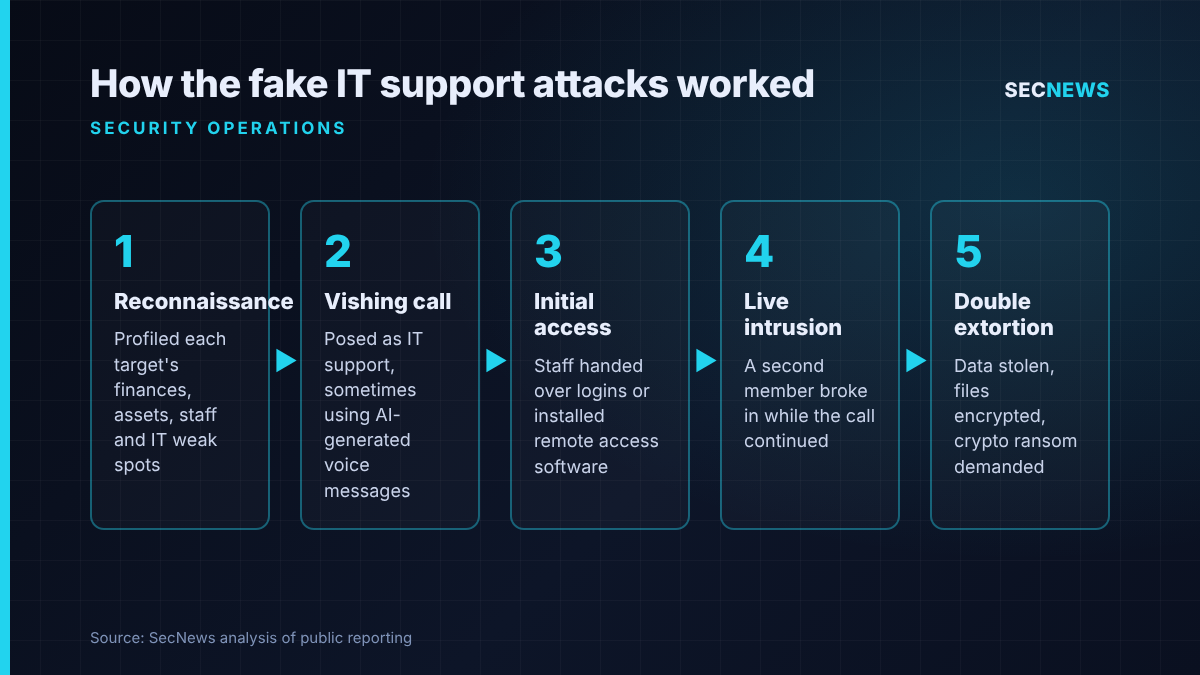
Nothing about the entry method is exotic, which is precisely why it matters. According to police, the gang first profiled each target: its finances, assets, staff and weak points in its IT estate. Members then phoned employees, presented themselves as the company’s own support team and talked them into either revealing their credentials or installing remote access software.
According to Tsutskiridze, the gang developed a bespoke platform producing AI-generated voice messages for these calls. Police have not said how often that tooling was used, so it would be wrong to assume every intrusion was automated. In one documented case, a caller kept the victim talking while a colleague broke into the network, and only hung up once access was confirmed. That detail tells defenders the call and the intrusion run in parallel, in real time.
The court records, as reported by LeMagIT, add phishing pages that imitated corporate VPN portals, spoofed caller numbers, and commodity remote tools such as TeamViewer and AnyDesk. In one alleged case an employee typed credentials into a fake VPN page and the attackers then obtained a one-time two-factor code, giving them remote access. Once inside, the crew stole data, encrypted systems and demanded cryptocurrency, threatening publication if victims refused. The records reportedly name Chaos as the ransomware used.
Why it matters for UK organisations
Impersonating IT support is not a foreign problem for UK defenders. Only this week a Dundee man linked to Scattered Spider was jailed for six years in the US over a separate campaign in which texts posing as victim companies or their IT suppliers harvested staff logins. This Ukrainian case shows the same approach being run as an industrial process by a different, Conti-linked ecosystem, with voice automation layered on top.
Many UK organisations have outsourced their service desk, often offshore, and lean on MSPs for remote support. That creates exactly the conditions this gang exploited: staff used to receiving unexpected calls from “IT”, remote tools that are normal in the estate, and verification processes that rely on information an attacker can research in advance. Arrests remove some operators, but the method is cheap, reusable and already shared across criminal groups.
Expert view
In my experience running social engineering engagements, the phone remains the most reliable way into a well-defended organisation. Firewalls, EDR and email filtering do little when a member of staff is persuaded to open the door themselves. The weak point is rarely a single person; it is the absence of a process that lets them say no without feeling they are obstructing a colleague.
The detail that stands out to me is the overlap between call and intrusion. If an attacker is live on the network while still on the phone, your detection window is minutes, not hours. A SOC that only reviews remote access alerts the next morning will be reading about the breach rather than stopping it. Equally, the mention of a one-time code being captured is a reminder that SMS and app codes can be relayed by a determined operator; only phishing-resistant methods such as FIDO2 keys and passkeys genuinely close that gap.
I would also caution against over-reading the AI angle. Synthetic voice makes these calls scale, but the controls that defeat them are the same ones that defeat a human caller: independent verification, restricted tooling and fast detection.
What to do now
- Set a hard rule and publicise it. Your service desk never asks for passwords or MFA codes and never cold-calls to install software. Make sure every employee knows this, so any caller who does is treated as hostile.
- Verify out of band. Staff should confirm any “IT” caller by ringing back on a known internal number or checking for an open ticket. Caller ID proves nothing.
- Lock down remote access tools. Maintain an approved list, block the rest with application control (Cyber Essentials: secure configuration and malware protection), and alert on any new installation or first-seen connection from TeamViewer, AnyDesk and similar.
- Move privileged and remote users to phishing-resistant MFA. Prioritise VPN, admin and finance accounts (Cyber Essentials: user access control).
- Tune detection for the live window. Correlate new VPN sign-ins, unusual device registrations and remote tool launches with recent help desk activity, and make sure these alerts page someone immediately, including out of hours.
- Harden the help desk itself. Require stronger identity checks before password or MFA resets, record calls where lawful, and include vishing scenarios in red team and tabletop exercises.
- Plan for double extortion. Incident response should cover data theft, ICO notification and decision-making on extortion demands, not only system restoration.
Bottom line
Four arrests and a $40.5m tally are a welcome blow, but the wider network remains largely unidentified and the technique costs almost nothing to reuse. No UK victims have been named, yet any British organisation with a busy service desk and permissive remote tooling is exposed to the same approach. Treat this as a prompt to test your help desk verification and your SOC’s ability to spot a live remote session within minutes.
Sources
- National Police of Ukraine: A call from “IT support” and the company is held hostage (in Ukrainian)
- Help Net Security: Ukraine arrests key members of ransomware gang that extorted $40.5 million posing as IT support
- Censor.NET: A group of hackers who swindled over $40 million has been exposed
- SimplySecure (BleepingComputer report): Ukraine, FBI arrest ransomware gang members tied to $40M in ransoms
- WindowsForum: Ukraine arrests ransomware suspects over AI voice help-desk scams