Japan’s RIKEN has taken the Fugaku supercomputer offline after an intruder used a public status dashboard to reach its internal network, where files in users’ home directories were or may have been taken. Up to 4,597 users may be affected, and exposed SSH keys mean the risk reaches well beyond Japan.
What happened
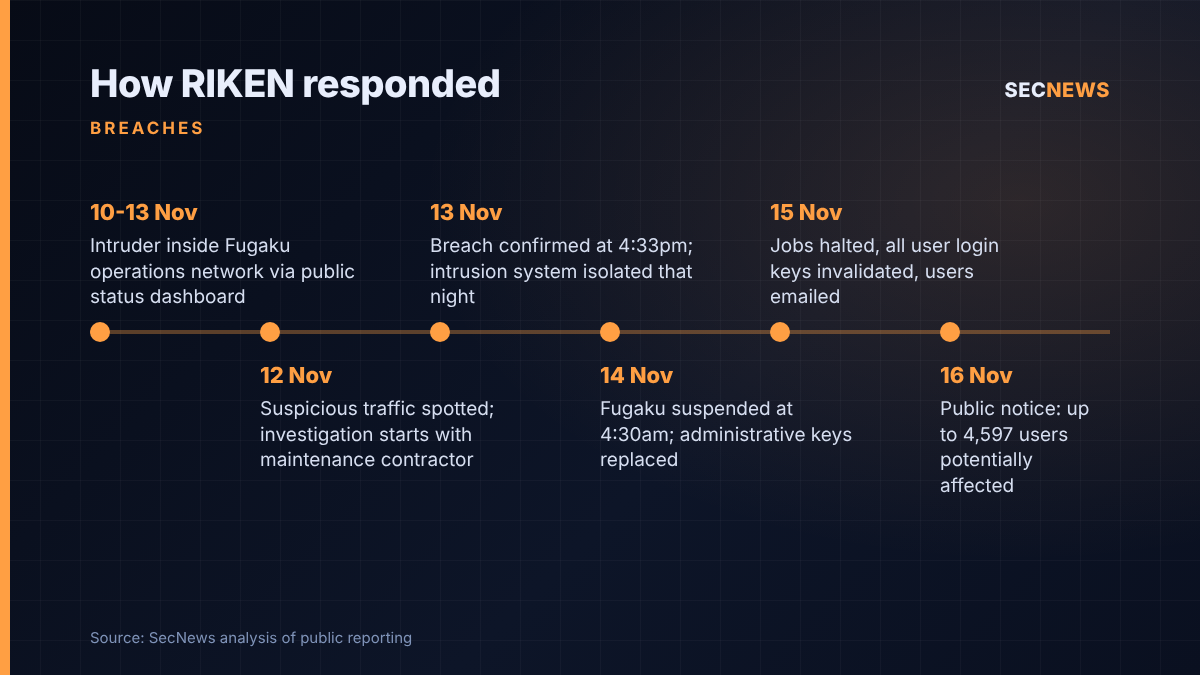
RIKEN, the Japanese national research institute that runs Fugaku through its Center for Computational Science (R-CCS), says an external party had access to the supercomputer’s internal operations network between 10 and 13 November 2026. Suspicious traffic was spotted on 12 November. Fugaku’s maintenance had been outsourced to an external provider, and RIKEN began investigating alongside them that day. Unauthorised access was confirmed at 4:33pm on 13 November.
The foothold was isolated that evening, Fugaku was suspended and cut off from outside access at 4:30am on 14 November, and administrative keys were replaced later that day. On 15 November it emailed users, cancelled every running and queued job, and invalidated all users’ login public keys. The institute notified Japan’s science ministry, the Personal Information Protection Commission and the organisations behind the national HPCI (High Performance Computing Infrastructure) programme. Its public notice followed on 16 November.
RIKEN says authentication records for as many as 4,222 Fugaku account holders (name, email and user ID) and 375 users of RIKYU, its AI for Science machine (name and email), were taken or may have been. That 4,597 total is a ceiling rather than a confirmed count. The more serious problem is what sat in users’ home directories: SSH private keys and access keys that researchers had stored there for connecting to systems and services outside RIKEN.
No restart date has been given. Fugaku stays down until the exploited software is fixed, compromised servers are rebuilt and the network design is reviewed.
The technical picture
RIKEN identifies the entry point as a publicly reachable web page that showed Fugaku’s operating status. How the attacker got from that dashboard onto the internal network is still under investigation. Once inside, the intruder altered a number of internal servers and planted malware on a subset of them.
Two further findings stand out. First, files in users’ home directories and records from the authentication system were taken, or may have been. Second, RIKEN confirmed that the attacker tried to use some of the harvested credentials to connect to other systems. Whether any succeeded is still being examined. So far, RIKEN says, nothing indicates that research data itself was exfiltrated.
That second finding is why this incident matters beyond Japan. Disabling logins on Fugaku does nothing to a stolen private key that is still trusted somewhere else. Any server, Git host or cloud account that accepts the matching public key will keep letting the attacker in until the key is removed there. Hence RIKEN’s instruction to users to strip the matching public keys from external services, create fresh key pairs and reissue any other stored credentials.
Why it matters for UK organisations
Research computing is international by design, and UK academics and industrial partners collaborate with Japanese groups. RIKEN has not published a breakdown of affected users by country, so I would not assume large UK numbers. But any UK researcher who has held a Fugaku or RIKYU account, or who shares project infrastructure with someone who has, should treat the incident as their own until they have checked.
The bigger lesson is about a pattern UK organisations already know. In May 2020, ARCHER, the national academic supercomputer hosted by the University of Edinburgh, was taken offline after its login nodes were exploited. All user passwords and SSH keys had to be reset. Administrators warned that several other academic machines across the UK and Europe had been compromised, and the NCSC was involved in the response. The same weakness keeps recurring: researchers chain SSH keys between systems, and a compromise at one site becomes a way into the next.
The dashboard detail should also worry anyone running shared infrastructure in the UK, from university HPC services to corporate clusters. Status pages, job monitors and capacity dashboards are often built quickly, published to the internet for convenience and then forgotten. They are rarely in scope for the patching and monitoring regime applied to login nodes. Outsourced maintenance adds another seam, which RIKEN acknowledges by promising to review responsibilities with its contractor.
Expert view
In my experience, the most valuable thing on a shared research system is rarely the compute. It is the pile of credentials users leave in their home directories. When we test HPC and research environments, we routinely find unencrypted private keys, cloud access keys in dotfiles and tokens for code repositories, all of them readable to anyone who gains the right privileges on a shared file system. The attacker in Fugaku’s case appears to have understood that, given the confirmed attempts to reuse what was taken.
The status dashboard is the other recurring theme. Small, low-status web applications sitting on the edge of a sensitive network are exactly where we tend to look first, because nobody owns them properly. They often run older frameworks and their logs are seldom watched. RIKEN has not named the flaw, but the architectural point stands: a public page showing internal state needs internal data, and that data path is a route in.
Credit is due for the speed of containment. Isolating the foothold within hours, rotating administrative keys and invalidating every user key is the right sequence. The hard part, revoking keys scattered across third-party services, now falls on thousands of individual users, and that is where incidents like this tend to leave a long tail.
What to do now
- Check for exposure. Ask research staff and partners whether they hold or held Fugaku or RIKYU accounts. Any key pair ever placed on those systems should be treated as compromised.
- Revoke, then replace. Remove the matching public keys from authorized_keys files, Git hosting services and cloud consoles before issuing new keys. Rotate any access keys or tokens that were stored alongside them.
- Hunt for reuse. Review SSH and cloud authentication logs from 10 November onwards for logins using the affected keys, especially from unfamiliar addresses.
- Audit your own edge. List every internet-facing dashboard, status page and monitoring tool, and confirm it is patched, owned and separated from management networks. This maps directly to the Cyber Essentials controls on firewalls, secure configuration and security update management.
- Reduce credential sprawl. Encourage passphrase-protected keys, SSH agents or short-lived certificates instead of private keys left on shared systems. This supports the Cyber Essentials user access control requirements.
- Tighten supplier arrangements. Where maintenance of research or operational systems is outsourced, agree in writing who monitors, who patches and who responds out of hours.
- Brief users on phishing. Warn affected staff to expect emails impersonating RIKEN or Fugaku.
Bottom line
Fugaku’s breach began with a modest status page and ended with researchers’ external credentials potentially in an attacker’s hands. For UK organisations, the immediate task is to find and revoke any keys that touched the system. The lasting lesson, already taught by ARCHER six years ago, is that shared research infrastructure needs the same edge discipline and credential hygiene as any corporate network.
Sources
- RIKEN: Notice regarding a possible personal information leak affecting Fugaku and RIKYU users following unauthorized access to the supercomputer Fugaku
- Cyber Security News: Japan Shuts Down Fugaku Supercomputer After Hackers Breach Internal Servers
- GBHackers: Japan’s Fugaku Supercomputer Hacked, Exposing Credentials and Personal Data of Up to 4,597 Users
- ITdaily: Supercomputer Fugaku offline after hack at Riken
- The Register: Brit research supercomputer ARCHER’s login nodes exploited in cyber-attack