Cleverbridge, which handles checkout and subscription billing for many software vendors, says an intruder copied payment card data held on its platform. Cardholders have been getting notices since 20 November. At least one notice says the stolen data includes the CVV code, which card industry rules bar keeping after authorisation.
What happened
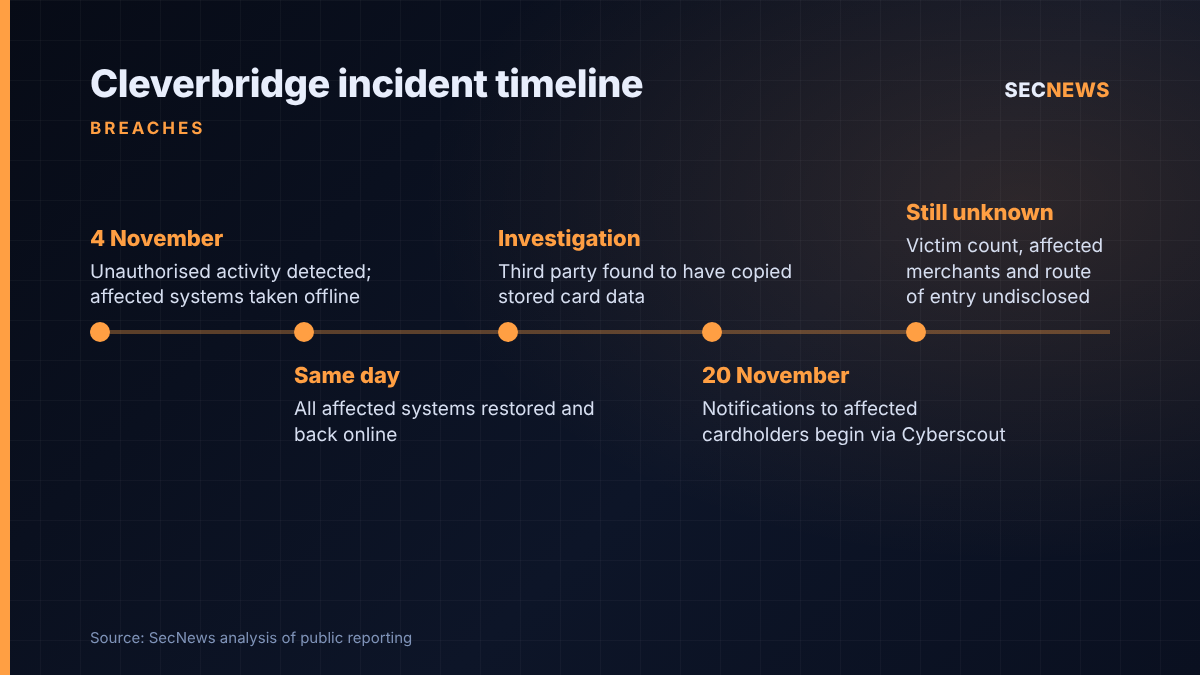
Cleverbridge acts as merchant of record for software and SaaS businesses. When a customer buys a licence or renews a subscription on a vendor’s website, Cleverbridge often takes the payment and its name may appear on the card statement. Its incident update says it detected unauthorised activity on 4 November 2026. It took the affected systems offline for a short time and had them all running again the same day.
The later investigation found a bigger problem. In Cleverbridge’s own words, “a third party copied payment card data stored on our platform.” The company says it began notifying affected individuals on 20 November, where appropriate, and that the investigation is still going on. It says this was not ransomware and that no systems were encrypted.
The public update does not list which card fields were taken. It tells people to check their own notification. According to a notice seen by BleepingComputer, the data copied for that purchase was the full card number, the expiry date and the CVV/CVC code. That notice said the cardholder’s name, contact information and billing address were not taken. That describes only one recipient’s case, and other customers may have lost different combinations of data.
Cleverbridge has not said how many people are affected, which vendors’ customers are involved, the route of entry or the length of the intrusion. According to reports of its statement, it has told data protection authorities, law enforcement, the card networks and its payment partners. It has engaged TransUnion’s Cyberscout to send notifications and is offering credit or identity monitoring where available.
The technical picture
The CVV is what makes this breach unusual. PCI DSS treats the card verification code as sensitive authentication data. Requirement 3.3.1 forbids keeping it after a transaction has been authorised, even in encrypted form. Without the code, a card number and expiry date are worth far less for online fraud. With all three, a criminal has most of what is needed for card-not-present purchases.
Cleverbridge’s help pages say it maintains PCI DSS compliance, has its processes reviewed every year by a Qualified Security Assessor, and protects card numbers in transit to the processor with TLS. Those pages say nothing about how card data is stored at rest. The company has not explained why security codes appear to have been on the platform after the transaction, or for how long.
BleepingComputer listed Red Hat, SUSE, Tenable, Veeam, Jamf, Sony and Parallels among Cleverbridge’s clients. Neither Cleverbridge nor those vendors have confirmed that any of their customers are affected. Readers should not assume that buying from one of them means their card was exposed.
Why it matters for UK organisations
Merchant-of-record platforms are a blind spot in most supplier inventories. A UK finance team buying a backup licence or a vulnerability scanner subscription thinks it is dealing with the software vendor. The payment, though, may run through a separate company whose name appears only as a line on the corporate card statement. That intermediary rarely appears in third-party risk registers.
For UK businesses, the immediate risk is fraud on corporate and procurement cards used for software purchases. A second, more practical risk comes after the clean-up. Cards replaced by issuers will break auto-renewing licences, so security tooling can lapse without warning partway through a contract. The usual wave of phishing is also likely. Messages claiming to be from Cleverbridge, Cyberscout or a software vendor and asking people to “verify” card details are the obvious next step for criminals.
The incident also has a UK GDPR side. Card data tied to an identifiable person is personal data. A UK controller whose customers paid through an affected processor should consider whether it needs to assess the risk itself rather than rely on the processor’s notifications. Cleverbridge has reportedly informed data protection authorities, but has not publicly said which ones.
Expert view
In my experience, payment-adjacent platforms are where PCI DSS scope quietly creeps. The main card vault is usually well hardened and well audited. The trouble tends to be around it: debug logs, retry queues, fraud-screening caches, analytics feeds and support tooling that pick up more of the transaction than anyone intended. When we test checkout environments, the most damaging findings are rarely in the payment page itself. They are in a forgotten data store holding full transaction payloads that nobody thought of as cardholder data.
This is speculation until Cleverbridge publishes a fuller account. Still, a CVV turning up in stolen data points to a control failure in data handling, not just an access failure. An annual assessment shows a company was compliant at one point in time. It does not prove that sensitive authentication data never reaches a place it should not be.
Containment was quick, but without the scale, root cause and merchant list, downstream businesses cannot judge their own exposure.
What to do now
- Find your exposure. Search corporate card, procurement card and expense records for charges labelled Cleverbridge or the software brands it bills for. The intrusion’s length is undisclosed, so look beyond recent months, and check with staff who buy software on personal cards and claim it back.
- Talk to your card issuer. Use the number on the card or the bank’s official app, not contact details from an unexpected email. Ask whether the card should be replaced, and switch on transaction alerts.
- Protect renewals. List auto-renewing security and infrastructure subscriptions tied to any card you replace, and update the payment details before the renewal date so protection does not lapse.
- Warn finance and procurement staff about phishing. Cleverbridge says it does not request card numbers, security codes or passwords through unsolicited messages or calls, so treat any such request as hostile. Email filtering and user awareness support the Cyber Essentials malware protection and secure configuration controls.
- Add merchants of record to your supplier register. For important software purchases, ask vendors who processes their payments, and ask that processor for its PCI DSS Attestation of Compliance. Treat it as a fourth party in your third-party risk process.
- Check your own CVV handling. If you run any checkout, make sure security codes never appear in logs, queues, analytics or support tools. Test for it, rather than relying on design documents.
- Review UK GDPR obligations. If your customers paid through Cleverbridge, record your assessment of the incident and whether any notification duty falls on you as controller.
Bottom line
Cleverbridge contained the intrusion quickly. However, payment card data, including CVV codes according to at least one notice, was copied from a platform that most buyers never knowingly dealt with. Until the company says how many people and which vendors are affected, UK organisations should assume any software bought through vendor checkouts could be involved. That means checking statements, protecting renewals and treating merchants of record as suppliers worth scrutinising.
Sources
- Cleverbridge: Incident update
- Cleverbridge Support: Is it safe to pay for my online order with a credit/debit card?
- Cyber Security News: Cleverbridge confirms hackers stole customer card numbers and CVV codes
- WindowsForum: Cleverbridge breach exposes payment card data, including CVV, in customer notice
- Dark Web Informer: Cleverbridge confirms data breach exposing card numbers, expiration dates and CVV codes