Next has told the market that an attacker reached some of its data by breaching one of its online technology suppliers, while insisting the information is harmless and that there is no evidence any customer personal data has been compromised. The FTSE 100 retailer will not name the supplier or say what was accessed, so customers, partners and anyone using the same provider are left with plenty of open questions.
What happened
On the morning of Monday 23 November 2026, Leicester-based Next plc put out a stock market statement saying it had been told by one of its third-party online suppliers about a cyber incident there. An unauthorised party had got into the supplier’s environment and reached information relating to Next. In the company’s words, the data was “certain benign data relating to NEXT”.
Next says it began a joint investigation with the supplier straight away. Its current position has three parts. First, there is no evidence so far that any customer personal data has been compromised. Second, it believes the information is limited and could not be used to defraud customers or the business. Third, it is confident its own systems were not breached and that the incident sits wholly inside the supplier’s estate. The retailer says it is working with the supplier, law enforcement and the relevant regulators, and is treating the matter “with the utmost seriousness”.
A lot has been left out. Next has not named the supplier. It has not said what kind of data was reached, how much of it, when the intrusion began or how the attacker got in. According to The Register, the retailer declined to give such details when asked, and the supplier provides technology services with the data involved understood to be low-level. Nor has Next said whether other customers of the same provider are affected. Investors shrugged: the shares edged up on Monday.
The disclosure comes after a difficult period for UK retail. In October, ASOS app users were sent an unauthorised “ASOS hacked” push notification. The retailer later confirmed that an attacker had used a socially engineered employee login to reach customer communication tools, and that names and contact details were exposed. In 2025, Marks & Spencer, Co-op and Harrods were all hit, and M&S suspended online sales for weeks.
The detail
Next’s statement is short, but its wording is worth reading closely. The incident is described as affecting “the supplier’s environment”, which suggests the retailer has evidence the attacker did not move from the supplier’s systems into Next’s own network. That is a different shape of incident from a vendor that holds privileged remote access to a customer, where the breach of one leads to the breach of the other.
The phrase “benign data” is doing a lot of work. A typical online retailer shares plenty with technology suppliers: product and pricing feeds, site configuration, analytics set-ups, integration settings and the contact details of staff who manage those services. Most of that would not be personal data under UK GDPR, which matters for the 72-hour reporting duty to the ICO. It could still be useful to an attacker. Staff names and roles, for example, are good material for targeted phishing, and integration details can show where the next weak point is.
No group has publicly claimed the attack and no technique has been disclosed. Until Next or the supplier says more, anything beyond the official statement is speculation.
Why it matters for UK organisations
For UK retailers, the bigger lesson is that the security perimeter now runs through suppliers’ estates. A modern e-commerce operation depends on dozens of SaaS platforms and agencies, each holding a slice of the business’s data and often some form of access. Attackers know that one compromised provider can give them material on many brands at once. FashionUnited cites S-RM and sector risk reporting that highlight third-party suppliers and the social engineering of staff credentials as preferred ways in.
Timing matters too. Check Point Research figures reported by FashionUnited show attacks on retail and consumer goods organisations rose 28 per cent in the two months before Black Friday, against 22 per cent across all sectors. With peak trading days away, inboxes are full of retail marketing, which makes it easier for a phishing campaign to blend in.
There is also a regulatory dimension. Next has said regulators are involved, which is sensible even where it believes no personal data was exposed. The ICO expects controllers to assess and document breaches, and to understand what processors hold on their behalf. Looking ahead, the Cyber Security and Resilience Bill would bring more managed service providers into scope and tighten incident reporting, partly because of supplier incidents like this one.
Expert view
I give Next some credit here. It disclosed promptly, it was clear about where the boundary of the incident lies, and it involved law enforcement and regulators early. Those are the basics, and plenty of organisations get them wrong.
That said, “benign” is a word I would use carefully this early in an investigation. In my experience, an organisation’s first view of what a supplier held is often incomplete. Data flows build up over years and test extracts get left behind. When we carry out supplier assurance reviews, the gap between what the contract says a vendor holds and what is actually sitting in their environment is one of the most common findings.
The other thing I would watch is what happens next with phishing. If staff or partner contact data was among the “low-level” information, Next employees and the supplier’s other customers should expect convincing lures referencing real projects and real names. Attackers do not need card data to make money from a supplier breach. They need a believable foothold for the next intrusion.
What to do now
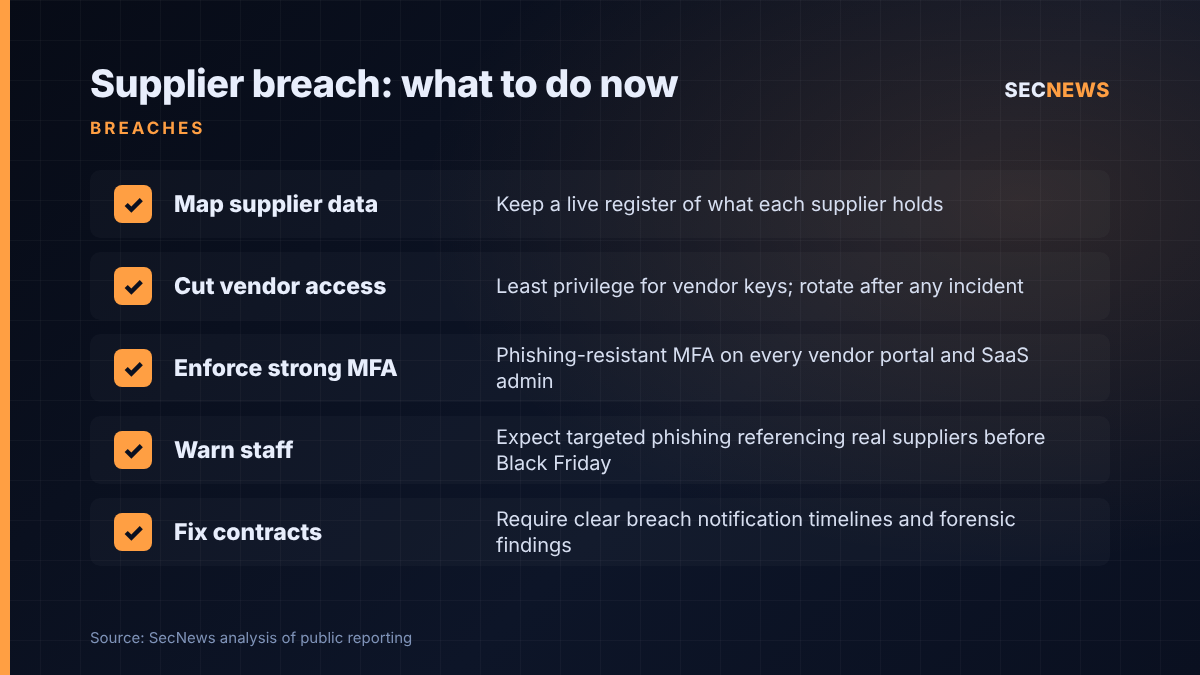
- Map what each supplier holds. Keep a live register of every online and SaaS supplier, the data they process and the access they have. Check it against reality, not just contracts.
- Cut supplier access to the minimum. Apply least privilege to API keys, service accounts and admin consoles shared with vendors, and rotate credentials after any supplier incident (Cyber Essentials: user access control, secure configuration).
- Enforce phishing-resistant MFA on every vendor portal and SaaS admin account, both yours and theirs where you can require it (Cyber Essentials: user access control).
- Brief staff and partners about targeted phishing referencing real suppliers, especially ahead of Black Friday, and make it easy to report suspicious messages.
- Write supplier breach notification into contracts, with clear timelines, access to forensic findings and a duty to tell you if other clients were affected.
- Rehearse a supplier-side incident in your tabletop exercises, including the ICO assessment, the regulator conversation and what you say to customers when facts are thin.
Bottom line
Next appears to have avoided the worst. On current evidence, customer personal data was not taken and its own network was not touched. But the incident is another sign that UK retailers’ risk increasingly sits with their suppliers. Until Next names the provider and says what was taken, every retailer that relies on online technology partners should assume it could be next and check its own supply chain now.
Sources
- The Register: British retailer Next downplays data breach at tech supplier
- City AM: Next says data stolen in cyber attack on supplier
- FashionUnited: Next confirms third-party supplier cyber incident amid sector-wide retail threats
- Beinsure: Fashion retailer NEXT investigates cyber attack on third-party online supplier