Have I Been Pwned has put a hard number on September’s breach at school software supplier Bromcom: 355,051 distinct addresses used by UK school staff and pupils. The intruders got in through a sign-on component that had been replaced but never switched off, and Bromcom has left the decision on reporting to the regulator with its school customers.
What happened
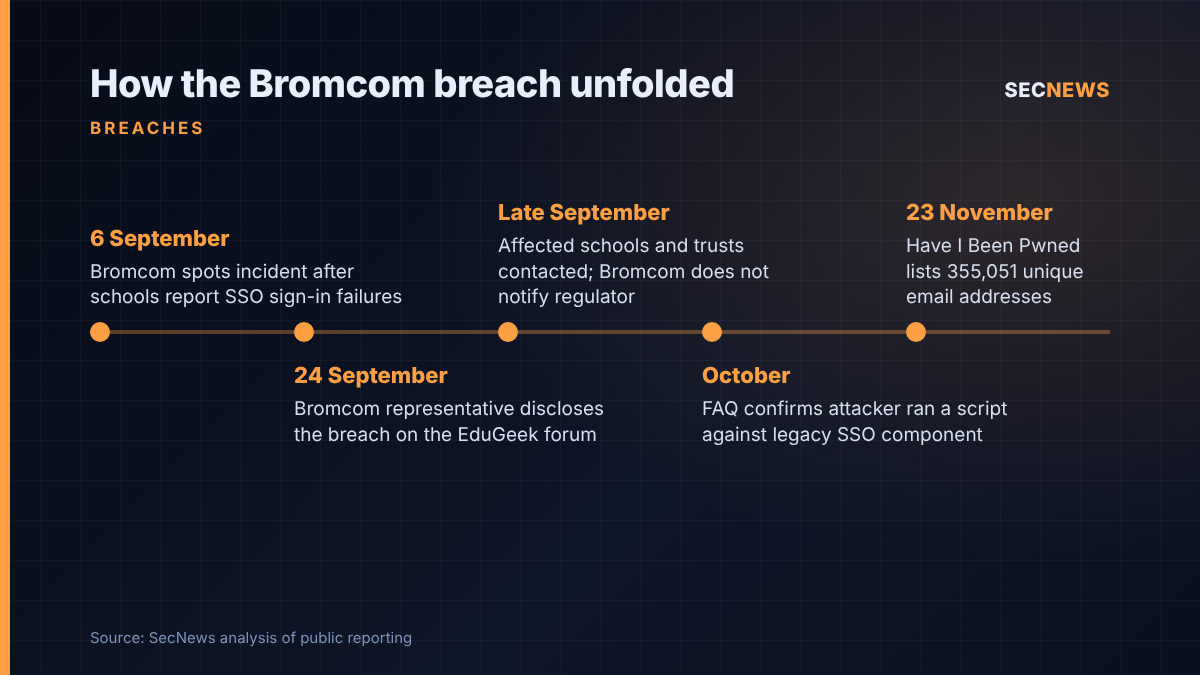
On 23 November 2026, the breach notification service Have I Been Pwned (HIBP) added Bromcom to its catalogue. The entry records 355,051 affected addresses for staff and pupils, plus single sign-on (SSO) registration reference numbers. It is the first public figure for an incident the supplier has been handling privately with customers since early September.
Bromcom supplies a cloud management information system (MIS) and related tools used in over 5,000 schools and by 390 multi-academy trusts. The Register lists the Ministry of Defence, Newport City Council and the Northern Ireland Education Authority among its recent customers. The company has not said how many schools were affected. The Register asked it whether the HIBP figure matches its own findings and had not received a reply when it published on 24 November.
Bromcom says it spotted the problem on 6 September 2026, after schools reported that staff and pupils could not sign in with SSO. Data Protection Education (DPE), which acts as data protection officer for many schools, said earlier versions of Bromcom’s FAQ described SSO registrations being deleted in bulk, which explains the lock-outs. A Bromcom representative posted about the breach on the EduGeek forum on 24 September, and DPE says many schools were contacted late that month. Bromcom now says its forensic investigation is complete.
The technical picture
The weak point was a legacy SSO registration service on Bromcom’s Communications Server, the piece that links a user’s Microsoft or Google identity to their school for Bromcom logins. A newer mechanism had already superseded it, but the old one stayed in production because, in Bromcom’s words, “it was still being called by an internal system”.
Bromcom says its forensic investigators confirmed that the attacker ran a script against the component and retrieved registration records. Drawing on earlier versions of the FAQ, The Register and DPE list the fields involved: the registered email address, the identity provider used, when the registration was created and last used, and Bromcom’s internal reference numbers. DPE adds that some records carried PIN-related data and some pupils had registered personal addresses. HIBP classes the exposed data simply as email addresses.
Bromcom is firm on what was not taken. It says the component held no passwords or tokens of any kind, offered no route around Microsoft or Google authentication, and was isolated from the MIS. Parents are unaffected, and no account takeover has been found. Its fixes include retiring the legacy service, adding authorisation checks, limiting users to removing only their own registration, and better logging.
Why it matters for UK organisations
Email addresses on their own sound mundane. The problem is context. This dataset ties each address to a named school and reveals which identity provider the person uses. That is reconnaissance a phishing crew would otherwise do by hand, and a Microsoft-themed lure mimicking the school’s MIS will land far better with a known Microsoft user than a generic one.
The stakes are high because the MIS sits behind that login, often holding pupil records, special needs and medical details, and safeguarding files. The leaked records do not open the MIS themselves, but a phished staff password on an account without strong multi-factor authentication (MFA) would.
The regulatory handling also deserves attention. Bromcom has not notified the Information Commissioner, arguing that it processed this data on behalf of schools and that each school or trust, as controller, must judge its own duty under UK GDPR. That is legally defensible, but it pushes stretched school business managers into a 72-hour assessment built on supplier information that changed several times over the autumn. DPE says it will report on behalf of its own customers, and notes that the ICO’s renaming as the Information Commission on 30 September has not changed the process.
Expert view
The root cause will be familiar to anyone who tests for a living. When we scope an external assessment, the trouble rarely comes from flagship applications. It comes from forgotten endpoints: an old API version kept alive for one integration, or a service nobody remembers owning. Bromcom’s component is a textbook example. It was replaced, but an internal dependency kept it reachable, and it evidently lacked the authorisation checks the company has since added. In my experience, asset registers and decommissioning plans tend to track products rather than the individual services behind them, which is exactly how these orphans survive.
I would also question the “low risk” verdict. Bromcom bases it on the limited fields involved and on most addresses using institutional domains protected by schools’ own controls. That holds only where those controls are actually in place. In education, MFA coverage still varies widely, especially for pupil accounts and support staff. A verified, provider-tagged list of 355,000 addresses keeps its value to criminals and tends to resurface months later.
The notification gap matters too. Weeks between detection and school letters leave controllers little room, so trusts should check their processor contracts set firm deadlines.
What to do now
- Confirm whether you are affected. Bromcom says record-level files sit in affected customers’ support portal accounts under Incident Documents; support partner customers should ask their partner. HIBP’s free domain search also covers school domains.
- Enforce MFA on every account that signs in to the MIS. This maps to Cyber Essentials user access control and the DfE Cyber Security Core Standard. Favour passkeys or hardware keys for staff and administrators.
- Watch your identity logs. Check Entra ID or Google Workspace sign-in records since early September for password spraying, surprise MFA prompts, new mail forwarding rules and unfamiliar locations.
- Brief staff and pupils now. No legitimate supplier will ask anyone to re-register an account or confirm a login they did not initiate. Unexpected prompts should be denied and reported.
- Record your controller decision. Log the incident, assess the risk with your DPO, decide on regulator notification and write down your reasoning either way.
- Keep a non-SSO route in. The September lock-outs showed why a documented break-glass route into critical systems belongs in your continuity plan.
- Audit your own legacy services. Inventory superseded components, integrations and test accounts, and switch off anything without a named owner. This reflects the Cyber Essentials secure configuration control.
- Tighten supplier terms. Ask key suppliers how they retire legacy components and how quickly they will tell you about a breach.
Bottom line
No passwords were stolen and the MIS appears untouched, so this is not a catastrophe. It is, though, a ready-made phishing list covering a large slice of the UK school estate, created by a component that should have been retired. Schools should treat the HIBP listing as the cue to close their MFA gaps and record their own notification decision, rather than relying on the supplier’s assessment.
Sources
- Have I Been Pwned: Bromcom Data Breach
- Bromcom: SSO Personal Data Breach FAQs
- The Register: Education software supplier’s legacy login system left 355,000 school email addresses exposed
- The Register: Legacy sign-on service comes back to bite school software provider Bromcom
- Data Protection Education: Bromcom SSO Data Breach