The NCSC wants an industry partner to take over the day-to-day running of CHECK, its assured penetration testing scheme, along with two other assurance services. Under the Project CORNERSTONE proposal, the partner would run on a self-funding concession while the NCSC keeps control of the standards and the brand.
What happened
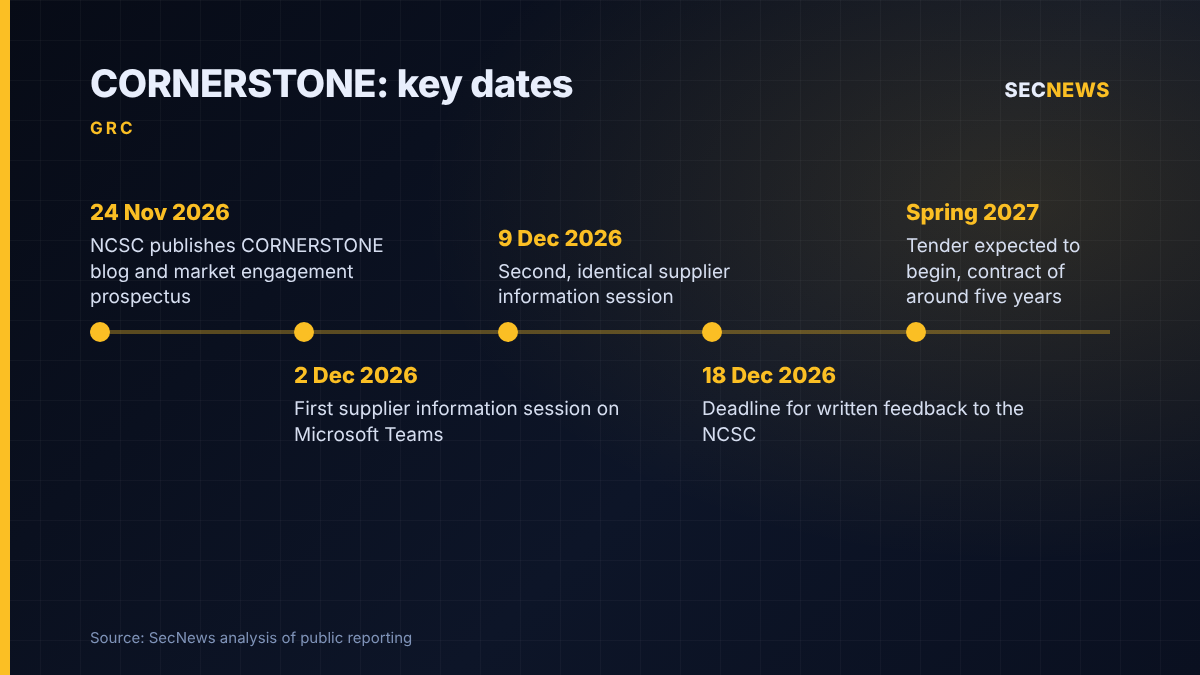
On 24 November 2026 the National Cyber Security Centre published a blog post and a market engagement prospectus for Project CORNERSTONE. The NCSC describes it as a multi-year effort to rethink how its outward-facing services are built and run. The first phase covers three areas:
- scheme management for CHECK, the NCSC’s assured penetration testing scheme for government, the public sector and critical national infrastructure (CNI);
- assurance of the Cyber Resilience Test Facilities (CRTF) that evaluate connected products;
- a brand new assurance scheme for commercial Protective DNS (PDNS) providers.
The NCSC says this is early market engagement, not a call for bids. It is holding two identical supplier sessions on Microsoft Teams on 2 and 9 December and wants written feedback by 18 December. It expects a tender to start in spring 2027, subject to the necessary governance and approvals, and is considering a contract of about five years. Taking part creates no commitment on either side.
The NCSC says the ambition goes beyond these three services. The prospectus describes CORNERSTONE as a way to test an operating model through which the centre could govern and assure a wider portfolio, potentially including Active Cyber Defence services where industry delivery makes sense.
The detail
The NCSC’s key distinction is between owning a scheme and administering it. In the proposed split, the centre keeps the technical standards, strategic oversight, approval of any new service and the licensing of the NCSC-assured brand. The prospectus calls this remaining the “root of trust”. A delivery partner, or possibly a consortium, would handle the work around it: onboarding providers and checking they remain suitable, scheme administration and assurance processes, secure data handling, management information, shared tooling and continuous improvement.
For CHECK, the NCSC says it is testing whether industry can take on scheme management, not penetration testing itself. Buyers would still contract directly with assured CHECK companies, as they do now. According to the NCSC’s 2025 Annual Review, 54 companies were assured under CHECK at the time and had carried out more than 2,684 tests in the preceding 12 months.
For CRTF, the partner would assure the test facilities themselves, confirming that they can apply the NCSC’s principles-based methodology. The NCSC would keep ownership of that methodology. PDNS is the odd one out. The existing NCSC Protective DNS service is a live, contracted service that blocks resolution of known malicious domains. CORNERSTONE would not re-let it. It would create a separate scheme that assures commercial PDNS providers against NCSC-approved requirements, so organisations could choose from vetted suppliers. The NCSC says PDNS is included partly to test whether new schemes can be built and scaled with industry.
The commercial model is the part most open to challenge. The NCSC “imagines” a self-funding concession, which suggests the operator’s revenue would come from the scheme ecosystem rather than central funding. It is asking the market where value and cost sit, what upfront investment an operator would need and what risk allocation would be attractive while still being value for money.
Why it matters for UK organisations
CHECK is the benchmark many public sector bodies and CNI operators write into their procurement. Any change to who runs it, and how it is paid for, will eventually reach buyers. The NCSC has done this before. Cyber Essentials certification is licensed through its delivery partner IASME, and the NCSC’s Annual Review records the transfer of its Smart Metering CPA scheme to CyTAL, which now operates it. CORNERSTONE would extend that approach into higher-assurance territory.
For buyers, the NCSC’s stated aim is faster onboarding, better data on what assured services achieve, and the ability to launch new schemes more quickly as threats change. The obvious risk is cost. A self-funding concession has to make money somewhere, and fees charged to assured companies tend to be passed on in day rates. Buyers who rely on CHECK to meet contractual or regulatory testing obligations should follow the commercial model as it develops.
The timing also matters. As UK regulation of essential and digital services tightens, demand for independent, assured testing is unlikely to fall. The NCSC itself says growing demand makes the current model harder to scale.
Expert view
In my experience, the value of CHECK has never been the paperwork. It comes from the standard behind it and from the NCSC being willing to remove people and firms who fall short. So the real question for CORNERSTONE is whether the root of trust holds when someone else runs the administration. The prospectus says the right things: the NCSC keeps the standards, keeps the brand and requires “appropriate independence and separation”. The details will decide it, especially who handles complaints, who can suspend a provider and how disputes reach the NCSC.
Conflict of interest is the obvious trap. Many organisations capable of running a national scheme also own testing practices, consultancies or certification businesses. A concession holder that admits, monitors and potentially sanctions its own competitors would need ring-fencing that is visible from the outside, not just written into a contract. The prospectus asks about this directly, which is encouraging.
Data is a further concern. CHECK engagements give the NCSC a cross-sector view of weaknesses in government and CNI systems, and the centre wants to keep access to that intelligence. Whoever handles it will hold a sensitive dataset.
That said, there is a good argument for the change. When we test, the slowest parts of the CHECK experience are usually administrative, not technical. If a partner can speed up onboarding and produce better management information while the NCSC concentrates on standards, the scheme could get stronger.
What to do now
- Assured providers: register for one of the supplier sessions on 2 or 9 December and send written views by 18 December. Once the tender starts, the chance to shape fees and governance largely disappears.
- Public sector and CNI buyers: check where your contracts, policies or regulator commitments name CHECK specifically. Note any renewal dates that fall in 2027 or later, when a new operator could be in place.
- Security leaders: raise the cost question in your feedback, whether directly or through a trade body. A self-funding model should come with transparent fees and published performance measures.
- Organisations considering PDNS: keep watching the new assurance scheme. An NCSC-assured list of commercial providers would make it easier to choose one, which supports the malware protection and boundary firewall controls in Cyber Essentials.
- Everyone: keep testing. Nothing changes yet for current CHECK engagements.
Bottom line
CORNERSTONE is a sensible attempt to scale NCSC assurance without wearing down the centre’s technical staff, and the NCSC is right to ask for criticism before writing a tender. Success depends on what the prospectus leaves open: funding, enforced independence and who acts when a provider falls short. Firms that rely on CHECK should respond now while the design is still open.