Gen Digital, the company behind Norton, Avast, AVG, Avira and LifeLock, has lifted its full-year forecast for a second time after quarterly revenue rose 12% to $1.369bn. The numbers say a lot about where consumer and micro-business security is going, and about what UK households and sole traders are actually paying for.
What happened
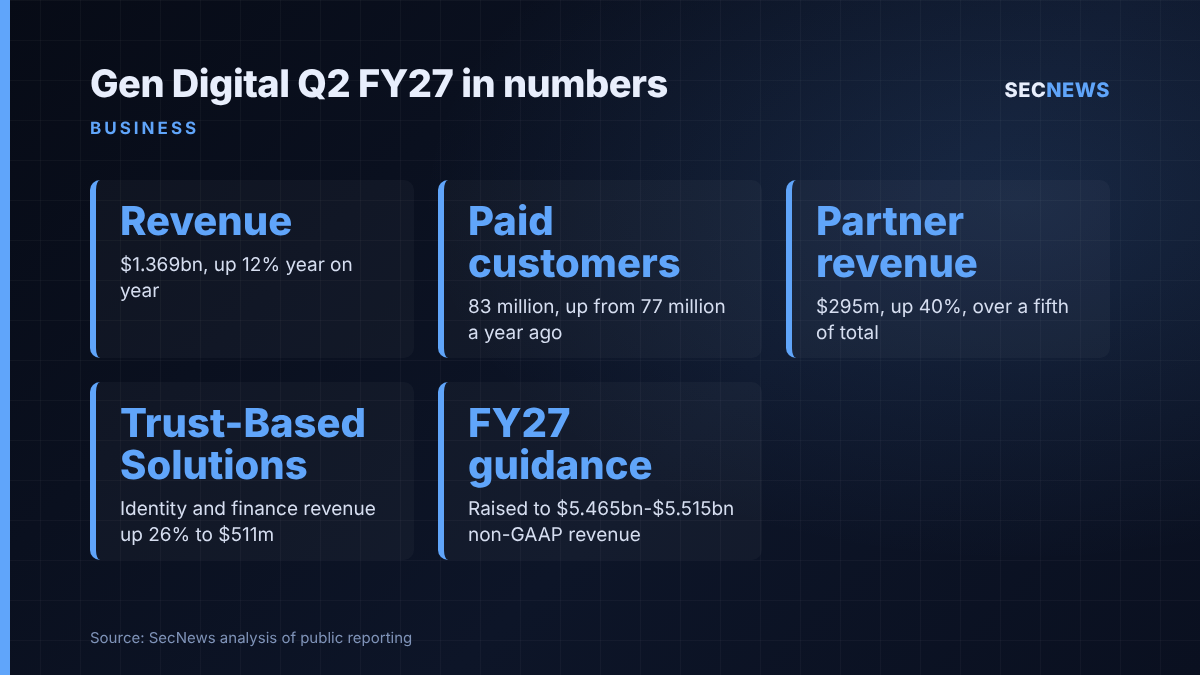
On 28 October 2026 Gen Digital published results for the second quarter of its 2027 financial year, covering the three months to 2 October. GAAP revenue came in at $1.369bn, against roughly $1.22bn a year earlier. Bookings grew 10% to $1.347bn. Chief executive Vincent Pilette called it the sixth quarter in a row of double-digit bookings growth.
GAAP operating income rose 16% to $507m, and net income more than doubled to $287m from $134m. On the adjusted basis that Wall Street watches, earnings per share rose 19% to $0.74. Paid customers reached 83 million, compared with 81 million three months ago and 77 million a year ago.
Gen then raised its outlook for the full year, which ends in early April 2027. It now expects non-GAAP revenue of $5.465bn to $5.515bn, up from $5.375bn to $5.475bn, and adjusted EPS of $2.93 to $2.98. It is the second upgrade this year, after one in August.
The detail
Gen reports in two segments, and they are growing at very different rates. Cyber Safety covers the antivirus, VPN, privacy and security suites most people know from Norton and Avast. It brought in $858m, up about 5%. Trust-Based Solutions covers identity protection, reputation services and the MoneyLion financial products, and it grew 26% to $511m. Gen is making most of its growth outside traditional endpoint protection.
The partner channel stood out. Revenue from retailers, telecoms operators, employee-benefit schemes and financial marketplaces rose 40% to $295m and now makes up more than a fifth of the total. On the earnings call, management said employee-benefit growth was the strongest in more than five quarters, and that the pipeline for its Norton Money Workplace product had passed $30m.
Norton 360, the flagship suite, has passed an annualised revenue run rate of $1.7bn. According to the call, customers who move to higher tiers or take several products show retention and revenue per user 5 to 10 points higher.
The call also covered AI. Gen said AI now handles about half of customer support contacts from start to finish, wrote 75% of the code it shipped in the first half, and helped bring operating expenses down to 30% of sales. Norton 360 is being rebuilt around a new VPN, scam protection and AI features. Gen is also building protection for consumers who are starting to give personal AI agents access to their email, passwords and payment details. Management expects no material revenue from these agent-security products this financial year. Pilette was also blunt that the company is “not working on the transformative acquisition today”.
Why it matters for UK organisations
Gen’s brands are everywhere in the UK. When the Competition and Markets Authority cleared NortonLifeLock’s roughly £6bn takeover of Avast in 2022, it named McAfee as the main rival and Microsoft’s built-in Windows protection as a growing alternative. The inquiry chair stressed how many UK consumers depend on such software. Most of those users are families, but many are sole traders, small shops and micro-businesses that run their whole company on a couple of laptops and a phone.
This matters for three reasons. First, the threat these products are sold against is changing. Gen told investors that scams make up more than half of what its products block, and that its telemetry showed email, text and phone-call scam protection up about 30% on the previous quarter. Lures are becoming more personal and more local, including family impersonation texts and AI-generated scam videos in the victim’s own language. In small UK firms, a convincing message to whoever pays the bills is often all an attacker needs.
Second, the partner growth means more UK workers will get consumer-grade security through their broadband provider, mobile operator or employer rather than buying it themselves. That widens coverage, but more of those devices will end up doing work with no company control over their set-up.
Third, the identity and AI-agent push shows where risk is heading. Gen said the breach notices it sent members increased over six times in the first half, and that people are starting to ignore them. For a UK micro-business, a credential leak from a personal account can easily become a business compromise.
Expert view
The more useful signal here is what customers are buying. They are not paying for better malware detection. They want help with scams, identity theft and data spread across dozens of services. In my experience testing small organisations, the attack path rarely starts with something an antivirus engine would catch. It starts with a reused password, a mailbox with no multi-factor authentication or a phone call that sounds real.
Still, a consumer suite on the director’s laptop is not a security programme. When we assess micro-businesses, we often find the paid product working well while the basics underneath it are missing: no separate admin account, no MFA on the email that resets every other password, and backups that sit on the same machine they are meant to protect. Bundles sold through employers and telecoms operators will raise the baseline, but they do not replace the controls in Cyber Essentials.
The AI-agent material deserves attention even though Gen admits it earns nothing yet. Giving a personal assistant your inbox, password vault and card details creates a new kind of insider. If a consumer security giant is building a business around policing that, smaller firms should assume staff will start doing it on work data before any policy says they can.
What to do now
- Know what protects each device. List every laptop and phone used for business, including personal ones, and record which security product is on it, who pays for it and when it renews. This maps directly to the Cyber Essentials malware protection and device inventory requirements.
- Turn on MFA everywhere it matters. Start with email, banking, accounting software and cloud storage. A consumer suite does not stop a phished password being used from another country.
- Separate admin from everyday use. Use a standard account for daily work, as the Cyber Essentials user access control requirement expects.
- Treat breach alerts as tasks. When an identity service warns that a password has leaked, change it and check where else it was used. Do not swipe the alert away.
- Set rules for AI assistants now. Decide whether staff may connect personal AI agents to business email, files or payment details.
- Train against scams. Agree a call-back check for any request to change bank details or pay urgently.
Bottom line
Gen’s raised forecast confirms that consumer security is now a business built on scams, identity and trust rather than on catching viruses. For UK households and the many small firms that run on consumer kit, the products are getting broader. The basics still matter more: MFA, separate admin accounts, tested backups and a habit of checking before paying.
Sources
- Gen Digital: Gen Delivers Another Double-Digit Growth Quarter in Q2 FY27 and Raises FY27 Outlook
- Securities.io: Gen Digital Lifts Fiscal 2027 Guidance as Q2 Revenue Rises 12%
- TradingKey: Gen Digital (GEN) Fiscal Q2 2027 Earnings Call: Revenue Up 12%, Guidance Raised
- GOV.UK (CMA): CMA clears NortonLifeLock / Avast merger
- Gen Digital: Gen Brands Norton, Avast, AVG and Avira Earn 16 Award Recognitions