Symantec says an attacker ran 41 PowerShell modules against an African stock exchange in a little over three minutes, using a toolkit it believes was probably written with AI help. The credential hunt, the probing of financial APIs and the quiet DNS exfiltration are all things UK market infrastructure should be testing for now.
What happened
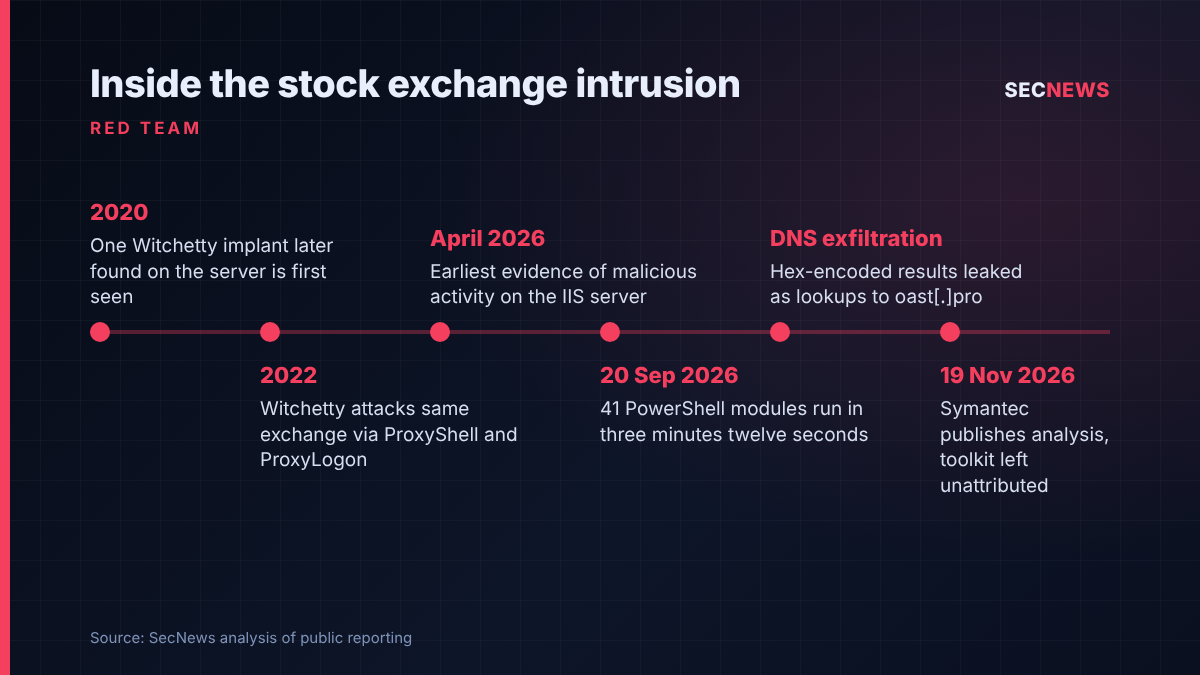
On 19 November 2026 Symantec’s Threat Hunter Team, part of Broadcom, published an analysis of an intrusion at a major stock exchange in an unnamed African country. On 20 September 2026, between 08:44 and 08:47 UTC, 41 separate PowerShell modules ran under a web shell on a Microsoft IIS server at the exchange. The whole sequence took three minutes and twelve seconds, and a new module started every few seconds.
The modules went looking for passwords, cloud keys and database connection strings. Those secrets were then tried against two systems that sit very close to the money: an investment API run by the exchange and a securities depository’s gateway. Symantec could not see where the results went, so whether any stolen credential actually worked is unknown. It found no evidence of privilege escalation or confirmed data theft.
The same server held six persistence implants, which Symantec attributes with high confidence to Witchetty (also tracked as LookingFrog), a China-linked espionage group. Symantec says one of those implants was first seen in 2020, and the earliest malicious activity it found on the server dates from April 2026. Symantec reported in 2022 that Witchetty had already hit this exchange, alongside two Middle Eastern governments, via ProxyShell and ProxyLogon on Exchange servers.
Symantec has deliberately not pinned the September toolkit on Witchetty. Its three scenarios are that the group returned with fresh tooling, that a more capable operator reused Witchetty’s foothold, or that an unrelated actor broke into the same box. None can be ruled out.
The technical picture
The toolkit was a set of single-purpose scripts rather than one large implant. According to Symantec, the jobs included host enumeration, profiling IIS, hunting for cloud and DevOps tooling, and scraping secrets from web roots, deployment folders and SYSVOL, including Group Policy Preferences passwords that defenders have been warned about for over a decade.
Other modules probed an AWS-hosted PostgreSQL database and a SQL Server, searched SharePoint for files mentioning credentials, queried Team Foundation Server and asked SCCM where a particular user last logged on, a classic way to find an administrator’s workstation. Four modules focused on the investment API, attempting a guessed login, replaying a bearer token and cycling harvested API keys against the depository gateway. A lookup of one specific investor number is one reason Symantec will not rule out espionage, even though the targets look financial.
Exfiltration is the part blue teams should study. Rather than posting data to a web server, each module encoded its results as hex and leaked them in small pieces as DNS lookups to oast[.]pro, a public out-of-band interaction service of the kind penetration testers use to confirm blind vulnerabilities. Whoever controlled the token could collect the data. Symantec calls the method rarely seen.
The AI question deserves careful wording. Symantec says the 41 modules were strikingly uniform: the same opening error-handling line, the same try/catch wrapper, the same hex encoding and the same empty-output marker. The DNS routine was duplicated identically in every script, where a human developer would usually factor it into one reusable function. One module carried a progress variable the others lacked, which Symantec likens to a model refining a single script in isolation. Symantec stresses that no single clue is conclusive and that it could not identify a model, but judges that together the signs fit AI-assisted or AI-generated code better than hand-built tooling. As Cybersecuritynews notes, the speed shows automation, not authorship.
Why it matters for UK organisations
The UK runs one of the world’s largest capital markets, with exchanges, depositories, clearing houses, brokers and a wide ring of post-trade suppliers. An internet-facing Windows web tier in front of APIs that talk to settlement systems will be familiar to anyone who has tested in that sector. So will the weaknesses targeted here: secrets in config files, legacy GPP passwords, reused tokens and API keys that never expire.
There are two lessons. First, a cheap and fast reconnaissance burst like this one shortens the gap between a foothold and a serious attempt on financial systems to minutes. Second, exfiltration over DNS to a legitimate testing service will slip past controls that only watch HTTP egress or block known-bad domains. Firms within the Bank of England and FCA operational resilience regime, and those taking part in intelligence-led testing such as CBEST, should make sure their scenarios include this pattern rather than assuming a slow, hands-on operator.
Expert view
None of these techniques is new. GPP passwords, SYSVOL trawling, SCCM lookups and DNS tunnelling have been in red team playbooks for years. What differs is the packaging. When we test, an experienced operator might spend an afternoon working through that list carefully on one host. Here it took three minutes, with a purpose-built script per task.
I would treat the AI attribution as plausible rather than proven, as Symantec does. The more important point is practical: whether a model or a tired developer wrote it, the uniform scaffolding is a gift to defenders, because a repeated pattern is easy to detect. In my experience, out-of-band testing domains are often allowed through because security teams use them themselves. That trust is now a weakness.
Finally, an old compromise left in place is an open door for whoever comes next. If an exchange already targeted in 2022 still had espionage implants on a server in 2026, the real problem is not the new toolkit.
What to do now
- Hunt for web server processes spawning PowerShell. Alert on w3wp.exe launching powershell.exe or cmd.exe, especially in rapid bursts. This maps to the Cyber Essentials malware protection control.
- Control DNS egress. Force servers to use internal resolvers, log queries and flag long hex-like subdomains or lookups to out-of-band testing services such as oast[.]pro and similar interaction domains. Allow them only from named testing hosts. This supports the firewalls control.
- Clear out GPP passwords and secrets in files. Search SYSVOL, web roots and deployment directories for cpassword values, connection strings and cloud keys, and move secrets into a vault. This is secure configuration.
- Tighten API authentication. Use short-lived tokens, rotate API keys, bind keys to known clients and alert on repeated key failures against settlement or depository gateways. This is user access control.
- Patch and rebuild internet-facing IIS and Exchange servers. Where historic compromise is suspected, rebuild from known-good images rather than cleaning in place. This is security update management.
- Import Symantec’s indicators into endpoint and DNS monitoring.
- Update test scenarios. Ask your red team or CBEST provider to include fast automated credential sweeps and DNS exfiltration through trusted services.
Bottom line
This intrusion used old techniques far faster, with code Symantec believes a model probably helped write, aimed at systems that move money in a capital market. UK financial organisations should assume the next reconnaissance burst could finish in minutes, and check that egress monitoring, secrets hygiene and API controls are ready.
Sources
- Symantec (Broadcom): Major African Stock Exchange Targeted in AI-Assisted Attack
- Cybersecuritynews: Hackers Use AI-Assisted PowerShell Toolkit With 41 Modules to Target African Stock Exchange
- GBHackers: AI-Assisted Hackers Deploy 41 PowerShell Scripts to Steal Credentials From African Stock Exchange
- Cyber Press: Hackers Launch 41 PowerShell Modules in Three Minutes to Harvest Financial Credentials