An attacker’s own carelessness has given defenders a rare look at autonomous AI hacking agents at work, including the moment they found an unknown flaw in a medical imaging tool. Amazon says the agents went from mapping the application’s API to writing files on the server in about 11 minutes.
What happened
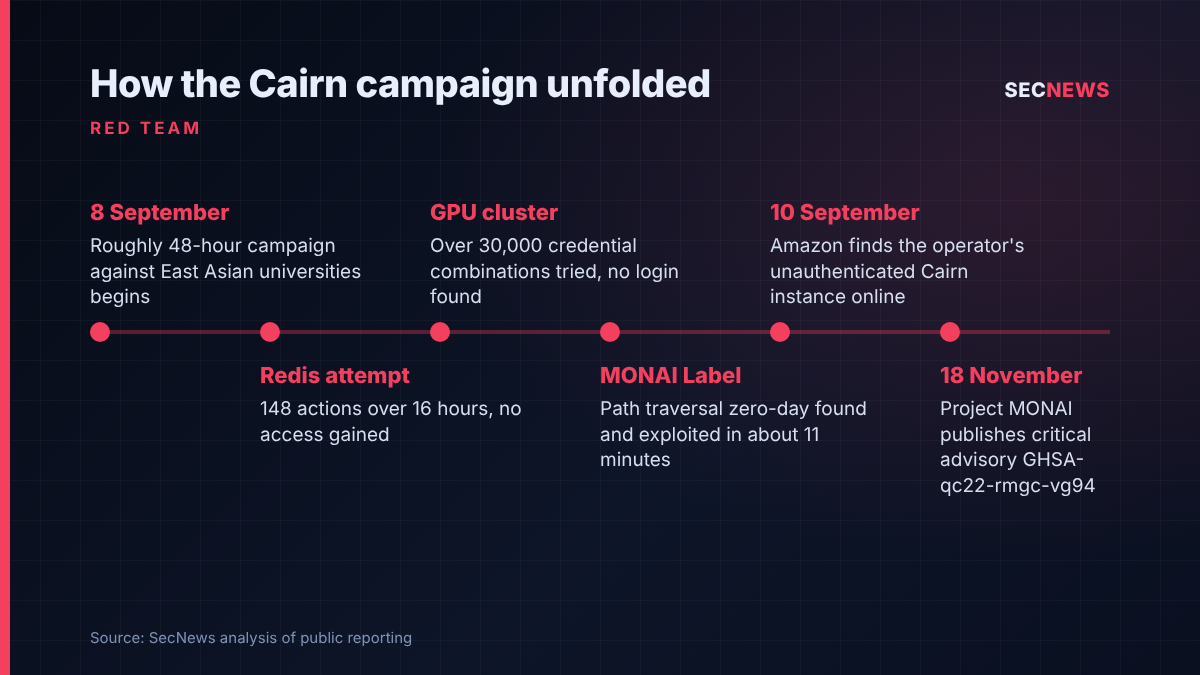
On 20 November 2026 Amazon Threat Intelligence published findings from a campaign it attributes, with moderate confidence, to a Chinese-nexus operator. The investigation began on 10 September, when Amazon came across a server hosting an instance of Cairn, an open-source framework that strings together multiple AI agents to carry out penetration testing tasks. The operator had left it reachable from the internet with no login, so its project settings, prompts and agent output were open to anyone who looked.
That history showed roughly 48 hours of activity from 8 September against IP addresses belonging to universities in East Asia outside mainland China. The prompts were in Simplified Chinese and script timestamps were set to China Standard Time. AWS declined to name the institutions or the country, and notified them through a government partner because they were not AWS customers.
The headline finding is that the agents, given little more than a list of targets and the instruction to “obtain shell access”, discovered and exploited a previously unknown vulnerability in MONAI Label, an open-source application used to annotate medical images for AI model training. Amazon reported the bug to the maintainers, and Project MONAI published a critical advisory, GHSA-qc22-rmgc-vg94, on 18 November. This is a separate investigation from the Unit 42 report on a different Cairn-using group that we covered on 12 November, and it centres on a newly discovered zero-day.
The technical picture
Amazon’s write-up usefully shows the failures too. Against one university’s Redis server, which had been left open without authentication, the agents worked through 148 steps over about 16 hours. They cycled through well-known Redis takeover methods, tried Log4Shell on a neighbouring service, abused a server-side request forgery flaw in a co-located Qdrant database to map the internal Docker network, then sprayed credentials at PostgreSQL and SSH. Nothing worked.
A second operation lasted more than six hours against a research GPU cluster. The agents built a list of around 80 genuine usernames by trawling faculty pages, lab sites, archived web content and academic papers, then tried more than 30,000 credential combinations across SSH, an admin dashboard, a storage appliance, a VPN and the campus portal. Again, no successful login.
The MONAI Label target went differently. The agents fingerprinted the framework, enumerated its API and spotted an upload function that accepted a caller-supplied identifier. According to the advisory, the datastore image and label upload endpoints did not validate that value, so path traversal sequences allowed files to be written anywhere the service account could reach. Crucially, MONAI Label ships with authentication disabled, so any client that can reach the port can abuse it; even with authentication switched on, the low-privilege annotator role is enough. In a later session the agents turned the file write into code execution and a root shell. The operator then stepped in, handing the agents a tunnel into a second university running the same software.
The advisory covers versions 0.8.5 and earlier and has no CVE. Coverage of the fix is slightly inconsistent: Amazon and BleepingComputer say a fix was released, while the GitHub advisory itself lists no patched version and points to a merged pull request (#1915) due in the next release.
Why it matters for UK organisations
MONAI is an open-source medical imaging AI project, and MONAI Label is the kind of tool that appears in university research groups, NHS-affiliated imaging projects and health-tech start-ups. Researchers often stand these up quickly on a GPU box or cloud instance, outside normal vulnerability management. A tool that defaults to no authentication, running on a machine that holds patient-derived imaging data, is exactly the asset that gets missed.
Universities, in the UK as elsewhere, attract state-linked espionage because of their research and industry partnerships, and their sprawling, devolved networks make exposure hard to track. What this report changes is the economics. An operator no longer needs a skilled human to spend a day hammering on a Redis server or researching staff names; an agent will do it tirelessly, overnight, and the operator only needs to intervene once something lands. Cyber Essentials expects internet-facing services to require authentication and critical or high-risk security updates to be applied within 14 days, and research infrastructure is not exempt from that just because it sits in a lab.
Expert view
When we test university and research environments, the riskiest hosts are rarely the managed corporate estate. They are the forgotten Jupyter servers, annotation tools and model dashboards that a PhD student exposed so a collaborator could reach them. What Amazon describes is essentially a methodical external test: reconnaissance, open-source intelligence on staff, credential attacks, then probing every input on an unfamiliar application until one breaks. None of it is new; it simply ran with almost no human effort and never got bored.
I would also read the failures carefully. A properly hardened Redis instance and decent password hygiene beat the agents for the best part of a day. The zero-day itself was a classic input validation bug in software that left the door unlocked by default. Gambit Security’s Eyal Sela told The Record that Cairn’s general-purpose design makes it “less predictable” than purpose-built tools, which is a fair warning for anyone writing detections around one framework’s behaviour.
Amazon’s CJ Moses makes the point that matters most for defenders: an agent that finds and exploits a flaw in minutes finishes before many SOCs have triaged the first alert. If your response depends on a human reading every event, you are already behind.
What to do now
- Find MONAI Label. Search asset inventories, cloud accounts and research subnets for MONAI Label and update to a release containing the fix as soon as one is available.
- Turn authentication on. Enable authentication on MONAI Label and on every research and ML tool that defaults to open access (Cyber Essentials: secure configuration).
- Restrict exposure. Put research tools behind a VPN or identity-aware proxy and block direct internet access at the firewall (Cyber Essentials: firewalls).
- Hunt for compromise. Look for unexpected files written outside the datastore directory, new Python processes spawned by the service, and outbound connections from imaging or GPU servers. Check logs for the two IP addresses Amazon published, 142.4.98.145 and 142.4.107.34.
- Harden the basics that worked. Require authentication on Redis and other data stores, enforce MFA on VPN and portals, and rate-limit or lock out credential spraying (Cyber Essentials: user access control).
- Automate first response. Wire high-confidence detections, such as mass login failures or web shells, to automatic containment, with analysts reviewing outcomes.
Bottom line
This is one of the clearest public accounts yet of AI agents finding and using a zero-day with minimal human help, and it came about only because the attacker forgot to lock their own console. Inventory your research tooling, put authentication in front of it and assume the next probe will run all night.
Sources
- AWS Security Blog: Chinese-nexus actor’s Cairn AI agents found a zero-day on their own
- GitHub (Project MONAI): GHSA-qc22-rmgc-vg94, Path traversal in datastore upload endpoints allows arbitrary file write
- The Record: Amazon says Chinese hackers used Cairn AI tool to discover apparent zero-day during attack on university
- BleepingComputer: Hackers use autonomous AI tool Cairn to find zero-day, take over server