A Dutch researcher has gone public with six unpatched, pre-authentication flaws in Danfoss AK-SM800A refrigeration controllers. Coordinated disclosure with the vendor is still under way. There are no CVEs and no fix, and his message to store operators is blunt: stop counting on patches and get these boxes off the internet.
What happened
Carlo Meijer of Midnight Blue, a Dutch security consultancy, has published an analysis of the Danfoss AK-SM800A. Supermarkets and other cold-chain operators use this controller to run their chillers, freezers and defrost cycles, and maintenance contractors often manage it remotely. Meijer took the firmware Danfoss offers for public download, ran the web components in an emulator and reviewed the code by hand. In under an hour he says he found six pre-authentication memory-corruption bugs. All six are stack-based buffer overflows, and he says he used no AI.
The unusual part is the timing. Midnight Blue says it is still working through coordinated disclosure with Danfoss and is holding back technical specifics until that concludes. Even so, it chose to describe the class, location and impact of the flaws now. Its reasoning is that these controllers are being actively targeted, so owners need an honest view of the platform today rather than months from now. Specialist press picked up the research from 16 November, and The Hacker News, Security Affairs and The Register all note that no CVE identifiers or patches exist yet.
For background, this site has already covered the October and November attacks on exposed Danfoss and Copeland controllers. Germany’s BSI says it knows of no exploitation of the six new bugs, and nobody links them to those incidents.
The technical picture
Meijer examined firmware 5.3.2, which was the newest build at the time, and says all earlier releases share the bugs. Five of them sit in web request handlers that are reachable without logging in, inside a large monolithic application that runs with root privileges. Midnight Blue showed code execution against an older 3.3.0 build and says the same weaknesses persist in 5.3.2.
Since version 4.0, Danfoss’s main defence has been “Strict” session control. This is an authentication gateway that demands HTTPS and session tokens and turns away almost every unauthenticated request. France’s CERT-FR recommended enabling it after the October attacks. The sixth flaw, however, lives in the gateway process that enforces Strict mode. With Strict mode on in emulation, Meijer could crash that gateway, and he believes further work would yield code execution.
His broader criticism is about engineering hygiene. The binaries ship without stack canaries or position-independent executables, which are standard compiler-level protections, and the units do not use the secure boot features of their i.MX6 processors. Midnight Blue argues that this would let an intruder with root stay resident even after a reset or reflash, or deliberately brick the hardware so it has to be replaced. It also notes that several Danfoss divisions are certified to IEC 62443-4-1 for secure development, and says that certificate tells buyers little about how the shipped product actually behaves.
Whether a patch exists is also unclear. Danfoss lists a 5.4.0 package dated November, but according to The Hacker News its notes describe no security fixes. The researchers say its build date, apparently 29 October, predates their reports. Germany’s BSI initially declared 5.4.0 unaffected and then corrected itself the same day, saying it could not rule that out. Danfoss did not answer The Register’s request for comment.
Why it matters for UK organisations
Danfoss refrigeration control is widespread in European food retail, and UK supermarkets, convenience chains, cold stores and pharmacy cold chains run similar estates. The operating model is the real exposure. A refrigeration contractor typically installs the controller, often adds a 4G modem for remote monitoring, and works under service and insurance terms that assume remote access. Corporate IT and the SOC may not know the device exists.
So far the warnings have come from Belgium, Ireland and Germany. The Centre for Cybersecurity Belgium says taking units off the internet cannot wait for a fix. Danfoss’s own update guide makes the same point, and according to The Hacker News it states that the advice “applies to all software versions, including those with Strict Mode enabled”. UK operators should not wait for a domestic advisory before acting on that logic.
There is a lesson for UK researchers too. Meijer worked on downloadable firmware in an emulator and never touched anyone else’s live controller. While Computer Misuse Act reform remains unfinished, that is the safest footing available, and nobody should “check” exposed controllers they do not own.
Expert view
In my experience, vendors push back hardest on partial disclosure while a CVD process is still open, and the convention exists for good reason. Here I think Midnight Blue got the balance about right. It published no endpoints and no exploitation method, and the information it did share mainly helps defenders. The products are already under attack, the vendor already says to keep them offline, and the core claim concerns code quality rather than a single bug. Owners need to hear that now, not after a 90-day embargo.
“Don’t bother patching” will sound heretical to anyone who audits against Cyber Essentials. It is really a statement about where to spend limited effort first. Midnight Blue describes chasing individual fixes for a codebase like this as “a misallocation of scarce security and personnel resources”. When we test operational technology, reachability nearly always matters more than any single CVE. A flawed device that nobody can reach is manageable. The same device on a public IP, or behind a contractor’s SIM card, is not.
Procurement teams should take note as well. A secure development certificate is not proof that hardening flags were switched on in the build you received, so ask for evidence.
What to do now
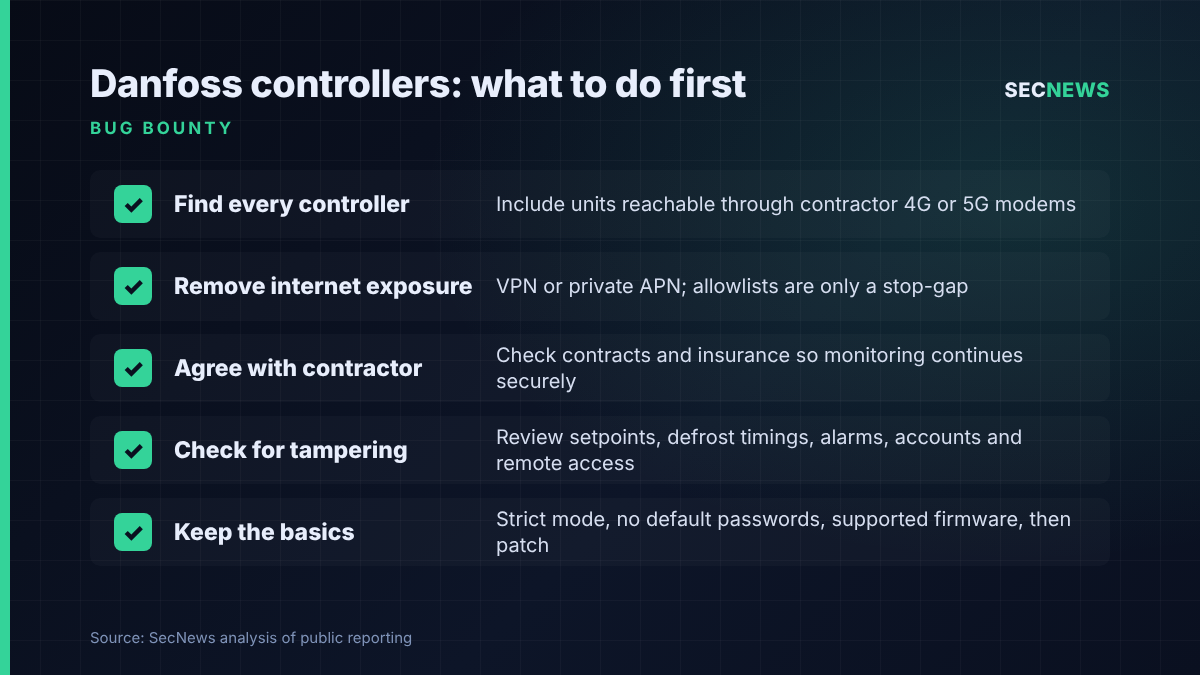
- Find every controller. Inventory Danfoss, Copeland, Dixell, Eliwell and similar units, including any that are reachable through a contractor’s mobile modem rather than your own IP ranges. This maps to the Cyber Essentials firewall and scoping requirements.
- Remove direct internet exposure. Put management interfaces behind a VPN or a private APN. A contractor IP allowlist is a stop-gap only, and geo-blocking does not count.
- Agree the change with your contractor. Check maintenance and insurance terms before cutting links, so that monitoring and alarms continue over the secure route.
- Look for tampering. Compare temperature targets, defrost timings, alarm thresholds, user lists and remote-access configuration against a known-good baseline. If you suspect compromise, rotate every credential.
- Keep the basics. Enable Strict mode, replace default passwords and run current supported firmware, in line with Cyber Essentials secure configuration and access control. Apply the real fix once Danfoss publishes an advisory.
- Raise it at renewal. Ask controller vendors for evidence of exploit mitigations, secure boot and a published disclosure policy.
Bottom line
This is a disclosure published early, on purpose and with restraint. The six flaws have no CVEs and no patch, and the key lesson for UK operators is that the safety of these controllers depends on network placement, not firmware version. Get them off the public internet this week, then deal with the patch when it eventually arrives.
Sources
- Midnight Blue: Don’t bother patching: multiple remote code execution vulnerabilities in Danfoss AK-SM800A
- The Hacker News: Six Unpatched Danfoss Refrigeration Controller Flaws Could Allow Remote Takeover Without Login
- Security Affairs: Fridge Controller Attacks: Researchers Find Six Zero-Days in an Hour
- The Register: ‘Not rocket surgery’ claims researcher who found six Danfoss fridge controller zero-days in under an hour