CrowdStrike is reportedly in talks to buy Zscaler, which would bring the biggest names in endpoint and cloud network security under one roof. Nothing has been signed and neither company has commented, but UK security teams that run both platforms should start thinking about what a merger would mean for contracts, roadmaps and concentration risk.
What happened
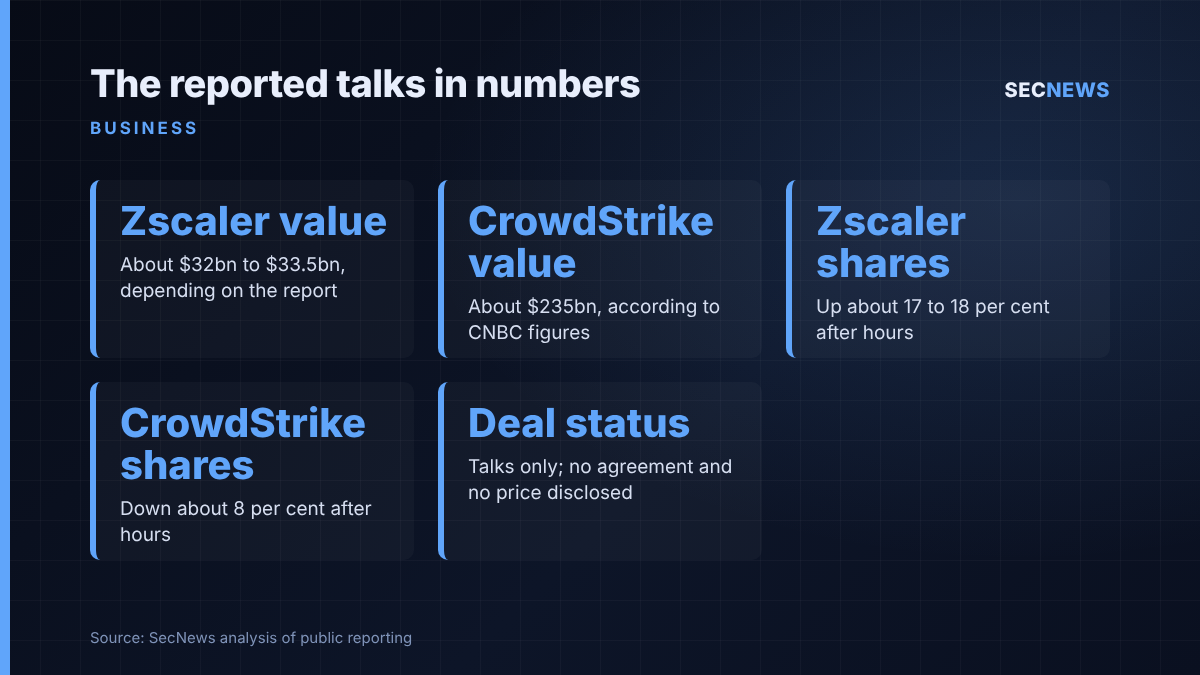
Late on Friday 20 November 2026, Bloomberg reported that CrowdStrike is in discussions to acquire Zscaler. Reuters followed shortly after, citing two people familiar with the matter who said the talks are ongoing. Both outlets made clear that no agreement has been reached. According to Reuters, the discussions could still collapse, and no price or deal structure has been disclosed.
The companies have said nothing of substance. Unite.AI reported that CrowdStrike declined to comment, and neither firm responded to Reuters before publication. Everything below is therefore based on anonymous sourcing and market reaction, not on any confirmed transaction.
Investors reacted quickly. Zscaler shares rose by roughly 17 to 18 per cent in after-hours trading, depending on the report, and CrowdStrike fell by about 8 per cent. Reported valuations vary. Reuters, as carried by The Star, put Zscaler’s market capitalisation at about $32 billion at Friday’s close, while a version of the same Reuters copy on Finwire gave about $33.5 billion. CNBC figures cited by Unite.AI put CrowdStrike at about $235 billion after its share price roughly doubled during 2026, and Zscaler at about $32 billion after a 13 per cent fall over the year.
Reuters noted that any transaction would probably need the support of Jay Chaudhry, Zscaler’s founder and chief executive, who remains its largest shareholder. CrowdStrike is still run by its co-founder, George Kurtz.
The detail
The two businesses sit at different points in the security stack, and that is the commercial logic in the reports. CrowdStrike built its name on the Falcon endpoint agent, then expanded into cloud, identity and threat intelligence. Zscaler sells cloud-delivered network security: its Zero Trust Exchange connects users to applications without a traditional corporate perimeter.
Reuters described network security as one of CrowdStrike’s biggest gaps, and said a combination would let it compete more directly with Palo Alto Networks, which already sells firewalls, secure access service edge (SASE) and endpoint protection together. The same report said enterprise buyers increasingly want fewer vendors, each supplying several products through a single relationship.
This would not be a merger of strangers. The firms have integrated their products for years. A 2025 joint announcement described how Red Canary, now part of Zscaler, would use Falcon endpoint telemetry alongside Zscaler user context in its managed detection and response service. Unite.AI also pointed to an expanded partnership announced on 2 September 2026, covering the sharing of user risk signals between Falcon and Zscaler’s adaptive access engine through the OpenID Shared Signals Framework, plus streaming network and AI event logs into CrowdStrike’s Next-Gen SIEM.
If agreed, the deal would be one of the largest in the sector’s history. CNBC, via Unite.AI, compared it with Google’s $32 billion purchase of Wiz in 2025, Cisco’s roughly $28 billion acquisition of Splunk in 2024 and Palo Alto Networks’ $25 billion takeover of CyberArk this year.
Why it matters for UK organisations
Both vendors are very common in UK enterprises, the public sector and managed service providers. In many organisations I deal with, Falcon on endpoints and Zscaler for internet and private application access is the default architecture, often bought through different resellers on different renewal cycles. A merger would put both control planes, endpoint and access, under one owner.
That brings potential gains: tighter integration, conditional access decisions driven by device health without extra glue code, and perhaps simpler commercial terms. It also brings concentration risk. Security agents run with deep privileges and receive frequent updates, so one faulty change from a single vendor can disrupt a whole estate. If the same company also controls the path every user takes to reach their applications, a bad day has a larger blast radius. Regulated firms should note that the Bank of England, PRA and FCA already expect them to understand dependencies on critical third parties, and the Cyber Security and Resilience Bill puts more emphasis on managed service and supply chain risk.
Procurement is affected too. Large acquisitions are often followed by repackaging into bundles, changes to licence metrics and price rises at renewal. Public sector buyers on framework agreements and organisations in multi-year deals should check what their contracts say about change of control, price protection and termination.
Expert view
I would be careful not to read too much into a Friday night leak. Talks at this scale often fail on price, on the founder’s willingness to sell, or on regulatory concerns, and a $30 billion-plus deal between two US market leaders would face competition scrutiny, potentially including the UK’s Competition and Markets Authority. Nothing should be changed in production because of a press report.
Still, the direction of the market is clear. Platform consolidation has been the dominant business story in security for two years, and buyers have encouraged it by asking for fewer consoles and fewer contracts. The trade-off is that defence-in-depth assumed separate layers from separate suppliers would fail independently. When endpoint, identity signals, network access and SIEM come from one company, those layers share code, update pipelines and corporate decisions. When we test environments built that way, the risk is less a missing control and more correlated failure: one compromised admin account or one bad update affecting several controls at once.
A combined company could still make a strong product. The question for UK security leaders is not whether consolidation is good or bad, but whether they are choosing it on purpose with clear exit options, or drifting into it.
What to do now
- Map your exposure. List where you rely on CrowdStrike, Zscaler or Red Canary services, including through MSPs, and record contract end dates and renewal terms.
- Read the change of control clauses. Ask your account teams or resellers how price protection and termination rights would apply after an acquisition.
- Test failure modes. Confirm what happens to user access if the Zscaler client or cloud service is unavailable, and that you can recover endpoints if an agent update goes wrong. This supports the secure configuration and malware protection controls in Cyber Essentials.
- Protect admin accounts. Enforce phishing-resistant multi-factor authentication and least privilege on both consoles, in line with the Cyber Essentials user access control requirement.
- Update your third-party risk register. Note the possible concentration and raise it with your board or risk committee, especially if you are a regulated financial services firm.
- Do not rush. Avoid signing long renewals or making architecture changes until there is a confirmed announcement and clarity on product roadmaps.
Bottom line
Bloomberg and Reuters report that CrowdStrike and Zscaler are talking, not that they have agreed a deal, and the talks may come to nothing. But the reports point to a market where the biggest vendors want to own the whole stack. UK organisations that depend on both firms should check their contracts, test their resilience and treat vendor concentration as a risk to manage, not a convenience to accept by default.
Sources
- The Star (Reuters): CrowdStrike in talks to acquire Zscaler, sources say
- Finwire (Reuters): CrowdStrike in talks to acquire Zscaler, sources say
- Unite.AI: CrowdStrike reportedly in talks to acquire AI security partner Zscaler
- CrowdStrike: Zscaler and CrowdStrike expand partnership to strengthen AI-driven SecOps