A tribunal has rejected a Merseyside law firm’s challenge to its £60,000 UK GDPR penalty, finding it negligent for leaving an old, over-privileged service account untouched for years. The judgment also closes off the argument that being small, or trusting your IT suppliers, softens a regulator’s view of weak security.
What happened
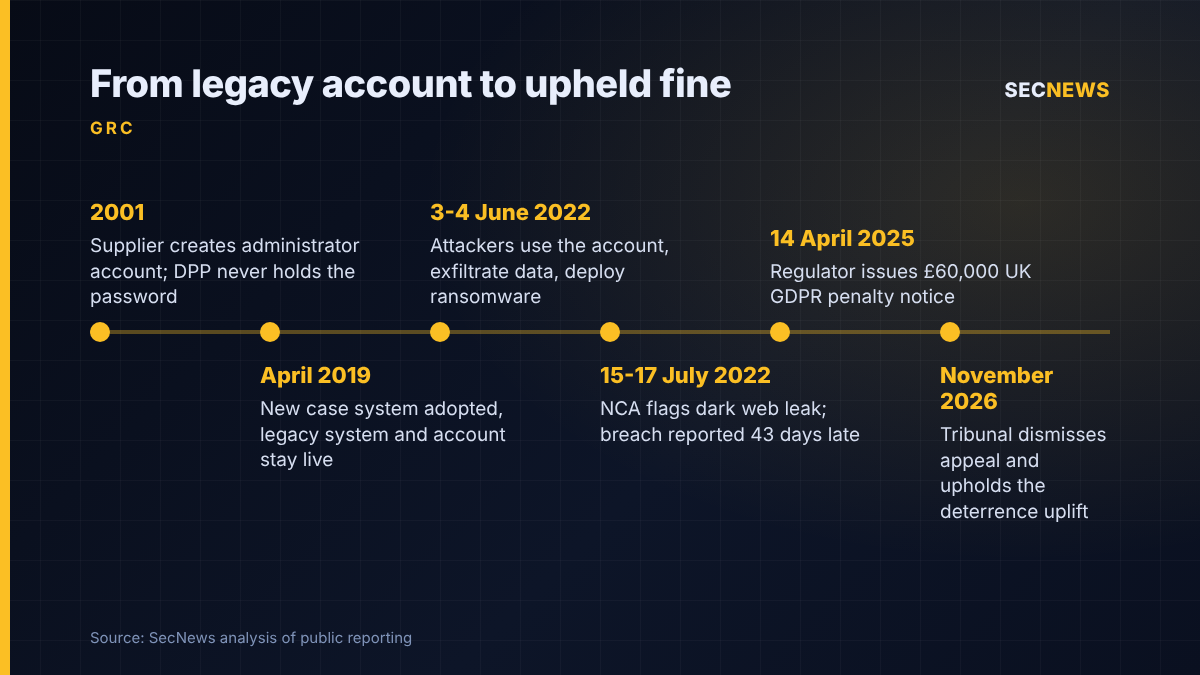
The General Regulatory Chamber of the First-tier Tribunal has dismissed the appeal brought by DPP Law Ltd against the monetary penalty imposed on it in April 2025. The decision, DPP Law Limited v The Information Commission [2026] UKFTT 1571 (GRC), was given on 19 November and reported by Legal Futures on 20 November 2026.
DPP Law is a Bootle-based firm of solicitors whose work covers crime, family, sexual offences and actions against the police, so its files are about as sensitive as personal data gets. In June 2022 attackers got into its network, took data and then disrupted its systems. The firm learned the scale of the problem on 15 July 2022, when the National Crime Agency told it that three folders totalling around 32.4GB had been posted on the dark web. According to the regulator’s notice, that material included court bundles, photographs and police body-worn camera footage. The notice puts those affected at 791 people: 682 clients and 109 expert witnesses.
The firm reported the breach on 17 July 2022, which the regulator calculated as 43 days after the incident. The Information Commissioner (now restyled the Information Commission) found breaches of Articles 5(1)(f), 32(1), 32(2) and 33(1) of the UK GDPR. DPP did not dispute the decision to fine it, but appealed the amount and its calculation, including findings behind it.
The detail
The case turns on one account. In 2001 an external case management supplier created an administrator account on the firm’s network. The supplier, and later its new owner, held the password; DPP never knew it. The firm moved to a new case management platform in April 2019, yet the legacy system stayed running and the account kept broad administrative rights across the estate. Supplier support for the old system ended in 2021.
The penalty notice sets out the attack sequence. Log analysis found around 400 brute-force attempts from February 2022 aimed at that legacy account. On 3 June 2022 the account, called sqluser, logged on, probably after a laptop had been compromised. Investigators then found signs of Cobalt Strike, disabled Windows Defender and file transfer tools such as Rclone. The firm did have multi-factor authentication on its VPN, but the service account was exempt.
DPP argued that it had tried to change the account’s password in 2011, that this broke the case system, and that its supplier then told it to leave the account alone. The tribunal accepted that history but held it did not move responsibility away from the controller. The 2019 migration and the end of supplier support were exactly the moments that should have prompted a fresh look at whether the account was still needed and what it could reach. The panel found DPP “failed to undertake an appropriate reassessment” and that the failings were negligent rather than an honest misjudgement.
On notification, the tribunal said the Article 33 test is not whether exfiltration has been proven. A report is required unless a breach is unlikely to create risk to people. With ransomware the probable cause and sensitive files on the affected servers, DPP had no reasonable basis for holding back.
On the money, the starting point was the £17.5 million statutory maximum, multiplied by 17% for seriousness and 0.8% for turnover, giving £23,800. The regulator then raised this to £60,000, about 1.7% of the firm’s £3.49 million turnover, for deterrence. The tribunal rejected DPP’s argument for a 0.7% turnover factor, saying the guidance is not a tariff. It upheld the uplift, partly so that other firms that lean heavily on outside providers take notice.
Why it matters for UK organisations
The tribunal worked through the regulator’s five-step fining guidance in detail for a cyber security penalty against a small business, and the regulator’s approach survived intact. Three points stand out.
First, size is not a shield. The panel said limited in-house IT capability did not make the failure to reassess the account any less serious. Second, outsourcing does not outsource accountability. Relying on specialist suppliers did not excuse the firm’s lack of understanding of its own risks, and the tribunal expected security to be kept under review continuously, not only once a supplier walked away. Third, the deterrence uplift held: a low share of turnover does not justify one automatically, but sensitive data and years of failings did.
Law firms are the obvious audience, but the same reasoning applies to accountants, clinics, charities and any small organisation holding special category data on systems a third party built.
Expert view
In my experience, the account that sinks a network is rarely the one anybody is watching. It is the service account a vendor set up a decade ago, exempt from MFA because “it would break something”, with domain-wide rights nobody has questioned since. When we test internal networks, legacy service accounts with stale passwords and excessive privileges remain one of the quickest routes from a single foothold to full control.
What I find useful about this judgment is that it treats the problem as governance, not just technology. The firm had firewalls, MFA on its VPN and external advisers. What it lacked was an owner who asked, at each change of system or supplier, why the account still existed and what it could touch. “Do not touch it, it is critical” is a phrase I hear often, and it should trigger a risk assessment, not end one.
On notification, waiting for proof of exfiltration before reporting is a common instinct, and the tribunal has now said plainly that it is the wrong test.
What to do now
- Inventory privileged and service accounts. List every administrator, service and vendor account, who owns it, what it can reach and when its password last changed. This maps to Cyber Essentials user access control.
- Retire or contain legacy systems. Where retention rules keep an old application alive, isolate it, remove internet exposure and cut its privileges to the minimum.
- Close MFA exemptions. Review every account excluded from multi-factor authentication. Where MFA truly cannot apply, compensate with restricted logon rights, network segmentation and alerting on use.
- Make supplier changes a security checkpoint. Migrations, contract endings and vendor acquisitions should each trigger a review of the access that supplier created or holds.
- Watch outbound data. The firm could not see what left its network. Logging and alerting on large outbound transfers, and on tools such as Rclone, would shorten detection.
- Rehearse the 72-hour decision. Agree in advance who decides on reporting, and default to notifying when sensitive data sits on an affected system and exfiltration cannot be ruled out.
Bottom line
The tribunal has backed the regulator on every main point: negligence, notification and the deterrence uplift. For small organisations holding sensitive data, the message is that inherited vendor access and slow breach reporting will be judged as your failings, not your supplier’s, and the fine will be set high enough to make others pay attention.