Corma, a start-up that trains its own AI models purely for cyber defence, has raised $125m at a $1bn valuation barely three months after leaving stealth. For UK security buyers and managed service providers, the round is a signal that autonomous security operations tooling is about to be sold hard, and that the due diligence questions need to be ready first.
What happened
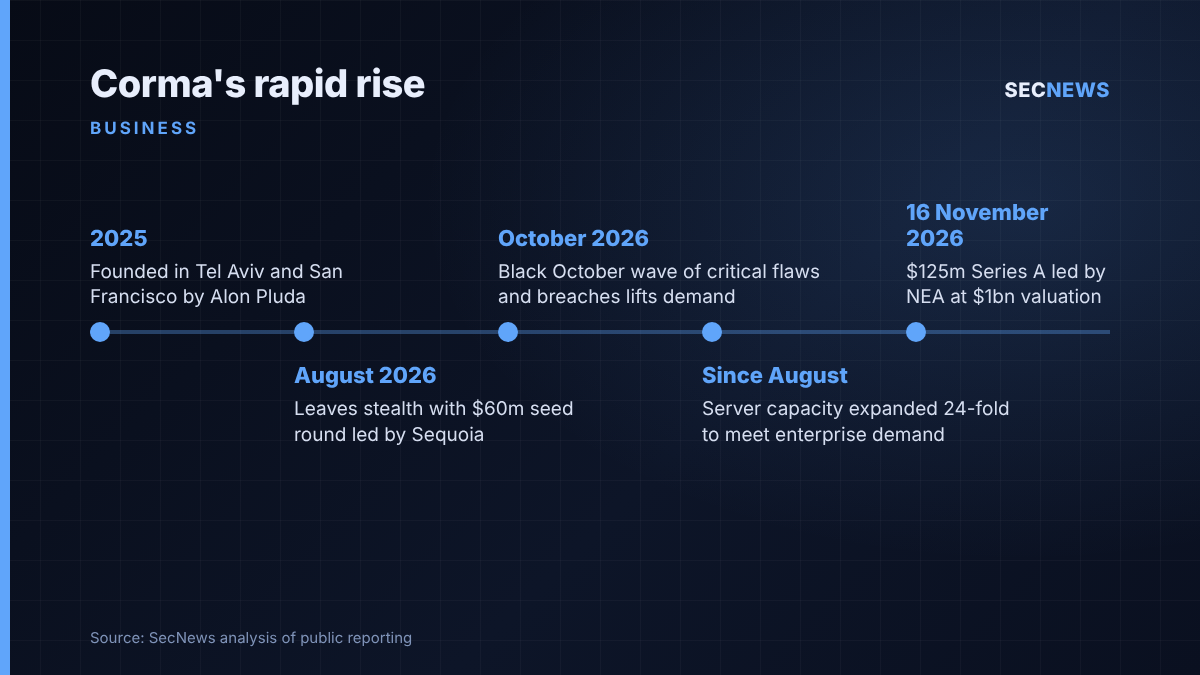
On 16 November 2026, Corma announced a Series A round of $125m led by the US venture firm NEA, putting the company’s value at $1bn. Sequoia Capital, Khosla Ventures and Coatue all reinvested. Including the $60m seed round led by Sequoia in August, Corma has now raised $185m in total.
The company was founded in 2025 and splits its operations between Tel Aviv and San Francisco. According to Calcalist, it has roughly 25 staff. Co-founder and chief executive Alon Pluda is a former member of Israel’s Unit 8200, and the company says its team mixes researchers who previously worked at Google and DeepMind with cyber operators from the same military unit.
Corma says demand from the world’s largest companies has been strong enough that it has grown its server capacity 24-fold since August. In a blog post, Pluda said prospective customers are on a waitlist while compute is added. He would not put a number on revenue, telling Calcalist only that it was rising so quickly that any figure would soon be stale. The new money is earmarked for larger models, more compute and some selective hiring.
The detail
Corma’s pitch rests on an argument about where frontier AI development has been pointed. The big labs have poured effort into models that write and repair code. A model that understands code well also gets better at spotting the bugs in it, and when wrapped in an agent it can potentially turn those bugs into working attacks. Corma ties its fundraising directly to “Black October”, the label given to last month’s cluster of critical flaws and breaches in widely used software. TechCrunch reported that interest in the firm picked up after a run of incidents on 21 October, including serious PHP and Node.js flaws and a security incident at the LiteLLM proxy project.
Defence, the company argues, is a different discipline. It means sifting huge volumes of logs, events and network telemetry for faint signals over weeks, while staying consistent across thousands of decisions. Corma says general-purpose coding models were never trained for that, so it builds its own foundation models for the job.
Those models are sold not as another product with its own console but as what the company calls an AI workforce: a set of agents that plug into the tools a customer already owns, investigate alerts, run proactive checks and carry out a wide range of defensive tasks. Pluda told Calcalist the whole process is “fully autonomous, with no human intervention involved”.
The company’s website also carries a chart, labelled DefenseBench V5, placing its own model ahead of a list of leading frontier models on defensive tasks and speed. That is a vendor-run benchmark, and I have seen no independent validation of it.
Why it matters for UK organisations
Corma has named no UK office or customers, so the direct effect here is limited for now. The indirect effect is not. A billion-dollar valuation for a company of around 25 people, three months after launch, tells you how much capital is chasing the idea of a security operations centre (SOC) staffed largely by machines. That money must be earned back through sales, and UK banks, utilities, retailers, telecoms operators and health providers sit squarely in the sectors Corma says it already serves.
For UK managed security service providers (MSSPs) and MDR firms, the pressure works in two directions. Autonomous triage could let a provider handle far more clients per analyst, which matters in a market where margins are tight and experienced SOC staff are hard to hire. But if large customers can buy an agent workforce directly and point it at their own tooling, part of the traditional managed service value proposition is under threat. Expect UK providers to partner with or build on these platforms rather than fight them.
There are also governance questions particular to the UK. Security telemetry is full of personal data, so sending it to models hosted overseas brings UK GDPR transfer and processor obligations into play. Regulated firms will need to fit any autonomous agent into their operational resilience and third-party risk frameworks, and organisations that will fall under the Cyber Security and Resilience Bill should expect scrutiny of suppliers that can act inside their networks.
Expert view
I take the underlying argument seriously. When we test large estates, the attacker’s advantage rarely comes from exotic techniques; it comes from defenders drowning in alerts and missing the quiet signal that matters. Better correlation across logs and long time windows would be welcome, and this is indeed a different problem from writing secure code.
What worries me is the word “autonomous” sitting next to “no human intervention”. An agent that can isolate hosts, disable accounts or change firewall rules across your existing tools is, from an attacker’s point of view, the most privileged identity in the building. If it is manipulated through poisoned log data or prompt injection hidden in an email it is analysing, the blast radius is your whole environment. In my experience, the controls around a tool matter as much as the tool itself, and the vendor’s benchmark tells you nothing about either.
Nor is valuation a proxy for maturity: a firm growing compute 24-fold in three months is still building its support model and assurance evidence.
What to do now
- Define the decision boundary before any trial. Decide which actions an AI agent may take on its own, which need a human approval step, and which it may only recommend. Start with read-only access.
- Treat the agent as a privileged identity. Give it its own accounts with least privilege, log everything it does, and review its permissions as you would any domain admin. It lines up directly with the user access control requirements in Cyber Essentials.
- Ask hard data questions. Where are models hosted, what telemetry leaves your estate, is your data used for training, and what transfer mechanism covers it under UK GDPR?
- Demand independent evidence. Ask for third-party testing, including adversarial testing of how the agent behaves when fed manipulated logs, rather than relying on vendor benchmarks.
- MSSPs: decide your position now. Work out whether you will integrate, resell or compete, and how you will explain liability to clients if an autonomous agent you deployed makes a damaging change.
- Keep the basics funded. No agent compensates for unpatched internet-facing systems, missing multi-factor authentication or untested backups.
Bottom line
Corma’s round is less about one Israeli start-up and more about where security budgets are being steered: towards AI agents that act on their own inside your network. That may well help defenders close the gap Black October exposed, but UK buyers should insist on clear limits, independent assurance and proper data controls before handing any machine the keys to their SOC.
Sources
- TechCrunch: Cybersecurity AI startup Corma reaches $1B valuation in about 3 months
- SecurityWeek: Corma Receives $125 Million to Train Foundation Models for Defensive Cybersecurity
- The Next Web: Corma raises $125m at a $1bn valuation, three months out of stealth
- Calcalist: Cyber startup Corma goes from stealth to unicorn in just three months with $125 million Series A
- ynet: Israeli AI cyber startup Corma hits $1 billion valuation after $125 million funding round