Equinor, the Norwegian state-controlled energy group that says it supplies almost 38% of the UK’s natural gas, is still working to contain a cyber attack on part of its corporate IT estate. Production is running and no data theft has been reported, but the incident is a live test of the containment and communications playbooks every UK energy operator should already have.
What happened
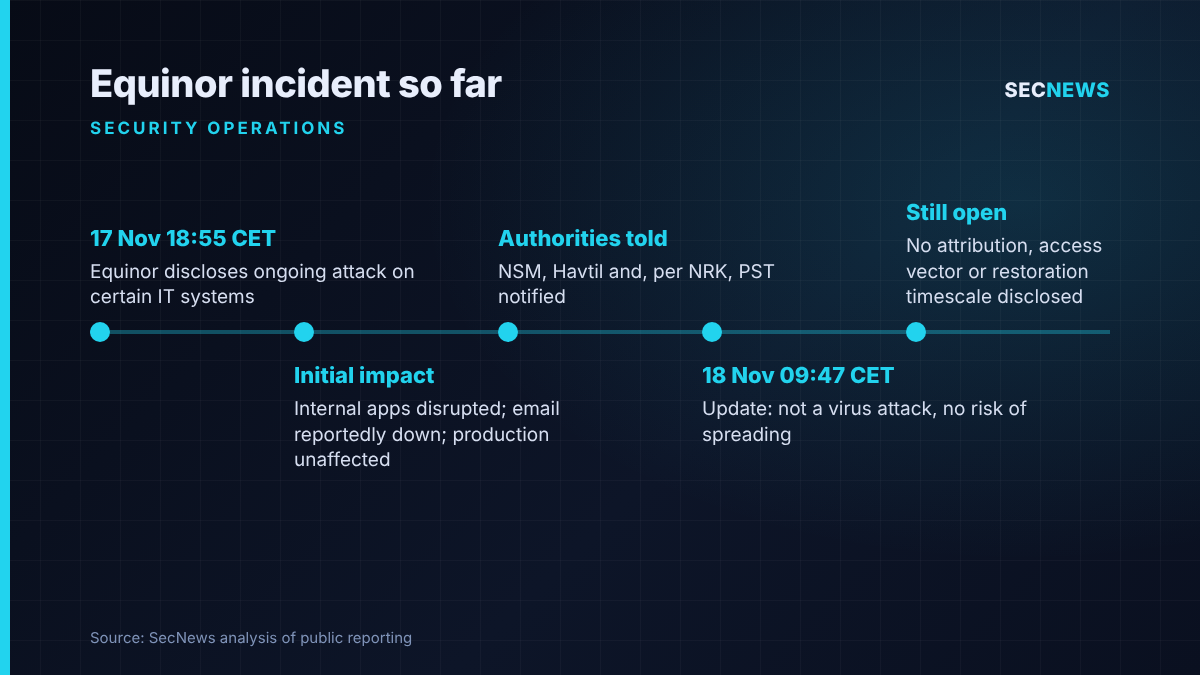
On the evening of Tuesday 17 November 2026, Equinor published a short notice saying it was dealing with a live cyber attack affecting some of its IT systems. The company said it had mobilised resources to “neutralise the attack and regain full integrity”, that it had no indication of data theft, and that oil and gas operations and production were unaffected. Relevant authorities were being informed.
Speaking to NTB, Norway’s national news agency, spokesperson Ellen Maria Skjelsbæk said staff might see disruption to some applications and internal IT services, though the company still had access to all of its systems. According to Security Affairs, a person at Equinor told Reuters that the internal email system was down.
The company updated its notice at 09:47 CET on Wednesday 18 November. Equinor said it now better understood the attack method and the scope of affected systems, but shared neither. It stated that this was not a virus attack and so carried no risk of spreading, that it saw no consequences for employees, partners or suppliers, and that production remained unaffected. Work to neutralise the attack and restore affected systems continues, and Equinor said it was too early to say how long that would take. At the time of writing there is no public attribution, no claim from any extortion group and no confirmed initial access vector.
Norway’s National Security Authority (NSM) said it knew of the incident and stood ready to assist. The offshore regulator Havtil was notified, and NRK reported that the Police Security Service (PST) had also been informed.
The technical picture
Very little technical detail is public, so it is worth being precise about what the statements do and do not tell us. The language is consistent with an intrusion confined to corporate IT: office applications, collaboration tools and email, rather than the industrial control systems that run platforms, processing plants and pipelines. That separation between IT and operational technology (OT) is exactly what the oil and gas sector is supposed to maintain, and the fact that production carried on suggests it held, at least so far.
The phrase “not a virus attack” is interesting. Read plainly, Equinor is telling stakeholders it is not dealing with self-propagating malware or a mass encryption event of the kind seen at Norsk Hydro in 2019. That leaves a range of possibilities, from a hands-on-keyboard intruder using stolen credentials to abuse of a cloud or identity platform. Equinor has not said which. The wording does show a responder confident enough in its scoping to rule out worm-like spread within about 15 hours of disclosure.
The decision to describe the attack as ongoing is also notable. Equinor chose to disclose while the adversary was, by its own account, still present, judging the risk of silence (rumour, market reaction, partner uncertainty) to outweigh the risk of tipping off the attacker.
Security Affairs reports that NSM raised Norway’s national cyber threat level last month and that successful attacks on Norwegian companies had tripled in six months. That links this incident to no actor, but helps explain the swift official response.
Why it matters for UK organisations
The UK exposure here is direct. Equinor’s own UK pages say it supplies almost 38% of UK natural gas and more than 19% of UK oil from Norway, and the company states that Britain imports close to two-thirds of its gas from Norway. In June 2025 it signed a ten-year agreement with Centrica covering about 5 bcm a year, which Equinor says equates to nearly 10% of UK demand. It also operates the Sheringham Shoal, Dudgeon and Hywind Scotland wind farms, is developing Dogger Bank, and says it employs more than 600 people and works with over 700 suppliers in the UK.
With production unaffected, there is no supply story today. The more practical concern for UK organisations is the supply chain. Hundreds of UK firms exchange email, files and remote access with Equinor. Until the company says which systems were touched, those partners should treat inbound messages and connections from Equinor with the same scrutiny they would apply to any supplier under active attack. Fraudsters often exploit exactly this kind of disruption.
It is also a reminder for UK operators of essential services in energy that regulators and the Cyber Security and Resilience legislation expect timely incident reporting and credible recovery plans. Equinor’s first notice ran to six sentences.
Expert view
In my experience, the first 48 hours of an incident at a large, complex organisation are rarely as tidy as the public statements suggest, and I would expect Equinor’s picture to evolve. Early “no evidence of data theft” lines are honest but provisional; they reflect what the logs show so far, not a forensic conclusion.
What does deserve credit is the shape of the response. The company separated what was affected from what was not, told staff whether they needed to act, notified the right authorities and committed to updates. When we test incident response plans, communications is usually the weakest thread: nobody owns the external statement, and the result is either silence or over-promising.
The IT/OT boundary is the other lesson. Segmentation is easy to draw on a diagram and hard to keep in practice, especially with remote vendor access, shared identity services and historians that bridge both worlds. If production really has stayed isolated, that is the payoff of years of unglamorous engineering work.
What to do now
- Check your Equinor touchpoints. If you are a supplier, partner or customer, identify every integration, shared mailbox, file transfer and remote access route to Equinor. Apply heightened verification to payment changes and unexpected requests, and watch for anomalous logins from partner accounts.
- Verify your IT/OT separation, not just the diagram. Review firewall rules, jump hosts, vendor remote access and shared Active Directory or cloud identity between corporate and control networks. This maps to the Cyber Essentials firewall and secure configuration controls, extended into the OT estate.
- Harden identity. Enforce phishing-resistant multi-factor authentication for administrators and remote access, review privileged accounts and remove dormant ones (Cyber Essentials user access control).
- Rehearse an “ongoing attack” disclosure. Draft holding statements for staff, partners, regulators and the market that can be approved within hours, and decide in advance who signs them off.
- Test recovery of email and collaboration services. If your primary email platform went down tomorrow, know how incident responders and executives would communicate out of band.
Bottom line
Equinor’s incident has not touched the gas flowing to Britain, and the company’s handling so far looks measured. But it is a timely stress test for UK energy firms and their suppliers. Prove your IT and OT networks are genuinely separate, know who speaks for you when an intruder is still inside, and treat any partner under attack as a potential route into your own estate.
Sources
- Equinor: Equinor detected cyber-attack – update
- IBTimes UK: Equinor Hit by Cyberattack as Concerns Grow Over European Gas Supplies
- Security Affairs: Norwegian Gas Giant Equinor Says It’s Under Cyberattack. Production Keeps Running
- Gulf News: Norway’s Equinor detects cyberattack on IT systems; operations unaffected
- Equinor: Equinor in the United Kingdom
- Equinor: Strengthening UK energy security with new gas sales agreement
- Dr. Web: Equinor meldet laufenden Cyberangriff auf einige IT-Systeme