StubHub International, the ticket resale marketplace serving UK and European fans, has told customers that an intruder may have reached their names, email addresses and phone numbers. Passwords and card data appear untouched, but the leaked fields are exactly what a convincing ticket scam needs.
What happened
StubHub International is operated by Ticketbis S.L., a company based in Bilbao. It has warned users that an unauthorised party got into parts of its platform at some point between late October and early November 2026. According to the customer notice, the exposed fields are first and last name, email address, telephone number and the country or regional setting on the account.
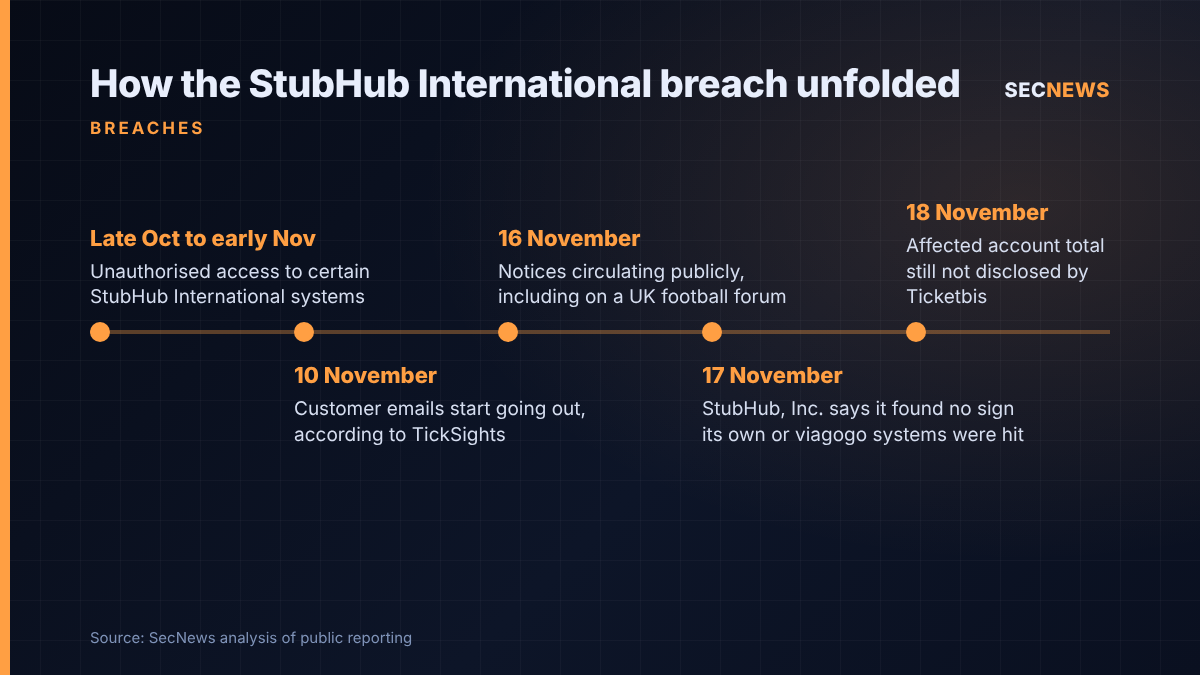
The dates differ depending on where you look. TickSights, an independent ticketing service, says Ticketbis began emailing affected users on 10 November under the subject line “Important information about your StubHub International account”. UK consultancy CyPro reports that the notices were circulating publicly by 16 November, including a copy posted on a UK football forum that evening. The incident became a public story on 17 November. That was the day StubHub, Inc., the separately owned North American business, published a statement saying the breach happened inside StubHub International’s systems and that it had found no sign its own or viagogo’s systems or customers were affected. The Register reported the customer emails on 18 November.
The company says it has contained the intrusion, closed off “certain vulnerabilities” and brought in outside specialists for a forensic investigation. It has not said how many people are affected. It has also not named the systems involved or explained how the attacker got in. The Register asked for a figure and got no reply. As of 17 November, CyPro could find no incident notice on the UK or Irish versions of the site.
The detail
The brand confusion matters here. StubHub International is the non-US part of the business. Viagogo had to sell it to Digital Fuel Capital in 2021, after the UK Competition and Markets Authority required the international business to be divested on competition grounds. StubHub, Inc. now trades as viagogo in the markets where StubHub International operates. Customers who have used both brands may not know which company holds their account, which helps anyone sending a fake “security update”.
On what was not taken, Ticketbis is careful. According to the notice, nothing found so far points to passwords, bank details or card numbers being reached, or to the data being misused. That is a provisional finding. The forensic review continues, and early scoping often shifts once investigators have the full log picture.
Ticketbis is a Spanish company, so its lead supervisory authority under the EU GDPR is likely to be Spain’s AEPD. UK customers keep their rights under the UK GDPR, including the right to ask the company exactly which of their data was involved.
There is no public attribution, extortion claim or set of indicators of compromise, so the practical risk sits with the people whose contact details have gone.
Why it matters for UK organisations
Contact-data breaches tend to be waved away because no card numbers were lost. That reading misses how fraud actually works. A message that greets someone by name, mentions a ticket marketplace they really use and arrives on both email and text is far more persuasive than a generic lure. Add a phone number and the attacker can follow up with a call claiming to be from “seller support”.
Sellers are a particular concern. Many UK resellers, from casual fans offloading spare tickets to small businesses trading at volume, have payout accounts, live listings and transfer deadlines. Each of those is a ready-made pretext: a payout “on hold” pending bank verification, a listing removed after a buyer complaint, a penalty for a late transfer. The aim is to harvest login credentials, bank details or one-time codes.
Employers have a stake too. Staff often register for consumer services with work email addresses, or reuse a work password at home. If a StubHub-themed phish lands in a corporate inbox and someone enters credentials on a fake page, the incident is no longer a consumer problem.
The breach also lands in a period when UK regulators are paying closer attention to the secondary ticketing market. Only in June, Ticketbis was handed a £889,200 CMA penalty, plus refunds above £590,000, because compulsory fees were left out of headline prices. A breach on top of that will sharpen scrutiny.
Expert view
In my experience, the hardest part of an incident like this is not the breach itself but the period of silence afterwards. A notice that lists the exposed fields and says the problem is fixed, without saying how the attacker got in or how many records were reached, leaves customers unable to judge their own risk.
When we test customer-facing platforms, the routes to contact data are rarely exotic. Over-permissive internal tools, support or CRM integrations with broad read access, exposed APIs that return more fields than the front end needs, and credentials stolen from staff or suppliers are all common. I am not suggesting any of these applies here, because Ticketbis has not said. The point is that minimising what each system can see is still one of the most effective controls available.
I would also urge caution about early claims of limited scope. “No evidence of access” is a statement about the evidence gathered so far. It is not proof of absence, and logging gaps can make the two look the same.
What to do now
- Warn your people. Tell staff and customers to treat unexpected messages about tickets, refunds, payouts or account checks with suspicion, and to go to the marketplace by typing its address rather than using a link.
- Change reused passwords. Anyone with a StubHub International account should set a unique password, starting with the email account linked to it. This supports the Cyber Essentials user access control requirements.
- Turn on stronger sign-in where possible. Use multi-factor authentication on marketplace and email accounts, and never share a verification code with anyone who calls or messages.
- Sellers should check payout settings. Record your current bank details and contact email now so that any unauthorised change stands out.
- Tune email defences. Security teams can add awareness notes and filtering for StubHub and viagogo-themed lures. They should also make sure staff know how to report suspected phishing quickly, in line with Cyber Essentials malware protection and secure configuration controls.
- Review your own data exposure. If you run a customer platform, check which internal tools and third-party integrations can read contact data in bulk, and cut back access that is not needed.
- Use your data rights. Affected UK customers can ask Ticketbis which of their data was involved, and can complain to the ICO if they are unhappy with the response.
Bottom line
This is not a card-theft story, and Ticketbis is right to say so. But names, emails and phone numbers linked to a known ticket account are valuable raw material for fraud. The company should publish the scale and the root cause. Until it does, UK buyers and sellers should assume that any message about their StubHub International account could be a scam.