The n0n extortion gang has published customer data it says came from JPMorgan Chase, Visa and Mastercard, after all three blamed breaches at outside providers. Early analysis points to a single concierge and marketing platform, and the leaked files are well suited to targeted phishing.
What happened
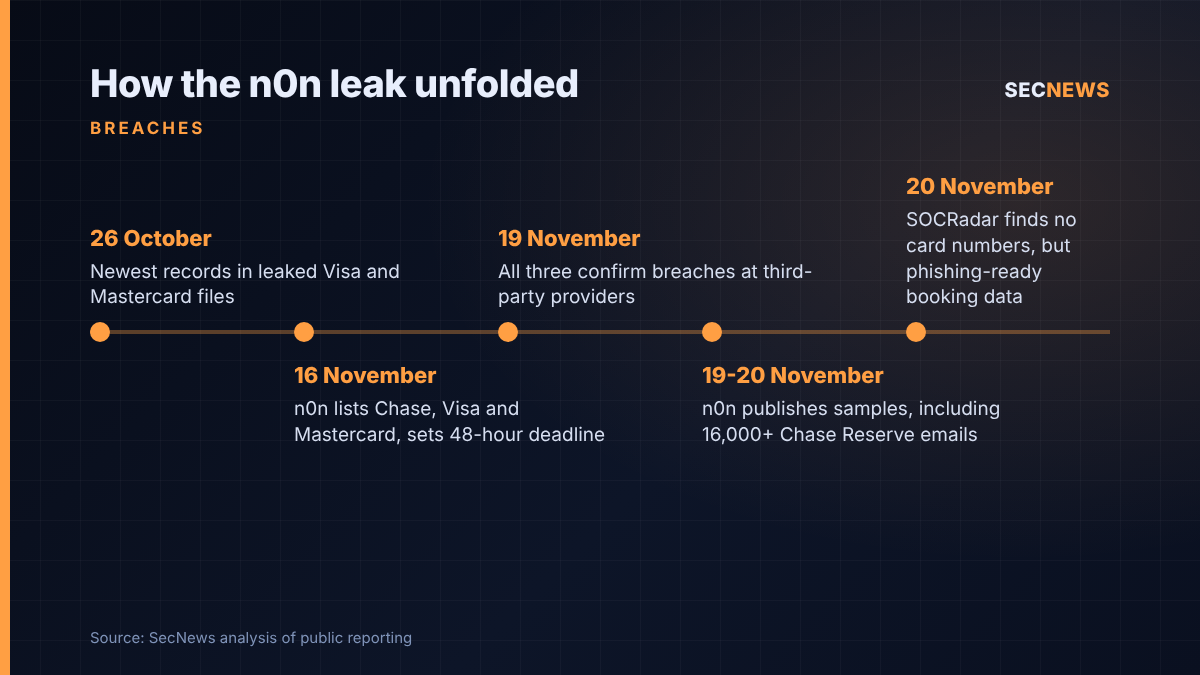
On Monday 16 November 2026, n0n added JPMorgan Chase, Visa and Mastercard to its leak site and gave them 48 hours to pay. By Thursday 19 November all three had confirmed they were investigating, and all three said the data came from a third party rather than from their own networks.
Visa told The Register that the incident involved a service provider in the Asia Pacific region, that its own systems were not touched and that no payment data, such as card numbers, was affected. Mastercard said a supplier had exposed a limited set of email addresses belonging to a small group of cardholders enrolled in one benefits scheme, and that its payment network was unaffected. JPMorgan Chase posted on X that attackers appear to have accessed marketing data held by vendors, possibly including customer names and email addresses. It will contact affected customers where appropriate and offer free credit monitoring, and says the breach is unrelated to an outage earlier that week.
n0n then published sample data from all three, saying they had missed its 48-hour deadline. Reuters and the Wall Street Journal report that the Chase material holds over 16,000 customer email addresses, a portion accompanied by phone numbers and postcodes, plus 124 email addresses belonging to bank staff. The addresses reportedly link to JPMorgan’s invitation-only Reserve card, aimed at clients with $10 million or more under management.
The technical picture
The most useful detail so far comes from SOCRadar, the threat intelligence firm that has tracked n0n since it emerged in September. On 20 November it told The Register that it had examined all 14 files in the published Visa and Mastercard archives. It found no card numbers, CVVs, passwords or home addresses. It did find mobile numbers, Bank Identification Number (BIN) prefixes, which are the first digits of a card that identify the issuing bank, and dated airline, hotel and restaurant bookings.
Three findings matter for defenders:
- One upstream source. SOCRadar says both datasets share the same 27-column booking layout, the same placeholder text and the same CRM ID format. The newest records in each stop 69 seconds apart on 26 October. That suggests a bulk copy from one provider’s marketing store, probably a concierge operator serving both brands.
- Only a small part has been published. The released files are roughly 0.4 per cent of what n0n says it took, which it claims totals roughly 4.3 GB, or 1.9 million marketing events. SOCRadar’s Ensar Seker warned: “So a further release is possible.”
- A possible access path. SOCRadar’s assessment, which it says is not a confirmed finding, is that the dates line up with the Qubole supply-chain attack made public this month, where stolen AWS access credentials were used to reach downstream customers’ S3 storage. Idera, which owns Qubole, has not commented, and the three financial firms declined to name their suppliers.
According to SOCRadar research cited by TechRadar, n0n gets in through compromised credentials, exposed cloud keys and weak remote-access systems, and builds tools with AI coding agents. Victim counts range from about 200 (eCrime.ch) to 365 (Ransomnews) in under three months. It is the same gang behind this month’s Expedia leak claims.
Why it matters for UK organisations
No UK firm has been linked to this leak, but the pattern fits. Visa and Mastercard sit behind most cards in British wallets, and UK issuers run concierge, travel and loyalty schemes through outsourced platforms much like the one SOCRadar describes. A dataset that links a person to a premium card, a mobile number, the issuing bank’s BIN and recent restaurant or flight bookings is exactly what a convincing vishing call needs.
Under UK GDPR, an organisation that hands customer data to a marketing or concierge processor remains the controller and remains accountable. “It was our supplier” does not end a breach report to the ICO, and the 72-hour notification clock does not wait for a vendor to get back to you. Financial firms also face FCA and PRA expectations on third-party risk and operational resilience.
Sophos’s Rafe Pilling told Infosecurity Magazine that this kind of incident is “very different from saying criminals have broken into Visa or JPMorgan”. True, but little comfort to those whose details are now circulating.
Expert view
When we test financial services clients, the core banking estate is usually the most hardened part of the business. The weakest links tend to sit at the edges: the campaign management tool, the analytics bucket, the agency that runs the premium rewards scheme. They often hold contact data in bulk, sit under a marketing budget rather than a security one, and rarely get the logging and access reviews that payment systems receive.
What stands out is the 26 October cut-off. If SOCRadar’s reading is right, the data was copied weeks before anyone went public, and it is unclear when the brands were told. In my experience, that gap between data leaving and the controller finding out is common with supplier-held data, because the controller has no telemetry on the supplier’s environment.
The cloud angle also deserves attention, while being clear that the Qubole link is unproven. Long-lived IAM credentials that give one provider standing access to many customers’ storage are a known weak spot. Tight scoping and alerts on bulk reads are basic hygiene, yet static keys years old still turn up in our cloud reviews.
What to do now
- Map who holds your customer data. List every marketing, loyalty, concierge and analytics supplier that holds personal data, what it holds and how it is accessed. Contracts should demand notification within hours.
- Cut what suppliers receive. Send only the fields a campaign needs and set retention limits.
- Review cloud trust relationships. Audit cross-account IAM roles and access keys granted to third parties, rotate long-lived credentials and alert on bulk S3 reads. This sits under the Cyber Essentials controls for secure configuration and user access control.
- Get ahead of the phishing. If you run card or premium schemes, warn customers now that you will never ask for card details or one-time codes on an inbound call. Brief contact centres.
- Prepare the ICO decision in advance. Agree who decides whether supplier-held data triggers a 72-hour report, and rehearse it with a scenario in which the first notice you get is a leak site listing.
- Protect staff identities. The Chase leak included employee addresses. Enforce phishing-resistant MFA for staff and watch for targeted lures that use the incident as cover.
Bottom line
No card numbers appear to have leaked, and the banks’ own networks seem untouched. Even so, n0n has shown that one outsourced marketing platform can expose customers of three global financial brands at once, with more data possibly to come. For UK organisations, the lesson is that a supplier holding your customer data is part of your attack surface, and the regulator will treat it that way too.
Sources
- The Register: Visa, Mastercard theft included info useful for phishing, but not draining bank accounts, say researchers
- The Register: Chase, Visa, Mastercard confirm third-party cyberattacks that may have exposed customers’ info
- Infosecurity Magazine: JPMorgan Confirms Customer Data Breach Following Third-Party Compromise
- IBTimes UK: JPMorgan Hit by Major Data Leak as Hackers Dump Rich Customers’ Personal Info on Dark Web
- TechRadar: Visa confirms apparent cyberattack, hackers also claim hit on JPMorgan