The National Audit Office says Whitehall has better risk frameworks than it did a decade ago, but risk teams are still consulted after the big decisions have been taken. Its new report also finds that board-level challenge on cyber security is held back by skills gaps, and that most departments report principal risks sitting outside their own stated appetite, with cyber among the hardest to bring back in line.
What happened
On 18 November 2026 the National Audit Office (NAO) published Risk management in government: improving capability and decision-making (HC 768, session 2026-27), a value for money study of how central government bodies identify, escalate and act on risk.
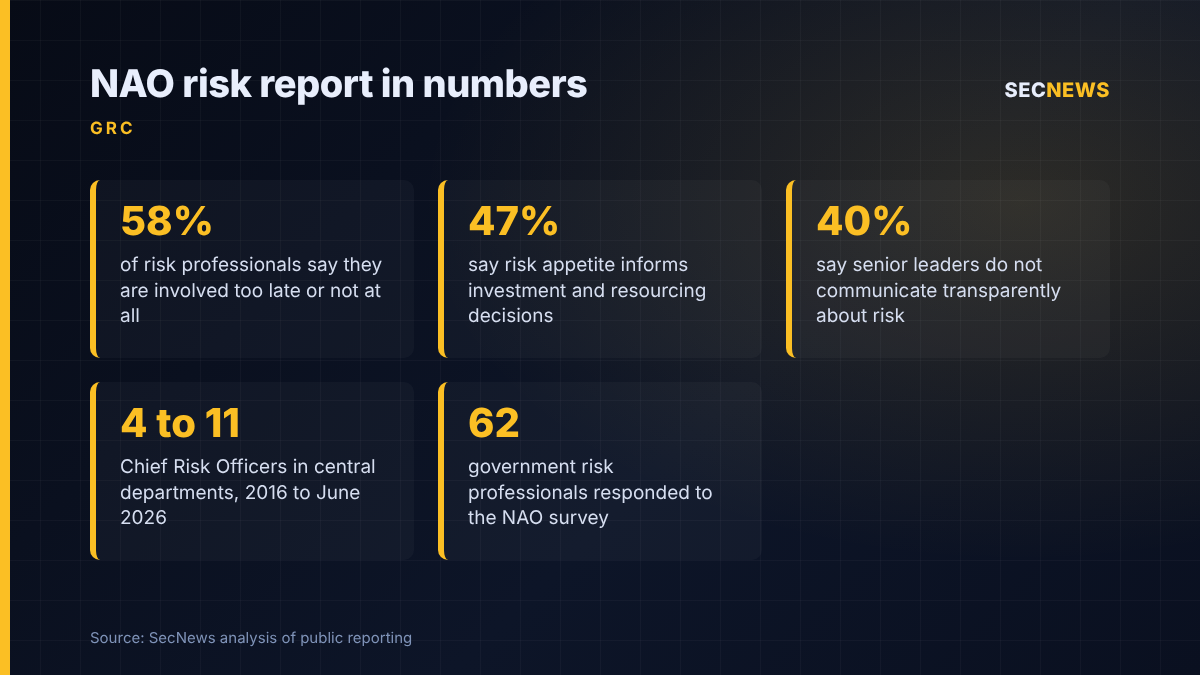
The headline finding is about timing. In a survey of 62 risk professionals across government, 58% said they are typically brought in too late to shape options, used mainly for assurance and sign-off, or not involved at all. According to the NAO, it could find few cases where advice from risk teams had actually altered a major decision or the direction of an organisation.
Government has created the Government Risk Profession and expanded the Risk Centre of Excellence (Risk CoE) in HM Treasury, and the number of Chief Risk Officers in central departments has risen from four in 2016 to 11 by June 2026. Gareth Davies, head of the NAO, said government must now put risk management “at the heart of how it plans, spends and delivers”.
The detail
Boards lack the skills to challenge. Audit and Risk Assurance Committees (ARACs) are meant to give independent challenge to the board and accounting officer. The NAO says committee members often lack the expertise to test management on emerging areas, naming cyber security, digital transformation, artificial intelligence and climate change. Cyber security training given by the then Department for Science, Innovation and Technology to the ARAC chairs of its arm’s-length bodies is cited as one response.
Leaders do not always understand what is on the register. Organisations do record major cyber risks, but the report says senior leaders do not always grasp those risks or how they connect to strategic objectives. Some 40% of survey respondents said senior leaders do not communicate transparently about risk.
Risk appetite is written down but rarely used. Only 47% of respondents said their organisation uses risk appetite to inform decisions on investment and resourcing. In June 2026 most departments reported that the majority of their principal risks sat outside stated appetite or tolerance, often for several years. The NAO says legacy technology and difficulty hiring and keeping specialist cyber staff may stop departments bringing cyber risks back within appetite.
Known risks still land. The report uses the October 2023 cyberattack on the British Library as a case study. The Library had already identified risk from growing third-party access to its IT and had planned stronger controls, but the attack came before they were in place, and recovery took substantial resources over an extended period. The NAO also cites the recent PHP vulnerabilities as an example of how fast an emerging technical risk can threaten public services.
The NAO also notes backlogs of overdue mitigating actions and patchy oversight of risk across departments, arm’s-length bodies and suppliers.
Why it matters for UK organisations
This is a public sector report, but its relevance runs wider. Suppliers to government sit inside the third-party risk the NAO says departments struggle to see, and the British Library example is explicitly a supplier access problem. Expect more questions in procurement and contract reviews about how vendors evidence their own controls.
The themes also line up with where UK cyber regulation is heading. The Cyber Security and Resilience Bill, now in its final parliamentary stages, will not add explicit director duties, but ministers have said the security requirements made under it will expect boards to oversee security and resilience frameworks at regulated operators, including managed service providers. A regulator asking “did your board understand and act on this risk?” is far harder to satisfy than one asking “is it on your register?”
The risk appetite point deserves particular attention. If a risk has been outside tolerance for three years and nothing has changed, either the appetite statement is fiction or the mitigation is not working. Both are governance failures, and both are easy for an auditor, regulator or claimant to spot after an incident.
Expert view
In my experience, the gap the NAO describes shows up in testing long before it shows up in an audit report. When we run an infrastructure test or a red team exercise, the findings that hurt most are rarely new. They are the legacy domain, the unsupported server or the third-party remote access route that has sat on the risk register as “amber, accepted” for years, with an owner who has moved on.
The late-involvement problem is the root cause. If security and risk people only see a programme at the sign-off gate, every finding becomes a delay, and delay pressure wins. Bringing them in at option appraisal, as the NAO recommends, is cheaper than any control you bolt on afterwards.
The ARAC skills finding is the one I would urge non-executives to take personally. A committee that cannot ask a sharp question about privileged access, backup isolation or supplier connectivity cannot really challenge a cyber risk rating. It needs members who know which questions to ask and will bring in independent expertise when the answer sounds too neat.
Finally, I welcome the NAO’s honesty about appetite. A cyber risk that is permanently outside tolerance should trigger a funded decision, an explicit acceptance by an accountable executive, or a change in how the service is delivered.
What to do now
- Review your top cyber risks against appetite. List any that have been outside tolerance for more than a year and force a decision: fund the fix, formally accept it at board level, or change the service.
- Get security into option appraisal. Make a security and risk review a required input at business case stage for new systems, migrations and outsourcing, not only at go-live.
- Test your audit committee’s cyber literacy. Provide targeted training for committee chairs and non-executives, and budget for independent technical advice when they need it.
- Clear the mitigation backlog. Track overdue risk actions with named owners and dates, and report ageing actions to the board alongside the register.
- Map supplier access. Identify every third party with remote or privileged access, enforce multi-factor authentication and least privilege, and review connections regularly. This maps directly to the Cyber Essentials controls on access control and secure configuration.
- Prioritise legacy estate. Unsupported software fails the Cyber Essentials security update management control outright; treat replacement plans as risk treatments with deadlines, not wish lists.
Bottom line
The NAO is not saying government lacks risk registers. It is saying registers too often record risks that nobody with authority acts on until an incident forces the issue. For cyber security that pattern is costly, and the remedy is mostly about governance rather than technology: involve risk and security people earlier, equip boards to challenge, and treat a risk outside appetite as a decision that must be made, not a status that can be left alone.
Sources
- National Audit Office: Risk management in government: improving capability and decision-making
- National Audit Office: Full report (PDF), HC 768
- National Audit Office: Better risk management can improve decision making in government, says NAO
- Infosecurity Magazine: Watchdog Warns UK Government Is Falling Short on Risk Management